Author Archives: hbcumoney

HBCU Money™ Business Book Feature – The Richest Man In Babylon

1052

The Richest Man in Babylon : The Original Version, Restored and Revised
Travel back in time as George S. Clason takes you back to Babylon in his enlightening, insightful book on financial investment and fiscal success. The original version now restored and revised, this series of delightful short stories teaches economic tips and tools for financial success that have withstood the test of time and are applicable still today. Enjoy reading, and start saving today!

HBCU Money™ Dozen 5/12 – 5/16

twelve

Did you miss HBCU Money™ Dozen via Twitter? No worry. We are now putting them on the site for you to visit at your leisure. We have made some changes here at HBCU Money™ Dozen. We are now solely focused on research and central bank articles from the previous week.

Research

Development Kits Make it Easier for the Do-it-yourself Crowd l CIOonline http://trib.al/9l3YTY4

Has Germany Subsidized The World’s Now-Cheap Solar Power? l Clean Technica http://dlvr.it/5hPS1L

Rescue robots could help in next Turkey mine disaster l New Scientist http://ow.ly/wWyvB

WV HS freshman wins EPA Sustainability Award for green housing material designed for earthquake zones. l EPA http://go.usa.gov/8cN5

Conservation groups team up to save Africa’s biodiversity Eden from drillers l New Scientist http://ow.ly/wWznu

Solar Likely To Become Dominant Source Of Energy Globally By 2050, IEA Forecasts l Clean Technica http://dlvr.it/5hBq11

Federal Reserve, Central Banks, & Financial Departments

Use our personal finance flash cards to learn how to make smart financial decisions l Econ Lowdown http://bit.ly/QFA6kT

The Fed isn’t helping the economy with low interest rates l Housing Wire http://hwi.re/5hNzqD

Where is all that investor and all-cash action? l Housing Wire http://hwi.re/5hLcl6

“Rethinking the ‘Lender of Last Resort” l Richmond Fed http://ow.ly/wWAFH

What are the potential gains for U.S. trade from a Trans-Pacific Partnership deal? l NY Fed http://nyfed.org/TaMBGL

How does the Fed evaluate if bank M&A meet antitrust laws & bank competition policy? l Chicago Fed http://ow.ly/wWBt0

Thank you as always for joining us on Saturday for HBCU Money™ Dozen. The 12 most important research and finance articles of the week.


The HBCU Money™ Weekly Market Watch

Our Money Matters /\ May 16, 2014

A weekly snapshot of African American owned public companies and HBCU Money™ tracked African stock exchanges.

NAME TICKER PRICE (GAIN/LOSS %)

African American Publicly Traded Companies

Citizens Bancshares Georgia (CZBS) $8.84 (0.23% DN)

M&F Bancorp (MFBP) $4.75 (0.00% UNCH)

Radio One (ROIA) $3.96 (0.50% DN)

African Stock Exchanges

Bourse Regionale des Valeurs Mobilieres (BRVM)  229.74 (0.29% UP)

Botswana Stock Exchange (BSE)  8 977.43 (0.01% UP)

Ghana Stock Exchange (GSE)  2 240.91 (4.46% UP)*

Nairobi Stock Exchange (NSE)  151.15 (N/A)

Johannesburg Stock Exchange (JSE) 49 159.77 (0.60% DN)

International Stock Exchanges

New York Stock Exchange (NYSE) 10 603.18 (0.33% UP)

London Stock Exchange (LSE)  3 637.91 (0.04% DN)

Tokyo Stock Exchange (TOPIX)  1 159.07 (1.63% DN)

Commodities

Screen shot 2014-05-16 at 4.53.29 PM

Without Subsidies, FCS Public HBCU Athletics Losing $130 Million Annually

Humility is a virtue all preach, none practice, and yet everybody is content to hear.  — John Selden

dt.common.streams.StreamServer

I needed a word to describe this internal report. The word I ended up settling on was hypovolemic. Healthline.com defines the condition as “Hypovolemic shock, also called hemorrhagic shock, is a life-threatening condition that results when you lose more than 20 percent (one-fifth) of your body’s blood or fluid supply. This severe fluid loss makes it impossible for the heart to pump sufficient blood to your body. Hypovolemic shock can cause many of your organs to fail. The condition requires immediate emergency medical attention in order to survive.” There might not be a better description of the findings of our internal HBCU Money study using NCAA provided data, we were able to get a startling and disturbing look at the athletic departments of public HBCUs athletic departments and their dependency on subsidies. Subsidies reported are a mixture of institutional support, government support, and student fees. Hopefully, this will spark some real conversation and give new light to the debate about whether or not HBCUs as a whole have the means to be athletically competitive long-term or is this a case of poor use of resources that is impairing the overall health of these universities and its students financial health long after they have left their hallowed grounds.

BREAKDOWN BY THE NUMBERS*:

REVENUES

Total: $177.0 million

Median: $7.9 million

Average: $8.0 million

EXPENSES

Total: $178.7 million

Median: $7.9 million

Average: $8.1 million

PROFIT/LOSS

Total: $-1.9 million

Median: $0

Average: $-79 827

SUBSIDY

Total: $126.9 million

Median: $5.5 million

Average: $5.8 million

WITHOUT SUBSIDY PROFIT/LOSS

Total: $-128.6 million

Median:$-5.8 million

Average: $-5.8 million

SUBSIDY % OF REVENUE

Total: 71.7%

Median: 75.0%

Average: 70.9%

*Chicago State University was included in our report of FCS public HBCUs. Considered an HBCU by HBCU Endowment Foundation, the school is a member of WAC, but athletic budget in line with its HBCU brethren.

According to USA Today, “Just 23 of 228 athletics departments at NCAA Division I public schools generated enough money on their own to cover their expenses in 2012. All 23 of the self-sufficient schools are from conferences whose champions automatically qualify for the Bowl Championship Series, which makes sense because that’s where the money is.” That is where the money is. Again, that is where the money is. The FCS public HBCU doing the “best” without a subsidy is Mississippi Valley State University, with a deficit of $2.4 million. In last place, Delaware State University with an egregious $10.5 million deficit without subsidies. With subsidies the most profitable team is Morgan State University at almost $475 000 in the profit column. Florida A&M, as has been reported recently, even with subsidies still manages to run an almost $1.1 million deficit. The report shows that in order for FCS public HBCUs to be able to operate without a subsidy and still produce the $177 million in revenue annually, they would need to set up an endowment of $3 billion. Greater than the sum all HBCUs, public and private, have in their endowment coffers combined. If alumni wanted a number that it would take to make HBCUs athletically competitive this would be it. However, remember this is only for public FCS HBCUs.

I continue to question the strategic investment many HBCUs on this list are currently putting into athletics and not research development or general scholarship. It is not hard to imagine that had FCS private HBCUs been included in the report, these numbers are even more frightening. The FCS public HBCU athletic budgets to research budget ratio approaches 80 percent. Essentially, we are spending $0.80 on athletics for every $1.00 we spend on research. This is unfortunate since all HBCUs do not even breach $500 million combined annually in research. For perspective since we always love to say “well the HWCUs are doing it”, we took a basket of 9 flagship HWCUs in their state and compared their ratio. The schools were University of Alabama, Florida, Georgia, Maryland, Michigan, Mississippi, Texas, LSU, and Ohio State. Combined their athletic budgets are $963.2 million, but their research budgets are a combined $6.8 billion or athletics gets $0.14 for every $1.00 research gets.

Too often HBCU alum and students are being sold a fairy tale of the investment in athletics without actually ever seeing numbers and data to support it. We are asked to just have “faith” that our leadership is doing the right thing. This while schools like Jackson State University and Prairie View A&M University are pining to spend $200 million and $60 million, respectively, on athletic complexes. I have been impressed with Paul Quinn and Spelman College’s decision making to use the athletic funds more strategically, which in the long run will have a major benefit on their institutions health. I love athletics as much as the next HBCUer, but I do not love seeing 90 percent of HBCU graduates finishing with debt to subsidize programs that are nowhere near capable of sustaining themselves. Especially when African Americans are struggling to close the wealth gap. If HBCUs believe they are part of the African American ecosystem and not independent of it, then there will be stronger considerations of how we use resources to maximize our ability to close gaps. Remember, the blood loss from hypovolemic shock eventually will cause ALL organs to fail.



2014′s 25 Highest Paid Hedge Fund Managers – No African Americans, Again

Wealth will set us fucking free, okay? ‘Cause wealth is empowering, wealth can uplift communities from poverty, okay? – Chris Rock

Screen shot 2014-05-07 at 5.36.21 PM

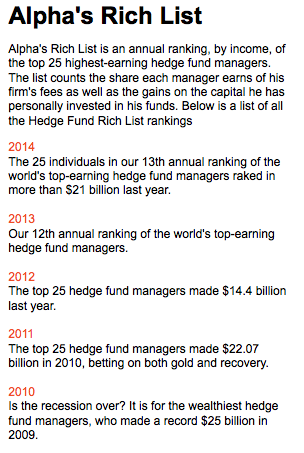
On May 6th, Institutional Investors’ released its 13th annual ‘Rich List’ highlighting the top 25 earning hedge fund managers. The 2014 list saw a combined earnings of $21 billion, an increase of 50 percent from the prior year, but still comes in as only the fourth highest total in the list 13 years. This year’s list required a minimum earnings of $300 million also a 50 percent increase over last year’s minimum, had an average earnings of $846 million per manager, and saw four hedge fund managers clear the $1 billion earnings mark. The back to back champion is David Tepper, founder of Appaloosa Management, earned $3.5 billion in 2013. To put in perspective just how much he earned, Lee Hawkins reported in 2007 that all African American professional athletes in the NFL, NBA, and MLB combined earned $4 billion. A look at more recent numbers show that the top ten earning African American athletes earned $383.2 million, meanwhile the top ten hedge fund managers brought in $15.7 billion or the athletes earned $0.02 for every $1.00 the hedge fund managers earned.

A few of these hedge fund managers also left their mark in college philanthropy. Paul Tudor Jones and his wife donated $12 million to the University of Virginia according to Philanthropy.com to “create the Contemplative Sciences Center to explore the intersection between modern science and the classical medical and contemplative traditions of Tibet.” Leon Cooperman and his wife made a $25 million donation to Hunter College for their library renovations and to seed a scholarship fund. David Tepper donated $67 million to Carnegie Mellon’s business school in 2013 and Kenneth Griffin, ranked number five on the Rich List, donated $150 million to Harvard College for scholarships, the largest ever donation in the school’s history. These four donations alone in the past 12 months are equivalent to over 12 percent of all HBCU endowments combined. The $254 million between these four donations if they were their own HBCU endowment would rank tied for third among HBCU endowments and equal to almost half of Howard University’s total endowment. Yes, just these four donations.

Screen shot 2014-05-07 at 5.37.37 PM

The key thing to remember about all of these hedge fund managers is they founded and own their company. Yes, it is finance and investments, but it is also understanding that entrepreneurship and risk taking is what gets rewarded in this economic system. Far too many of us are still thinking in terms of labor and not enough of us are thinking in terms of ownership regardless of the industry. We want to graduate and get a “good” job. Nor does the business if you decide to start one have to be some social business that changes the world. The president of Hampton University owns a bottling company. It is not sexy, but it does employ a great deal of people and allows him and his wife to be financially generous to Hampton time and time again.

Our intellectual capital continues to be poorly distributed as a community. It often seems the only thing that little African American boys and girls believe they can do is entertain others. We are either singing and dancing or chasing a ball of some sort. The lack of hedge fund managers (among a great many other professions) continues to highlight our perplexing relationship to finance. We like the perks of consumption which requires money, but adverse to the real building of wealth and the vehicles like hedge funds that can create paradigm shifts. It is clear we are playing the game, unfortunately we seem to currently be playing it to lose.