Author Archives: hbcumoney

HBCU Money™ Business Book Feature – Idea Man: A Memoir by the Cofounder of Microsoft

paul_allen_idea_man

“The entire conversation took five minutes. When it was over, Bill and I looked at each other. It was one thing to talk about writing a language for a microprocessor and another to get the job done….If we’d been older or known better, Bill and I might have been put off by the task in front of us. But we were young and green enough to believe that we just might pull it off.”

Paul Allen, best known as the cofounder of Microsoft, has left his mark on numerous fields, from aviation and science to rock ‘n’ roll, professional sports, and philanthropy. His passions and curiosity have transformed the way we live. In 2007 and again in 2008, Time named him one of the hundred most influential people in the world.

It all started on a snowy day in December 1974, when he was twenty-one years old. After buying the new issue of Popular Electronics in Harvard Square, Allen ran to show it to his best friend from Seattle, Bill Gates, then a Harvard undergrad. The magazine’s cover story featured the Altair 8800, the first true personal computer; Allen knew that he and Gates had the skills to code a programming language for it. When Gates agreed to collaborate on BASIC for the Altair, one of the most influential partnerships in the digital era was up and running.

While much has been written about Microsoft’s early years, Allen has never before told the story from his point of view. Nor has he previously talked about the details of his complex relationship with Gates or his behind-closed-doors perspective on how a struggling start-up became the most powerful technology company in the world. Idea Man is the candid and long-awaited memoir of an intensely private person, a tale of triumphant highs and terrifying lows.

After becoming seriously ill with Hodgkin’s lymphoma in 1982, Allen began scaling back his involvement with Microsoft. He recovered and started using his fortune—and his ideas—for a life of adventure and discovery, from the first privately funded spacecraft (SpaceShipOne) to a landmark breakthrough in neuroscience (the Allen Brain Atlas). His eclectic ventures all begin with the same simple question: What should exist? As Allen has written:

To me, that’s the most exciting question imaginable….From technology to science to music to art, I’m inspired by those who’ve blurred the boundaries, who’ve looked at the possibilities, and said, “What if…?” In my own work, I’ve tried to anticipate what’s coming over the horizon, to hasten its arrival, and to apply it to people’s lives in a meaningful way…The varied possibilities of the universe have dazzled me since I was a child, and they continue to drive my work, my investments, and my philanthropy.

Idea Man is an astonishing true story of ideas made real.

HBCU Money™ Dozen 6/30 – 7/4


img-thing

Did you miss HBCU Money™ Dozen via Twitter? No worry. We are now putting them on the site for you to visit at your leisure. We have made some changes here at HBCU Money™ Dozen. We are now solely focused on research and central bank articles from the previous week.

Research

£5 Million Crowdfunded Wind Power Project For UK l Clean Technica dlvr.it/6CzwlL

$3.2 Million For Clean Energy Small Businesses l Clean Technica dlvr.it/6Cz8J3

Critics Blast Microsoft’s Takedown of No-IP Domains l CIOonline trib.al/rLRQvRM

Study links feed management and reproductive success in horses l KY Equine Researchow.ly/yNqpU

Iran is going to spend $500 million to save this shrunken lake l New Scientist ow.ly/yMZXM

What makes fireworks do what they do? Check out this video l National Geographic bit.ly/1lDefC8

Federal Reserve, Central Banks, & Financial Departments

Animation: Learning from Megadisasters l World Bank: wrld.bg/yLzST

Population: A big reason why the Hispanic population’s share of wealth is likely to increase l St. Louis Fed bit.ly/1o2qsSt

Help middle school students learn basic decision-making skills with The Art of Decisionmaking l Econ Lowdown bit.ly/1pEUAtX

As credit trends improve, what new set of challenges are banks facing? l Philly Fedow.ly/yDgYq

Economics and personal finance teachers: Preview courses and videos for your classes l Econ Lowdown bit.ly/1pEURwO

Booming economies are not boosting employment in Africa, why? l Guardian Africa gu.com/p/3qk83/tf

Thank you as always for joining us on Saturday for HBCU Money™ Dozen. The 12 most important research and finance articles of the week.

The HBCU Money™ Weekly Market Watch

Our Money Matters /\ July 3, 2014

A weekly snapshot of African American owned public companies and HBCU Money™ tracked African stock exchanges.

NAME TICKER PRICE (GAIN/LOSS %)

African American Publicly Traded Companies

Citizens Bancshares Georgia (CZBS) $8.91 (0.00% UNCH)

M&F Bancorp (MFBP) $4.90 (0.00% UNCH)

Radio One (ROIA) $4.76 (1.17% UP)

African Stock Exchanges

Bourse Regionale des Valeurs Mobilieres (BRVM)  234.79 (0.50% DN)

Botswana Stock Exchange (BSE)  9 181.11 (0.22% UP)

Ghana Stock Exchange (GSE)  2 377.59 (10.83% DN)*

Nairobi Stock Exchange (NSE)  153.64 (N/A)

Johannesburg Stock Exchange (JSE) 51 918.44 (0.07% UP)

International Stock Exchanges

New York Stock Exchange (NYSE) 11 104.71 (0.49% UP)

London Stock Exchange (LSE)  3 665.06 (0.74% UP)

Tokyo Stock Exchange (TOPIX)  1 278.59 (0.17% DN)

Commodities

Screen Shot 2014-07-03 at 1.28.34 PM


Detroit’s Bankruptcy: An Indictment On African America’s Institutional Power

Contrary to the commonly accepted belief, it is the risk element in our capitalistic system which produces an economy of security. Risk brings out the ingenuity and resourcefulness which insure the success of enough ventures to keep the economy growing and secure. – Robert Rawls

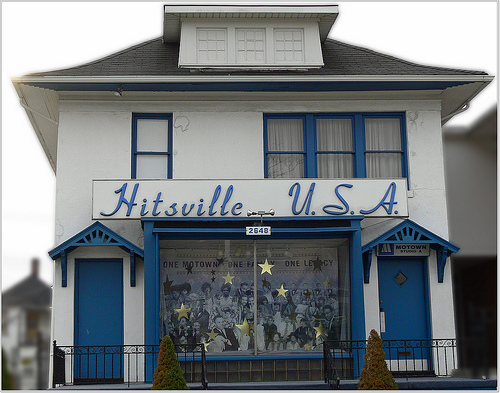
Hitsville 2

The year is 1988 and Berry Gordy is completing the sale of Motown Records to MCA and Boston Ventures LP for a reported $61 million or $121.6 million adjusted for inflation today. Motown Records was an African American institution for over two decades and in 1983 was the largest African American owned company in the United States according to Black Enterprise. It had been the stalwart of Detroit’s African American community and the home of legends like Diana Ross, Smokey Robinson, and global icon Michael Jackson. 25 years later the city of Detroit is a shell of its former self and filed the largest municipal bankruptcy in U.S. history at an estimated $20 billion. How did the symbol of African American power have such an inglorious fall from grace?

Detroit is 138.75 square miles and in terms of cities with 100,000 or more people in it there is no city with a larger African American concentration than Detroit with almost 85 percent of the population being African American. In 1950 the city’s population was near 1.9 million. Historically, Detroit was once home to 18 African American owned hospitals between 1917-1991, home to Lewis College of Business, the only HBCU located in Michigan, and First Independence Bank which is still one of African America’s largest owned banks with over $200 million in assets or almost 5 percent of all African America’s combined bank assets. The city’s African American population was thriving thanks to strong institutions throughout the city much like Motown, but many could argue that complacency settled in. The African American middle class there felt like they had “made” it. Time to set the ship on cruise control and go fishing. The problem? There was an iceberg ahead.

Today, none of the African American owned hospitals in Detroit remain, Lewis College of Business struggles to keep the doors open with no working website or functioning phone number, and the unemployment rate still hovers around 20 percent in the city for African Americans despite the country’s recovery. The political infrastructure seems to be more ripe with corruption over the past few decades than leadership doing more to inhibit progress than promote it. Corruption in the city would be epitomized by the fall from grace at the time by one of HBCU’s shining political stars, former mayor and Florida A&M graduate, Kwame Kilpatrick who is now serving 28 years in federal prison for laundry list of scandals as Detroit’s mayor. The city has a reported 70,000 abandoned buildings, 50 percent of the city’s street lights are not working, and over 40 percent of the entire city is currently below the poverty line. Often times it is confused that the auto bailout of General Motors and Chrysler was an assistance to Detroit. Great job on the public relations of that one to John and Jane Taxpayer who bought it hook, line, and sinker. Unfortunately, GM and Chrysler had long moved their headquarters and majority of operations out of Detroit to suburban areas that were more tax-friendly. They were Detroit in spirit only. The $80 billion they received in bailout was not though. A bailout out that would see U.S. taxpayers lose $11.7 billion as the government divested itself of ownership of both.

Detroit has fallen as its African American population has seen its power decline and some very questionable leadership at times from the aforementioned mayor’s office. However, there is real opportunity in Detroit for African America and the barrier to entry has been lowered because of the distress. Capitalism in a nutshell rewards the creation of chaos or the organization of chaos. The latter is what is present in Detroit. A real investment in Lewis College of Business would go a long way to stabilizing the education and social aspect of African Detroitians higher education access. Dan Gilbert, owner of Quicken Loans, Cleveland Cavaliers, and most notably known for his famous social media rant against LeBron James for leaving him, has invested over $1 billion the heart of downtown Detroit. As one Bloomberg reporter pointed out he is  basically sifting through the best of food at the top of the trash can. He has purchased 3 million square feet or the equivalent of 0.07 percent of the entire city. Not a major overhaul by any stretch of the imagination, but probably the best quality of what is there and any revitalization will leave Dan Gilbert reaping immense rewards. Despite a declining population this is still a city with 700,000 residents which means it is the 18th largest city by population in America and $6.7 billion in household income, but is being treated like a ghost town.

There is still a “Hitsville” in Detroit for those that can see through the chaos of the battered and broken city. A chance to bring a phoenix from the ashes if you will. The city is in need of industry and a way to stem its declining population which for someone with a background in community development is like the opportunity given to Michelangelo to paint the sistine chapel. If African America was ever looking for an opportunity for a home run where the stakes of high risk and high reward, then there is no better place in America right now than Detroit. Warren Buffett is famously quoted as saying “be fearful when others are greedy and greedy when others are fearful” and right now Detroit is screaming to African America for an opportunity to be greedy. With 137 square miles still left of needing investment, maybe it is time to put some of that $1 trillion of buying power to use.

HBCU Money™ Business Book Feature -The First Billion Is the Hardest: Reflections on a Life of Comebacks and America’s Energy Future

The-First-Billion-Is-the-Hardest-T-Boone-Pickens-abridged-compact-discs-Random-House-Audiobooks

With a Plan for Reducing U.S. Oil Dependency

It’s never too late to top your personal best.

Now eighty years old, T. Boone Pickens is a legendary figure in the business world. Known as the “Oracle of Oil” because of his uncanny ability to predict the direction of fuel prices, he built Mesa Petroleum, one of the largest independent oil companies in the United States, from a $2,500 investment. In the 1980s, Pickens became a household name when he executed a series of unsolicited buyout bids for undervalued oil companies, in the process reinventing the notion of shareholders’ rights. Even his failures were successful in that they forced risk-averse managers to reconsider the way they did business.

When Pickens left Mesa at age sixty-eight after a spectacular downward spiral in the company’s profits, many counted him out. Indeed, what followed for him was a painful divorce, clinical depression, a temporary inability to predict the movement of energy prices, and the loss of 90 percent of his investing capital. But Pickens was far from out.

From that personal and professional nadir, Pickens staged one of the most impressive comebacks in the industry, turning his investment fund’s remaining $3 million into $8 billion in profit in just a few years. That made him, at age seventy-seven, the world’s second-highest-paid hedge fund manager. But he wasn’t done yet. Today, Pickens is making some of the world’s most colossal energy bets. If he has his way, most of America’s cars will eventually run on natural gas, and vast swaths of the nation’s prairie land will become places where wind can be harnessed for power generation. Currently no less bold than he was decades ago when he single-handedly transformed America’s oil industry, Pickens is staking billions on the conviction that he knows what’s coming. In this book, he spells out that future in detail, not only presenting a comprehensive plan for American energy independence but also providing a fascinating glimpse into key resources such as water—yet another area where he is putting billions on the line.

From a businessman who is extraordinarily humble yet is considered one of the world’s most visionary, The First Billion Is the Hardest is both a riveting account of a life spent pulling off improbable triumphs and a report back from the front of the global energy and natural-resource wars—of vital interest to anyone who has a stake in America’s future.