To be a poor man is hard, but to be a poor race in a land of dollars is the very bottom of hardships. – W.E.B. DuBois
Over almost the past 60 years, a period post World War II until now, African America has followed an almost unbridled strategy of fighting for access to institutions owned and controlled socially, economically, and politically by others. This while other communities like Asian, Latino, and Jewish Americas continue to build their own institutions. Everything from schools, business hubs, neighborhoods, and think tanks to name just a few. Except for the likes of Malcolm X and even Martin Luther King, Jr. before he was assassinated, the strategy of gaining access to other communities’ institutions as a definition of success, acceptance, and “equality” has gone largely unabated. There is plenty of data that could be examined to make a quantitative analysis of whether since World War II we have improved our social, economic, and political positions to assess whether we should continue down this proverbial path. Instead, we rely on qualitative analysis (if you can call it that) of how an event makes us feel. In fact, one could go so far as to say we are more interested in superficial progress than structural progress. We celebrate the Ruby Bridges access to another community’s schools and starting of the domino effect that has been crumbling our institutions ever since, but have never truly celebrated the building of the schools she was being educated at before then that were built by us and for us.
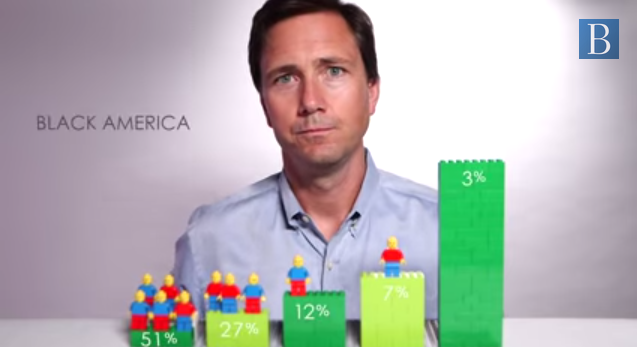
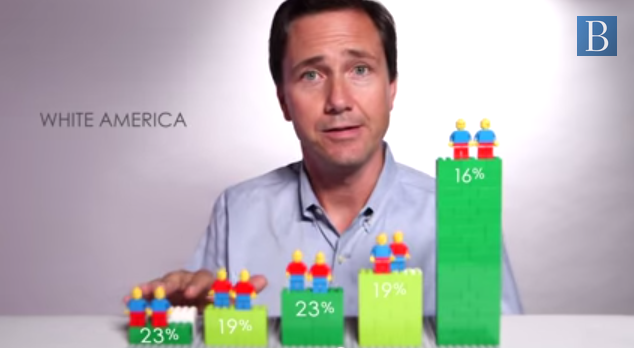
A report from the Brookings Institution paints a grim picture for the reality of upward mobility in America for African Americans in poverty. Above in the two pictures, Brookings Fellow Richard Reeves highlights the chances of someone from the bottom quintile of American society reaching the top quintile if they are African American or European American. As you can see above, the chances for an African American starting from the bottom and rising to the top is 3 percent while the chances they remain stuck in the bottom quintile is over 50 percent. In contrast, an European American born in the bottom has a 16 percent chance of rising to the top and less than one-fourth chance of remaining in the bottom quintile. This represents a more than 500 percent better chance that an European American in poverty can rise to the top of the economic ladder than their African American counterpart. Clearly, all poverty is not equal.
The household and institutional wealth gaps are not getting worse, they are spiraling out of control to a point of potentially reducing African America to a permanent underclass. Largely, due to the fact that African American social, economic, and political capital is not diversified nor circulates. Unfortunately, we are often trapped into conversations about symbolic changes and not substantive ones that could increase the probability for African Americans self-dependency. Scholar Theodore R. Johnson describes African America, “is a fragile state embedded in the greatest superpower the world has ever known.”
What are we not doing and what other groups are doing never seems to be a question we are willing to ask ourselves. Our efforts at best tend to revolve around gaining faux access and blaming others for not allowing us to drink from their cup. Or we give away what little we do control trying to show we are just as “American” as everyone else. HBCUs do this every time they give a “minority” scholarship to a non-African American on their campus when in actuality their African American students are the ones who need the scholarship as reflected in the median net worth of African America being dead last among all groups. Or when we stop celebrating our cultural events to not make others feel unwelcome or uncomfortable. However, anytime African Americans enter other groups environments we code switch or enter the double consciousness to survive because they are not going to lessen their cultural capital to make us feel comfortable. Again, what are they doing that we are not? They are investing in themselves and their institutions.
Why are the odds of making it out of poverty so drastic between two groups within the same economic quintile? Because one has access to a pipeline that is owned and was created for themselves and the other (African America) abandoned what it had built and now owns next to nothing. African America does not like the quality of its K-12 through college schools, but those with capital do not create funds to train and hire better teachers, build new libraries, improve technology, etc. African American unemployment is twice the national level, but we sit aside no money to create seed grants for budding entrepreneurs or deposit money in our own banks so that they can lend to African American owned businesses seeking to grow. This is why out of the 1.9 million African American owned businesses, only 100 000 have more than one employee. Yet, if you go to any Metro Bank, an Asian American owned bank, not only do you see their community faithfully walking in and out, but you will also see a plethora of Asian American owned businesses built up around it. Wherever they have their bank they set up a business development around it so when a customer takes money out of the bank they can walk right out of the door and into one of their community’s stores which in turns allows that store to pay back its loan so that its banks remain strong and other businesses can borrow and grow and employ those in their community. This is the lifting of all boats and why in short order Asians are on the heels of European Americans for highest median net worth and why Latino America has already surpassed African America in wealth. We are doing everything to invest in others and not ourselves.
We are poorer today than in 1915. Let that sink in a bit. In early 20th century, we owned 500 hospitals, 134 banks, 100 boarding schools, and more. Today, we have one hospital, 23 banks, and four boarding schools left. Our dependency on others has never been greater. Particularly, African America has become dependent on the government with 1 in 5 African American jobs in the public sector, the highest among all groups, naturally. If we want to reverse the trend, then we need only look at what our ancestors did 100 years ago coming out of slavery. Every other immigrant group has taken our blueprint and is rising to power. Unfortunately, until we quit trying to fight for “equality” and start fighting for power, then the probability of substantive and qualitative progress will have less odds than winning the lottery – twice.
WATCH BROOKINGS’ INSTITUTE RICHARD REEVES FULL VIDEO
Sixty-five percent of respondents report that their families are either “doing okay” or “living comfortably” financially, compared to 62 percent in 2013.
Forty-seven percent of respondents say they either could not cover an emergency expense costing $400, or would cover it by selling something or borrowing money.
Twenty percent of respondents report that their spending exceeded their income in the 12 months prior to the survey.
Sixty percent of respondents indicate they are either somewhat or very confident they would be approved for a mortgage if they were to apply.
Among respondents who borrowed for their own education, those who failed to complete an associate degree or bachelor’s degree, those who attended for-profit institutions, and those who were firstgeneration college students are more likely to be behind on their payments than others.
The Minneapolis Fed explains how the twelve Federal Reserve presidents in each district are selected and the process behind it. Eleven of the country’s twelve Federal Reserve districts have an HBCU or PBI located in them. Their influence over local economies monetary policy is something all HBCU citizens should be cognizant of.
Winner of the 2014 Anna Julia Cooper-CLR James Book Award presented by the National Council of Black Studies
Winner of the 2014 PEN Oakland-Josephine Miles Award for Excellence in Literature
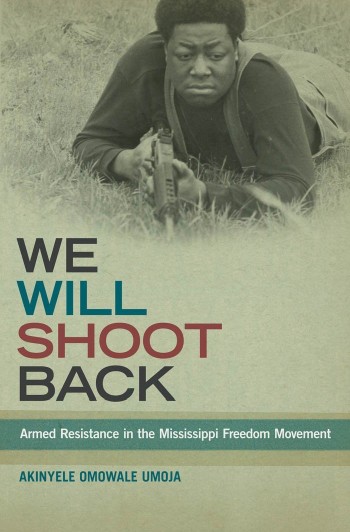
In We Will Shoot Back: Armed Resistance in the Mississippi Freedom Movement, Akinyele Omowale Umoja argues that armed resistance was critical to the Southern freedom struggle and the dismantling of segregation and Black disenfranchisement. Intimidation and fear were central to the system of oppression in most of the Deep South. To overcome the system of segregation, Black people had to overcome fear to present a significant challenge to White domination. As the civil rights movement developed, armed self-defense and resistance became a significant means by which the descendants of enslaved Africans overturned fear and intimidation and developed different political and social relationships between Black and White Mississippians.
This riveting historical narrative reconstructs the armed resistance of Black activists, their challenge of racist terrorism, and their fight for human rights.