
Monthly Archives: May 2013

African America’s April Unemployment Report -13.2%

jobs_pic

Overall Unemployment: 7.5% (7.6%)

African America Unemployment: 13.2% (13.3%)

Latino America Unemployment: 9.0% (9.2%)

European America Unemployment: 6.7% (6.7%)

Asian America Unemployment: 5.1% (5.0%)

Analysis: The overall unemployment rate is down. African and Latino America were the only communities to see a decline in their rates. An extremely rare occurrence. European America was unchanged and Asian America saw a slight uptick. African America continues to be the only group with double digit unemployment.

African American Male Unemployment: 12.6% (12.7%)

African American Female Unemployment: 11.6% (12.2%)

African American Teenage Unemployment: 40.5% (33.8%)

African American Male Participation: 67.4% (68.1%)

African American Female Participation: 62.3% (61.3%)

African American Teenage Participation: 27.5% (27.6%)

*Previous month in parentheses.

Analysis: Men and women groups saw declines in their unemployment rates. The teenage group saw almost a 20 percent rise in their unemployment rate from last month. Participation rates saw a promising rise for women while men saw a weighty drop. The African American teenage participation rate remain fairly unchanged.

Conclusion: America overall added only 165 000 jobs in the month of April. African America netted 99 000 new jobs. African American men and teenagers loss 51 000 and 49 000 new jobs, respectively. Thankfully, African American women experienced a net of 199 000 jobs. For the third month in a row African America has seen an overall increase in employment. African American women by far the most important economic group in African America is experiencing its highest employment in the past 5 months. African American men are still above their 5 months low but starting to trend downward in their employment numbers. The participation rate for men has reached its 5 month low while the women has reached its second highest participation rate over the past 5 months. The teenage group’s employment continues to be erratic, unstable, and appears to be trending downward. The group (women) that is the most economically important is also the most economically burdened carrying much of African America’s fate on its shoulders and once again appears to be finding that weight trending upward. Overall, participation is at its second highest rate in the past 5 months. Whether that can be maintained while bringing the men and teenage groups back into the fold to spread the economic burden is yet to be seen. The sequester while taking its toll has not been as negatively impactful as originally thought given African America’s dependency on public sector employment. While things do seem to be getting better or at the very least not getting worse, in order for African America to even reach a 9.9 percent unemployment rate it would need to add 600 000 jobs.

The HBCU Endowment Feature – Bethune-Cookman University

220px-Bethune-CookmanSeal

School Name: Bethune-Cookman University

Median Cost of Attendance: $22 958

Undergraduate Population: 3 527

Endowment Needed: $1 594 062 880

Analysis: Bethune-Cookman University needs approximately a $1.6 billion endowment for all of its undergraduates to attend debt free annually. The flagship private HBCU in Florida and the 7th ranked HBCU endowment in 2011 and 2012. An HBCU with one of the most storied histories via its founder Mary McLeod Bethune. Its current endowment is 2.6 percent of the needed endowment. Bethune-Cookman even with its prestige is sometimes forgotten in the whole of HBCU conversations and at times Mary McLeod Bethune’s ghost seems to lord a heavier presence than the institution she founded. Despite this, the school continues to produce quality graduates and has the 3rd lowest reported student loan debt per graduate in the MEAC. A vitally important factor in graduates being able to achieve wealth more quickly upon graduation and thereby being able to become qualified donors sooner. Unfortunately, Bethune-Cookman has a limited graduate school which is highly problematic for a flagship private school and should be an area the school looks to for an expansion. This is a primary limitation of the school producing more high quality donors long-term and could become problematic. However, if Bethune-Cookman has proven anything over the course of its history, it has proven to be a stable ship amongst HBCUs never wavering too far off course of its intended mission. It also must look to triple its undergraduate population over the next decade in order to increase the size of its alumni population. An issue facing almost every HBCU with Bethune-Cookman University not being exempt. A marketing campaign centered around its geography would not hurt the school’s ability to increase enrollment. Being located in Daytona Beach is an ideal setting to sell to high school graduates, transfer students, and graduate students. The school is on the cusp of becoming a $50 million endowment but would need to come up with an outside of the box capital campaign over the next decade to encroach on the $100 million endowment club. There certainly is not a steadier HBCU in Florida than Bethune-Cookman University at the moment and if it can continue to promote that stability it will undoubtedly payoff in the long run allowing it to maintain its place in the HBCU echelon.

As always it should be noted that endowments provide a myriad of subsidies to the university for everything from scholarship, faculty & administration salaries, research, and much more.

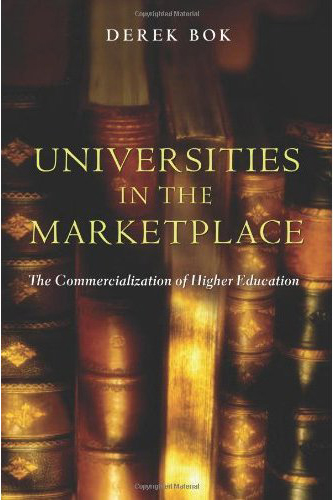
HBCU Money™ Business Book Feature – Universities in the Marketplace

Universities in the Marketplace

Is everything in a university for sale if the price is right? In this book, one of America’s leading educators cautions that the answer is all too often “yes.” Taking the first comprehensive look at the growing commercialization of our academic institutions, Derek Bok probes the efforts on campus to profit financially not only from athletics but increasingly, from education and research as well. He shows how such ventures are undermining core academic values and what universities can do to limit the damage.

Commercialization has many causes, but it could never have grown to its present state had it not been for the recent, rapid growth of money-making opportunities in a more technologically complex, knowledge-based economy. A brave new world has now emerged in which university presidents, enterprising professors, and even administrative staff can all find seductive opportunities to turn specialized knowledge into profit.

Bok argues that universities, faced with these temptations, are jeopardizing their fundamental mission in their eagerness to make money by agreeing to more and more compromises with basic academic values. He discusses the dangers posed by increased secrecy in corporate-funded research, for-profit Internet companies funded by venture capitalists, industry-subsidized educational programs for physicians, conflicts of interest in research on human subjects, and other questionable activities.

While entrepreneurial universities may occasionally succeed in the short term, reasons Bok, only those institutions that vigorously uphold academic values, even at the cost of a few lucrative ventures, will win public trust and retain the respect of faculty and students. Candid, evenhanded, and eminently readable, Universities in the Marketplace will be widely debated by all those concerned with the future of higher education in America and beyond.

HBCU Money™ Dozen Links 4/29 – 5/3

???????????????????????????????????????

Did you miss HBCU Money™ Dozen via Twitter? No worry. We are now putting them on the site for you to visit at your leisure. We have made some changes here at HBCU Money™ Dozen. We are now solely focused on research and central bank articles from the previous week. HBCU Politics™ our sibling publication will be taking over the political and government happenings so be sure to visit them at http://www.hbcupolitics.com for their release if you miss it.

Research

A new economic analysis shows the value of our nation’s working water fronts l NOAA Sea Grant

Donkey heart valves for human use #equine #horses l KY Equine Research  http://ow.ly/kpJuJ

What is Green Racing? l Argonne National Lab http://1.usa.gov/153mqFt

Students – see the summer educational cruises on the Great Lakes l IL-IN Sea Grant http://ow.ly/kGHjr

Low Tornado Numbers and Low Tornado Deaths, May 2012-April 2013 l NSSL http://ow.ly/kGHy0

VIDEO: #Ocean acidification. It’s a problem for the ocean, for marine life, and for humans l CA Sea Grant http://go.usa.gov/TyaP

Federal Reserve, Central Banks, & Financial Departments

Revisiting the history of the 30-year mortgage l Housing Wire http://goo.gl/fb/JNPHL

Banks and employers aid jumbo-loan borrowers l Housing Wire http://goo.gl/fb/QzoGn

Famous South African TV show is helping people make better financial decisions l World Bank http://bit.ly/18uCWLk

“Intergenerational Policy and the Measurement of Tax Incidence” l St. Louis Fed http://bit.ly/163oeOS

Uganda holds rate, sees stable inflation, positive economy l Central Bank News http://dlvr.it/3KJ48f

Financial imbalances and household welfare – Empirical evidence from the EU l Europe Central Bank http://bit.ly/11GPmNH

Thank you as always for joining us on Saturday for HBCU Money™ Dozen. The 12 most important research and finance articles of the week.

The HBCU Money™ Weekly Market Watch

Our Money Matters /\ May 3, 2013

NAME TICKER PRICE (GAIN/LOSS %)

African American Publicly Traded Companies

Citizens Bancshares Georgia (CZBS) $5.40 (0.00% UNCH)

Radio One (ROIA) $1.50 (0.00% UNCH)

African Stock Exchanges

Bourse Regionale des Valeurs Mobilieres (BRVM)  191.66 (0.83% UP)

Botswana Stock Exchange (BSE)  N/A (N/A)

Ghana Stock Exchange (GSE)  1 799.91 (50.03% UP)*

Nairobi Stock Exchange (NSE)  120.06 (N/A)

Johannesburg Stock Exchange (JSE) 39 592.28 (1.30% UP)

International Stock Exchanges

New York Stock Exchange (NYSE) 9 357.74 (1.20% UP)

London Stock Exchange (LSE)  3 435.66 (0.96% UP)

Tokyo Stock Exchange (TOPIX)  1 153.28 (0.44% DN)

Commodities

Gold 1 464.00 (0.25% DN)

Oil 95.65 (1.77% UP)

*Ghana Stock Exchange shows current year to date movement. All others daily.

All quotes reported as of 2:00 PM Eastern Time Zone