
Monthly Archives: January 2013

STOP: African Americans should NOT be maxing out their 401(k)

“At the bottom of education, at the bottom of politics, even at the bottom of religion, there must be for our race economic independence. “ – Booker T. Washington

Imagine five people are running a race – can the person in distant last run at the same speed as the ones in front and catch up? Obviously not. The African America median net worth is shown to be dead last in a 2004 report by the UCLA Center for Asian American Studies out of the four major ancestral groups studied. The report shows Asian America 1st with a median net worth of $144,000 followed in 2nd by European America with $137,200 then in 3rd Latino America with $19,300 and bringing up the rear is African America at $12,000. Remember this was 2004 before the Great Recession that would see African Americans lose eighty three percent of its wealth according to the Economic Policy Institute. Arab America was not reported but it is not hard to imagine they too are well ahead of us. It is indeed time we rethink our financial strategy.

So then why am I saying we should NOT be maxing out our 401(k)? Suze Orman told me it’s a great thing. Flag on the play. One of the major issues is we continue to try to answer African American questions with European American answers. You can not do as another is doing when your situation is not the same as a group. Most of the so-called financial help that we see on TV is based in an Eurocentric view of American life and reality.

To max out your 401(k) would mean to contribute $16,500 pre-tax income per year or $1,375 per month into it. We currently contribute at a median of approximately $175 dollars a month or $2,100 annually to our 401(k)’s as reported in the Ariel Capital Charles Schwab Black-White Investor Annual Survey. Its not hard to see why though when the median income for African America is approximately $32,500 (Asian & European America stand at $65,500 and $54,500 respectively) according to the latest U.S. Census Bureau data. The likelihood that we would be able to reach that plateau without putting our families into poverty ($22,000 is the poverty income level for a family of 4) is as likely as a year without a rap beef given that you would be taking the median taxable income down to $16,000 by contributing the max. I don’t know many places in America you can make it on $16,000 a year. Unfortunately as noted in the census as well 25% of African America is below the poverty line.

Let us make sure we understand though what the 401(k) as a vehicle is built to do and what it does. The major contention with the 401(k) is that its primary investment vehicle is mutual funds. Per Investopedia a mutual fund is “An investment vehicle that is made up of a pool of funds collected from many investors for the purpose of investing in securities such as stocks, bonds, money market instruments and similar assets.” These funds are “actively” managed funds. That is there is a manager who buys and trades actively trying to beat the market. They of course then past that expense on to you. Usually you can find a mutual funds management cost as the expense ratio. Unfortunately, as Motley Fool points out in its mutual fund study “more than 80% of mutual funds underperform the stock market’s average returns.” The other problem with mutual fund for African America is that it does not equate to direct ownership of any company. In a self-directed Roth IRA you have direct control of where that money is going. So you can buy Google stock directly or you can place it in Index Funds, which have historically outperformed mutual funds because they are not actively managed and so have less cost built into them leaving more money in your pocket for the long-term.

So what SHOULD we be doing as African Americans?

1)    Build a six to nine month emergency fund. An emergency fund for African-Americans is a tricky dynamic because any money we hold in cash is capital that is earning very little and could be used in building long-term wealth. However, we are also more likely to suffer job loss, hospital visits with no insurance, helping family members, and other unforeseen needs so how one manages their cash (it is king after all) balances in short-term and long-term investments might be the most vital element to wealth creation.

2)    Try to max out your Roth IRA contribution (max $5,000 per year), which will give you control of where the funds are invested and can place them in less costly investment products. If you do no more than put them in index funds, which as stated have historically had better returns than mutual funds and also cost you less. Roth IRA’s also have tax-free earnings, which means when you have to take the money out at retirement in 30 plus years you would not have to pay any taxes on it. And as the cost of living rises you will need dramatically more dollars tomorrow than you do today for the same standard of living. Because I believe we need more equity ownership though I’d suggest no more than 50% of your Roth IRA be in index funds. The majority should be in individual stocks and bonds.

3)    Next if your company matches 401(k) contributions then put in the percentage they will match and not a penny more. Its free money and so there is no reason to pass it up. At that point you want to treat the money in the most conservative manner possible. Remember if your company is giving let’s say $0.50 for every $1.00 you put in you’ve already made a gain of 50%! At that point there is no need to get cute and become greedy with an aggressive mutual fund that as we see is almost guaranteed to lose money. Or as I tell former clients if you walk into a casino and they give you free money. Put it in a bag and walk right back out (and say thank you of course).  That is to say get the return from your company matching and then put it in a safe product. Do not gamble the free money away in high-risk mutual funds.

4)    All monies after that should be going into either starting a business of your own or an individual (or joint) brokerage account where you will buy and trade stocks, bonds, and other investment vehicles. This by far should be your largest account as it is the account that can give you the most direct ownership of companies through direct ownership of their stocks (equity) and bonds (debt) of companies with unlimited contributions.

This is a very basic game plan to address wealth creation. Wealth creation in of itself is a simple and complex creature. But these basic steps can help you and your families get started off on the right path. Recognizing where we are in the game and that is dramatically behind in the ownership category we cannot afford to put money into investment vehicles that do not give us any. Knowing is half the battle to quote a GI Joe. Now go out there a bit more armed to build for future generations.

The HBCU Endowment Feature – Alcorn State University

d27d21f87e58d67af762a5f350025219

School Name: Alcorn State University

Median Cost of Attendance: $24 232

Undergraduate Population: 3 296

Endowment Needed: $1 597 373 440

Analysis: Alcorn State University needs approximately $1.6 billion in order for all of its undergraduates to attend debt free annually. It should be noted that the three public HWCUs in the state of Mississippi combined do not have $1 billion in endowment value between them. Alcorn State University was the 2012 HBCU of the year led by an aggressive campaign of change by its current leadership. From the outside the view of that change comes with mixed emotion of whether the school will stay true to its HBCU mission or evolve into a different type of university. If the adage all PR is good PR then Alcorn is leading the way. Making a splash being both HBCU of the year but also hiring the SWAC’s first European American coach certainly kept the school in the press. If they will be able to transform that press into donations is still too early to tell. The demographics of the state where the median income for African Americans is below the national poverty line does not make the matter any easier for building the endowment through the African American community which in part could explain the move away from its HBCU mission. Alcorn State University is in an uphill battle with some serious demographics pushing against it despite the arguably dynamic leadership and media exposure. Alcorn State University could certainly take a role as a community developer in the ilk of Hampton University which has proven financially beneficial for Hampton and could do the same for Alcorn State with very little competition in the area. An approximately $9 million endowment currently, it is badly in need of a major donation and not a pledge to give it a more sure footing for its future in whatever direction it chooses.

As always it should be noted that endowments provide a myriad of subsidies to the university for everything from scholarship, faculty & administration salaries, research, and much more.

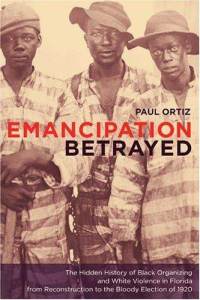
HBCU Money™ Business Book Feature – Emancipation Betrayed: The Hidden History of Black Organizing and White Violence in Florida from Reconstruction to the Bloody Election of 1920

emancipation-betrayed-hidden-history-black-organizing-white-violence-paul-ortiz-hardcover-cover-art

In this penetrating examination of African American politics and culture, Paul Ortiz throws a powerful light on the struggle of black Floridians to create the first statewide civil rights movement against Jim Crow. Concentrating on the period between the end of slavery and the election of 1920, Emancipation Betrayed vividly demonstrates that the decades leading up to the historic voter registration drive of 1919-20 were marked by intense battles during which African Americans struck for higher wages, took up arms to prevent lynching, forged independent political alliances, boycotted segregated streetcars, and created a democratic historical memory of the Civil War and Reconstruction. Contrary to previous claims that African Americans made few strides toward building an effective civil rights movement during this period, Ortiz documents how black Floridians formed mutual aid organizations–secret societies, women’s clubs, labor unions, and churches–to bolster dignity and survival in the harsh climate of Florida, which had the highest lynching rate of any state in the union. African Americans called on these institutions to build a statewide movement to regain the right to vote after World War I. African American women played a decisive role in the campaign as they mobilized in the months leading up to the passage of the Nineteenth Amendment. The 1920 contest culminated in the bloodiest Election Day in modern American history, when white supremacists and the Ku Klux Klan violently, and with state sanction, prevented African Americans from voting. Ortiz’s eloquent interpretation of the many ways that black Floridians fought to expand the meaning of freedom beyond formal equality and his broader consideration of how people resist oppression and create new social movements illuminate a strategic era of United States history and reveal how the legacy of legal segregation continues to play itself out to this day.

HBCU Money™ Dozen Links 12/31 – 1/4

Did you miss HBCU Money™ Dozen via Twitter? No worry. We are now putting them on the site for you to visit at your leisure.

Government Departments

House Dem: GOP plan to cut spending with debt ceiling is ‘legislative terrorism’ l House News bit.ly/Wt0p9l

Life in the Fast Lane: Racing to Identify Species as Biodiversity Shrinks l National Science Foundation 1.usa.gov/WsaGm9

Education Council selection is underway. We encourage parents to nominate themselves for a seat! l NYC Schools on.nyc.gov/138QFXn

House GOP seeks to abolish IRS, replace income tax with consumption tax l House News bit.ly/WsbRC9

DYK African-Americans have an increased risk for glaucoma? l Women’s Health go.usa.gov/gG7W

Secretary’s Column: Looking Ahead to #2013 l Department of Agriculture ow.ly/gyIGT

Federal Reserve, Central Banks, & Financial Departments

Interested in some context to financial crises? Check out this interactive timeline l Chicago Fed ow.ly/gyK3K

Examine how social networks, payments and banking intersect l KC Fed ow.ly/gyLef

Megan Cohen blogs on the piggy bank’s origin and evolution l NY Fed bit.ly/XqrsYN

The global financial & economic crisis in 2008 has reawakened interest in fiscal policy l World Bank ow.ly/gyLJz

Teachers, how do you explain the quasi-governmental nature of the Fed? Let the Classroom Economist help l Atlanta Fed goo.gl/SLwH3

16% of sub-Saharan Africans use mobile phones for banking, vs. 3% in the rest of the developing world l World Bank http://bit.ly/UcBImB

Thank you as always for joining us on Saturday for HBCU Money™ Dozen. The 12 most important government and central bank articles of the week.

The HBCU Money™ Weekly Market Watch

Our Money Matters /\ January 4, 2013

NAME TICKER PRICE (GAIN/LOSS %)

African American Publicly Traded Companies

Citizens Bancshares Georgia (CZBS) $4.12 (UNCH)

Carver Bank New York (CARV) $4.15 (3.75% UP)

Radio One (ROIA) $0.88 (14.29% UP)

African Stock Exchanges

Bourse Regionale des Valeurs Mobilieres (BRVM)  167.12 (0.4% UP)

Botswana Stock Exchange (BSE)  7 510.24 (UNCH)

Ghana Stock Exchange (GSE)  1 199.32 (0.03% DN)*

Nairobi Stock Exchange (NSE)  97.30 (N/A)

Johannesburg Stock Exchange (JSE) 40 274.79 (0.07% UP)

International Stock Exchanges

New York Stock Exchange (NYSE) 8 649.99 (0.49% UP)

London Stock Exchange (LSE)  3 191.10 (0.66% UP)

Tokyo Stock Exchange (TOPIX)  888.51 (3.34% UP)

Commodities

Gold 1 651.70 (1.37% DN)

Oil 92.89 (0.03% DN)

*Ghana Stock Exchange shows current year to date movement. All others daily.

All quotes reported as of 2:00 PM Eastern Time Zone