
“If you can control a man’s thinking you do not have to worry about his action. When you determine what a man shall think you do not have to concern yourself about what he will do. If you make a man feel that he is inferior, you do not have to compel him to accept an inferior status, for he will seek it himself. If you make a man think that he is justly an outcast, you do not have to order him to the back door. He will go without being told; and if there is no back door, his very nature will demand one.” – Carter Godwin Woodson, The Mis-Education of the Negro

When Whitley Gilbert left Hillman College to marry Dwayne Wayne, a generation of Black America cried, laughed, and dreamed in unison. For six seasons, A Different World gave us a vision of what it meant to grow intellectually, emotionally, and culturally at a Historically Black College or University (HBCU). Hillman wasn’t just a fictional school — it was a cultural landmark, a stand-in for the pride, politics, and promise of Black higher education.
But somewhere along the way, the narrative shifted. Fast-forward thirty years, and the children of Cliff and Clair Huxtable, Uncle Phil and Aunt Viv, or Dre and Rainbow Johnson are not headed to Hillman or Howard — they’re off to Ivy League PWIs or West Coast elite universities that barely acknowledge the HBCU ecosystem. On screen, Black excellence has become synonymous with integration, not institution-building.
What happened?
The Fade of Hillman: Why Representation Matters
To understand the cultural loss, we must understand what was gained when A Different World aired. Created as a spin-off from The Cosby Show, the series debuted in 1987 and eventually found its voice under the direction of Debbie Allen, a real-life HBCU graduate from Howard University. Allen infused the series with storylines rooted in the authentic experiences of Black students at Black schools — tackling topics like apartheid, colorism, student activism, Black love, and the sacredness of community.
The result? A nationwide spike in interest and applications to HBCUs. According to a 1992 report from the National Center for Education Statistics, Black college enrollment rose dramatically in the years A Different World aired — and many credit the show directly. The series normalized Black educational excellence, not through assimilation, but through self-determination.
In contrast, today’s TV shows treat HBCUs like cultural relics or, worse, invisible.
Fictional Families, Real Cultural Drift
In the post-Different World era, shows featuring Black families are more likely to send their children to predominantly white institutions (PWIs). On Black-ish, Dre and Rainbow’s son, Junior, eventually enrolls at a PWI despite an entire episode wrestling with the idea of going to Howard. In Grown-ish, Zoey Johnson attends the fictional California University, an obvious PWI stand-in, where the HBCU experience is nearly absent except when stereotypically contrasted for “wokeness” or culture clashes.
Even the reboot of Bel-Air, which offered a chance to lean into the richness of Black institutions, leans hard into elite whiteness. The Banks children navigate high schools and social spaces that echo white privilege, and the specter of HBCUs exists only in passing remarks — not as anchors of identity or aspiration.
On-screen, Blackness now often arrives pre-approved, curated for corporate palatability. Gone is the unapologetic emphasis on Black space and self-definition. The message is subtle but clear: assimilation is the prize; institution-building is passé.
Where Are the HBCU Families?
It is not just that fictional African American families aren’t choosing HBCUs — it’s that HBCUs don’t seem to exist in their world at all. Despite the fact that over 100 HBCUs operate in the United States — from Morehouse and Spelman in Atlanta, to Prairie View in Texas, to North Carolina A&T and Virginia State — they rarely show up in the stories told to us about our own families.
This erasure is not accidental. It reflects the broader cultural currents in which HBCUs have been strategically underfunded, disrespected by mainstream rankings, and underrepresented in media. And when art imitates life — or vice versa — the omission becomes part of a feedback loop: if HBCUs aren’t shown on TV, they seem less relevant; if they seem less relevant, fewer students apply; fewer students mean less alumni giving, and the cycle of marginalization continues.
Consider this: how many Black TV writers, producers, and showrunners today are HBCU alumni? How many even mention their HBCU pride in interviews, bios, or creative work?
The cultural pipeline has cracked — and the representation on screen reflects that fracture.
Assimilation as a Storyline — And a Trap
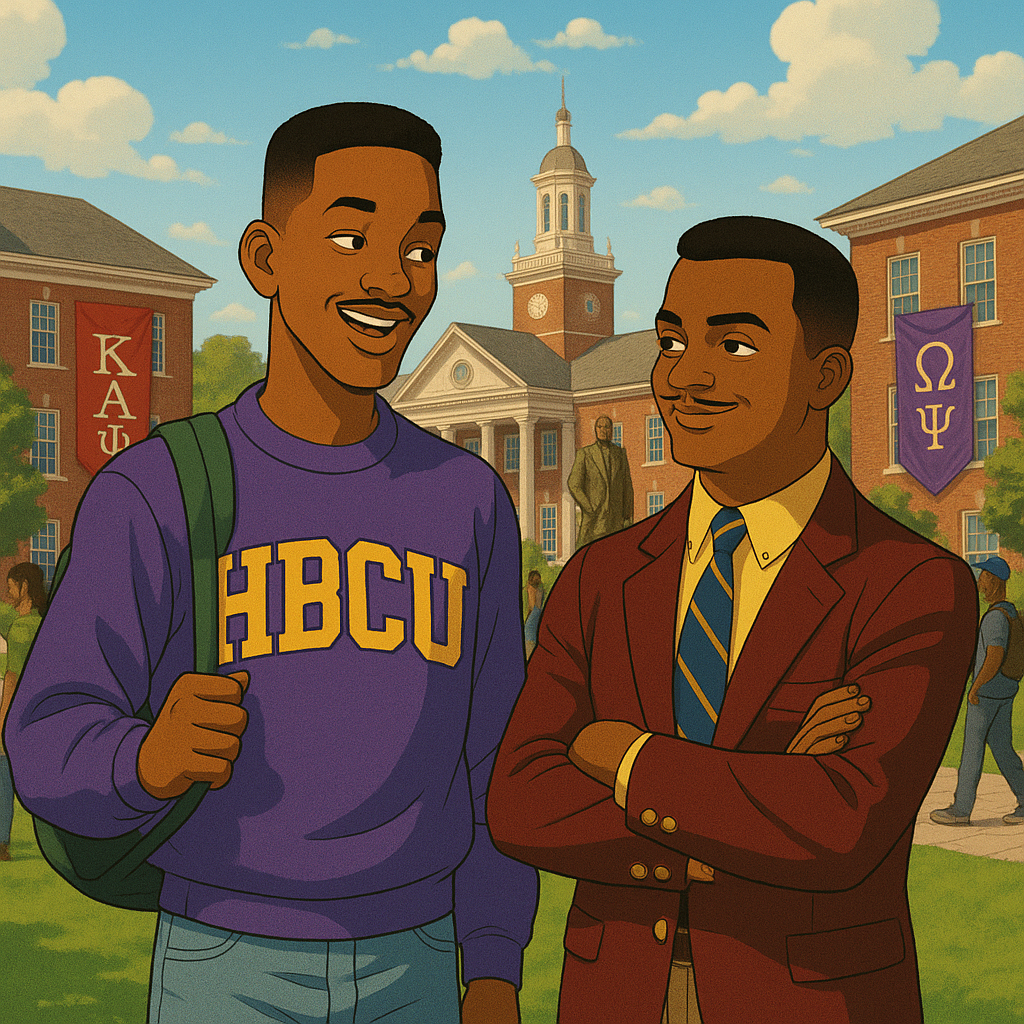
There’s a reason The Fresh Prince of Bel-Air worked so well. Will’s Philadelphia-born charisma collided with Carlton’s prep-school privilege, creating a comedy of contrasts rooted in class, code-switching, and internalized white gaze. But even then, Will and Carlton both eventually attended the fictional ULA — another HBCU stand-in — and the show made space to honor Black institutions. In today’s remakes and reboots, the goalpost has moved. The tension no longer lies in navigating Blackness within Black spaces — it’s about achieving acceptance in white ones.
That’s dangerous.
When every fictional Black success story leads to a PWI, the message isn’t just one of educational preference — it’s a silent endorsement of the idea that Black excellence only matters when validated by white institutions. It undermines the legacy of HBCUs and implicitly suggests that the spaces Black people built for themselves are less worthy of screen time or societal investment.
The Stakes Are Real
This is more than a cultural critique. It’s an economic, social, and political issue. HBCUs graduate 80% of Black judges, 50% of Black lawyers, 40% of Black engineers, and 40% of Black Members of Congress. They are engines of Black leadership — and media has the power to either support or suppress that momentum.
Shows like A Different World didn’t just entertain — they built pipelines. They encouraged enrollment, boosted donations, and sparked policy conversations. At their best, they acted as visual endowments, depositing cultural capital into communities that needed it most.
When those narratives disappear, so does the incentive for viewers to value or invest in HBCUs. Worse, it renders the very idea of building Black institutions obsolete in the cultural imagination.
Why The Writers’ Room Needs HBCUs
The disappearance of HBCUs from fictional family life is also a commentary on who’s writing the stories. As Hollywood grapples with diversity, equity, and inclusion, it continues to rely heavily on Ivy League or top PWI talent pipelines. While some HBCU alumni are breaking through — such as Lena Waithe (Columbia College Chicago, but often a supporter of HBCUs) and Taraji P. Henson (Howard University) — there is still no wide-scale industry embrace of HBCU-trained writers, producers, or creatives.
This matters.
Representation isn’t just about who’s on screen — it’s about who decides what stories are told, who centers the cultural context, and who gets to be the architect of Black futures.
The Cultural Cost of Being “The Only One”
There’s a deep psychological tax in being “the only one” — a familiar theme in shows that send Black characters to elite PWIs. Whether it’s Zoey Johnson navigating white professors or Carlton Banks handling racial profiling by the police, these storylines, while real, often celebrate survival rather than thriving. They portray success as proximity to whiteness rather than mastery of one’s own.
Contrast this with Hillman, where students struggled, triumphed, fell in love, challenged politics, and made mistakes — all within a culturally affirming environment. The campus was Black. The professors were Black. The rules, norms, and traditions were Black.
That distinction is powerful.
In a world increasingly shaped by algorithms, streaming wars, and performative diversity, where we imagine Black life unfolding — especially for fictional families — is just as important as what happens.
Black-Owned Media: The New Front Line of Cultural Restoration
If the absence of HBCUs from our screens reflects a loss of cultural focus, then the solution lies not just in pleading for more representation — but in owning the means of production, distribution, and storytelling. For generations, Black-owned media has served as a counterbalance to the marginalization found in mainstream outlets. But today, especially in an era defined by digital platforms, there’s a new frontier of opportunity — and HBCUs are uniquely positioned to lead.
To change the narrative, we must also change the narrators.
HBCUs as Incubators for Black Media Ownership
HBCUs are not just educational institutions — they are cultural laboratories. Schools like Howard University, Florida A&M, and North Carolina A&T have produced a long lineage of journalists, filmmakers, producers, broadcasters, and business leaders in media. Cathy Hughes, the founder of Urban One (formerly Radio One), the largest African American-owned broadcasting company in the U.S., began her media career at Howard. Her success is not the exception — it’s the proof of concept.
What if more HBCUs developed cross-disciplinary media programs that fused journalism, film production, and business with a distinctly Afrocentric and institution-building ethos? Imagine an HBCU student graduating not just with a film degree, but with the rights to a series developed in a campus-run studio, ready to be licensed to a Black-owned distribution network. Imagine HBCUs running their own content incubators — writing rooms, studios, streaming apps — where the next A Different World is created by us, for us.
Building Our Own Pipelines: From Classroom to Platform
For too long, Black creatives have had to depend on mainstream networks or streaming services to greenlight their work. This gatekeeping often results in sanitized or stereotyped representations, with HBCUs either ignored or distorted. But what if HBCUs created their own media pipelines — complete with production houses, content libraries, and distribution partnerships?
Howard University already owns WHUR 96.3, a powerhouse urban radio station in Washington, D.C. Florida A&M operates WANM, its campus radio station. Spelman and Morehouse have nurtured partnerships with media production companies. These are the seeds of a broader media ecosystem.
Now imagine:
- HBCU Streaming Networks: Think “HBCUflix,” operated by a consortium of HBCUs with a content catalog drawn from student filmmakers, professors, and alumni creatives.
- Campus-Controlled Local TV Stations: Using FCC-designated low-power TV station licenses to broadcast HBCU sports, lectures, news, and entertainment to local communities.
- Black-Owned Newsrooms: Reviving the tradition of the Chicago Defender or Pittsburgh Courier in digital form, anchored by HBCU journalism schools.
This isn’t hypothetical. It’s blueprint-ready. What’s required is a collective investment of time, capital, and institutional will — plus alumni and philanthropic backing — to scale these models.

In the evolving landscape of Black-owned media, DeShuna Spencer stands out as a visionary force. As the founder and CEO of kweliTV, Spencer has created a platform that not only amplifies Black voices but also serves as a blueprint for how Historically Black Colleges and Universities (HBCUs) can reclaim and reshape cultural narratives through media ownership and innovation.
DeShuna Spencer and the Birth of kweliTV
DeShuna Spencer, a Memphis native and Jackson State University alumna, launched kweliTV out of a desire to see authentic Black stories represented in media. Frustrated by the lack of diverse and accurate portrayals of Black life on mainstream platforms, she envisioned a space where the global Black experience could be celebrated in its entirety. “Kweli” means “truth” in Swahili, reflecting the platform’s mission to present honest and multifaceted narratives of the African diaspora.
kweliTV curates a vast library of over 800 indie films, documentaries, web series, children’s programming, and more, sourced from North America, Africa, Latin America, the Caribbean, Europe, and Australia. The platform emphasizes content that has been recognized at film festivals, with 98% of its films having premiered at such events and 65% earning prestigious awards.
A Platform for Empowerment and Education
Beyond entertainment, kweliTV serves as an educational tool and a catalyst for social change. The platform’s mission is rooted in the belief that storytelling can drive activism, connect communities, and spark meaningful conversations . By showcasing content that delves into topics like racial equality, Black history, political activism, and wellness, kweliTV provides viewers with narratives that challenge stereotypes and promote understanding.
Recognizing the importance of education, Spencer has expanded kweliTV’s reach into academic institutions. The platform’s EDU component offers campus-wide subscriptions, delivering culturally rich content to schools and libraries. This initiative aims to shift the Black narrative, dismantle implicit bias, and address the erasure of Black history in education.

Supporting Black Creators
kweliTV is committed to economic inclusion and the empowerment of Black creatives. The platform collaborates with over 450 filmmakers worldwide, with 91% of them being of African descent and 50% women. Notably, 60% of subscription revenue is allocated to these creators, ensuring that they are compensated for their work and can continue producing impactful content.
In a move to further support its community, kweliTV launched kweliFUND, a crowdfunding platform designed exclusively for its creators. This initiative allows filmmakers to raise funds for their projects directly from the platform’s audience, fostering a sense of community and collaboration between creators and viewers.
A Model for HBCUs and Black-Owned Media
Spencer’s work with kweliTV offers a compelling model for how HBCUs can engage in media ownership and content creation. By establishing their own media platforms, HBCUs can provide students with hands-on experience in storytelling, production, and distribution, while also ensuring that Black narratives are told authentically and with nuance.
Furthermore, partnerships between HBCUs and platforms like kweliTV can facilitate the sharing of resources, expertise, and content, amplifying the reach and impact of Black stories. Such collaborations can also lead to the development of new media ventures, including streaming services, radio stations, and digital publications, all rooted in the rich cultural heritage of HBCUs.
Looking Ahead
DeShuna Spencer’s journey with kweliTV underscores the transformative power of media ownership in shaping cultural narratives. By prioritizing authenticity, education, and empowerment, Spencer has created a platform that not only entertains but also enlightens and inspires.
As HBCUs and Black-owned media entities look to the future, the example set by Spencer and kweliTV serves as a beacon, illustrating the profound impact that intentional storytelling and media ownership can have on communities and the broader cultural landscape.
For more information about kweliTV and its mission, visit kweli.tv.
Creating a Cultural Distribution Infrastructure
Ownership is not just about creating content; it’s about controlling how, when, and where that content reaches audiences. This is where distribution — the final, and often most powerful leg of the media supply chain — comes into play.
We’ve seen what happens when Black creators rely on platforms like Netflix, Amazon Prime, or Hulu: their content is subject to algorithmic bias, buried under trending categories that don’t serve Black audiences, or removed altogether without explanation.
The answer? HBCUs and Black-owned media must move to own the pipes — the literal and digital infrastructure of cultural delivery:
- OTT Streaming Platforms: Develop Roku, Fire TV, and mobile app channels focused on HBCU-produced content, from sitcoms to documentaries to sports coverage.
- Podcasting Networks: Establish campus-based podcast studios and national syndication pipelines, building on the success of Black podcasting voices in culture, politics, and mental health.
- Media Training & Ownership Programs: Create degree and certificate programs focused specifically on media ownership, policy, and digital rights — the business side of the content coin.
These systems not only decentralize media control, but they also re-center HBCUs as hubs of cultural production and protection.
Reinforcing a Narrative of Sovereignty
This shift is not just about representation; it’s about sovereignty. Black-owned media — especially when powered by HBCUs — doesn’t just offer us better stories. It offers us control over how Black futures are imagined. It allows for stories where our children attend HBCUs not as exceptions but as norms, where our families are not defined by white validation but by Black institutions and Black love.
It also allows us to engage intergenerationally. Grandparents who once watched A Different World could stream its spiritual successor with their grandkids — not waiting on NBC, but logging into a platform built by us. The message? Black stories, Black education, and Black institutions still matter — and we’ll tell that truth ourselves.
A Call to Action: HBCUs, It’s Time
The time has come for HBCUs to formally declare themselves cultural content producers — not just pipelines to jobs in someone else’s newsroom, but architects of our own. This means:
- Partnering with Black venture capitalists and philanthropists to fund media tech.
- Creating cross-campus media alliances to pool talent and resources.
- Reaching out to Black celebrities and alumni for licensing deals, co-productions, and endorsements.
We already have the minds. We have the stories. We have the history. Now we need to build the systems.
Because until we do, our children on screen will keep walking through Ivy-covered gates that never reflect the richness of the Black experience — and the cultural erasure will quietly continue.
But when we own the studio, the mic, and the means of distribution — Hillman will return, and this time, it won’t just be a different world.
Bringing Hillman Back: What’s Next?
It’s time for another renaissance.
There’s an opportunity here for Black creators, networks, and communities to reclaim HBCUs as vital to the cultural conversation. Imagine:
- A new series that follows a multi-generational HBCU family through decades of change.
- A young adult drama centered on students at Spelman, Morehouse, or Hampton navigating climate change, cancel culture, and campus love.
- A sci-fi thriller set at a fictional HBCU where Black inventors and scientists are the last hope for humanity.
These aren’t pipe dreams. They are possible — and necessary.
Because culture moves policy. Culture shapes perception. And culture, at its best, reminds us of who we are and what we’re worth.
Final Word: Hillman Wasn’t Just a Show
Hillman was a blueprint. It showed us that we don’t need to ask permission to be excellent. That we can build institutions where our children are seen, heard, and nurtured. That we don’t have to shrink to fit someone else’s standard.
Today, as fictional African American families continue to send their children to PWIs — with barely a nod to the institutions that made their very existence possible — we must ask ourselves what kind of future we’re imagining.
Because if we don’t see HBCUs on our screens, in our scripts, and in our stories, we risk losing them in real life.
And that’s a different world we cannot afford.
Disclaimer: This article was assisted by ChatGPT.

 HBCU Money