
“Real estate power does not wait on political peace—it plans around it.” — HBCU Money
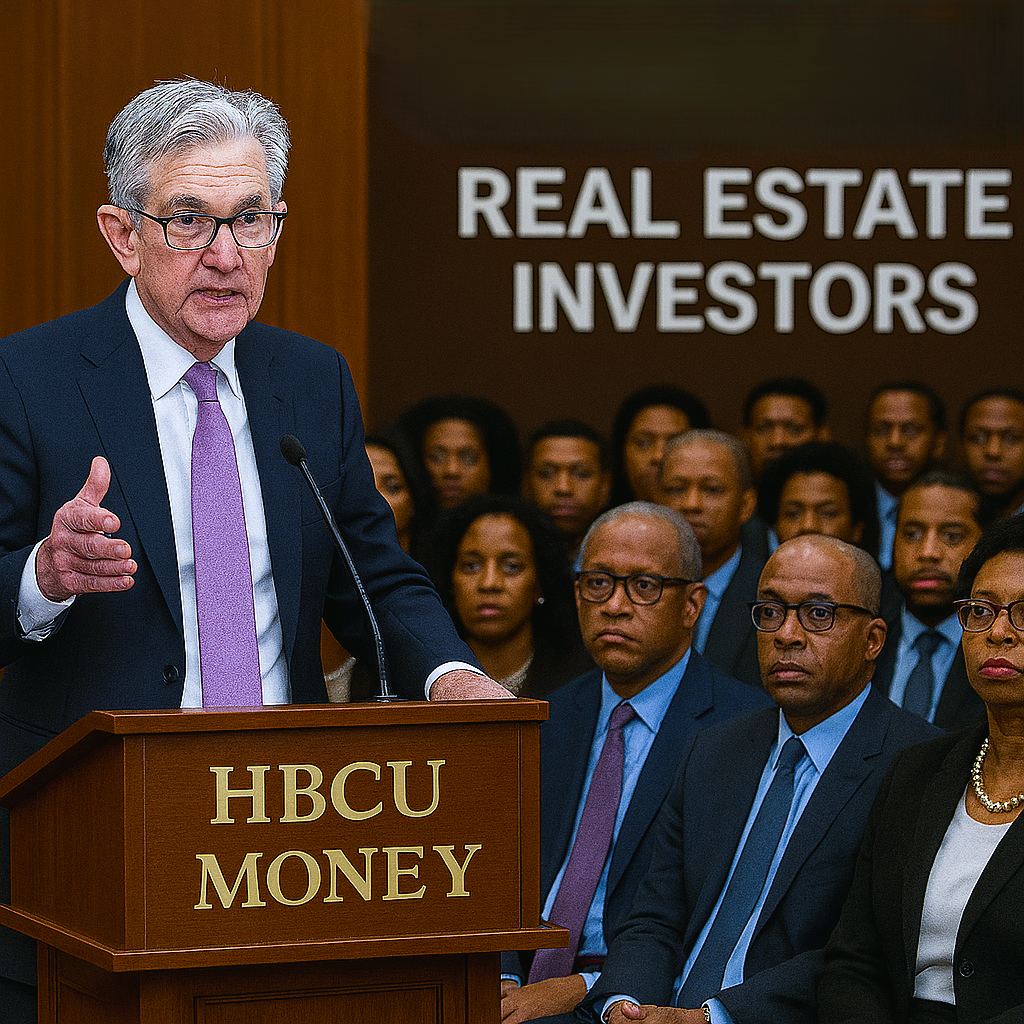
In commercial real estate, calm markets are often a prerequisite for aggressive growth. When volatility creeps in—especially from policy uncertainty—wise investors do not panic, but they do reposition. As rumors swirl that Federal Reserve Chair Jerome Powell may be removed from office before the end of his term, the CRE market is already baking in disruption. For HBCU alumni who invest in real estate, this moment demands attention, strategy, and foresight.
Although Powell’s official term runs through May 2026, and he can technically serve until 2028, market insiders are moving as if his exit could happen sooner—possibly under a second Trump administration. On July 17, GlobeSt.com reported that commercial real estate markets are increasingly factoring in political risk, with deal structures, loan pricing, and capital flows tightening ahead of any actual policy change.
For HBCU alumni who have spent years assembling rental portfolios, developing mixed-use properties, or backing Opportunity Zone projects near campuses, this isn’t abstract economic theory. This is cash flow, cap rates, and leverage dynamics in real time.
The Federal Reserve controls interest rates, liquidity, and lending standards—the lifeblood of commercial real estate. But the Chair also shapes expectations. Even the perception of instability at the Fed causes lenders to pull back and investors to reprice assets.
Jerome Powell has been seen as a steady hand, even when unpopular. His cautious rate policy—especially amid post-pandemic inflation—kept CRE markets from overheating or crashing. But if he’s ousted or disempowered, markets may expect more aggressive rate cuts under political pressure, a weakening dollar complicating international investment and supply chain costs, and a loss of institutional independence introducing a political lens into every Fed decision.
For HBCU alumni real estate investors, it means more volatile borrowing costs, reduced predictability in returns, and a need to re-evaluate how aggressively to pursue expansion or refinance.
Lenders are tightening up—and they are doing so before Powell is removed. That should concern anyone whose real estate model is sensitive to capital cost.
Bridge and construction loans are becoming harder to secure without pristine credit and higher equity injections. Cash-out refinances—especially for small portfolios—are being capped or delayed altogether. Development deals in low-income communities (where many HBCU graduates invest as a mission) are being scrutinized harder or shelved entirely.
As one investment banker told GlobeSt, “We’re seeing deals priced as if Powell’s out in six months, and we’re living in a very different rate environment.” It’s not a prediction—it’s a hedge. And HBCU alumni need to do the same.
If you’re invested in—or considering entering—any of the following CRE asset classes, Powell’s fate may shape your returns:
| CRE Sector | Risk From Fed Instability |
|---|---|
| Multifamily | Rising rates hurt acquisitions and refinancing; rent growth may not keep up with cost of capital |
| Retail | Already under pressure from e-commerce; volatile rates shrink tenant pool and landlord leverage |
| Hospitality | Heavily exposed to economic cycles; refinancing becomes challenging if Fed turmoil hits |
| Industrial/Logistics | Generally stable, but price compression expected if Fed credibility drops |
| Development Projects | Most vulnerable—cost of capital, input inflation, and credit availability all in flux |
HBCU alumni often favor multifamily and mixed-use in urban corridors. That makes preparation even more critical.
Let’s be clear: instability in the Fed disproportionately hurts Black real estate investors.
Less institutional capital backing Black developers means higher reliance on bank debt. Lower net worth and liquidity reserves can make it harder to endure tightened credit cycles. Projects in historically Black neighborhoods—often underinvested already—face greater scrutiny from conservative lenders during uncertain times. And Black investors are more likely to reinvest locally, meaning pullbacks hit community wealth and revitalization efforts harder.
If you’re financing student housing near Howard, renovating a historic property near Southern, or redeveloping land near Fort Valley State, you may suddenly find banks “reassessing” your application—not because of your deal, but because of Washington.
HBCU alumni have a legacy of building through adversity. This moment demands no less. Key investor moves right now include:
Renegotiate your debt terms while rates are still predictable. If your loans mature in 2026 or 2027, the window to lock in current rates or secure extensions is closing. Powell’s tenure—and potential replacement—will shape forward rate curves. Beat the volatility while you still can.
Shift to fixed-rate debt. Adjustable-rate debt was cheap two years ago. Now it’s a ticking time bomb. Consider refinancing into fixed-rate debt, even at a slight premium, to gain stability and prevent future cash flow disruptions.
Expand your lender relationships. Do not depend on one or two institutions. Build ties with Black-owned banks, CDFIs, and credit unions aligned with HBCU values. These institutions may have more mission-aligned flexibility if traditional banks tighten up.
Build a liquidity cushion. Discipline now prevents desperation later. Liquidity is the real hedge during economic uncertainty—especially if tenants default, contractors raise costs, or refinance windows close.
Delay discretionary projects. This is the time to tighten pro formas, not push for maximum leverage. If a deal still pencils at 9% debt, proceed. If it only works at 6%, wait.
Pool capital. Use alumni associations and real estate clubs to form investment syndicates. One investor may get denied a $5M deal. Five alumni together might get approved for $25M. Leverage unity, scale, and relationships.
Crisis also presents acquisition opportunities. There will be distressed sellers needing to offload assets quickly, developers unable to complete projects, and landlords who can’t refinance expiring loans. HBCU alumni, especially those with capital or credit, should keep an eye out. Joint ventures among alumni can create scale and deploy capital when others retreat. Use this time to buy smart, not fast.
Beyond Powell himself, it’s the Fed’s credibility that gives investors confidence to commit capital to 10–30 year projects. If a new Chair appears beholden to political pressure, markets may price in new risks to long-term bonds, accelerate inflation fears, and depress asset values. That would slow not just your next project—but the next generation’s.
That is why HBCU alumni must take this seriously, not just as investors—but as stewards of intergenerational wealth.
HBCU institutions also have a role to play. They can create alumni investment syndicates that provide deal flow and capital. They can offer discounted land or property near campus to alumni developers. They can develop relationships with mission-driven lenders and introduce alumni projects for financing. And they can host economic briefings and real estate strategy sessions to keep their alumni sharp and agile in rapidly changing markets.
Colleges like Tuskegee, Texas Southern, and FAMU have alumni who are reshaping skylines. These institutions must recognize this as an extension of their impact—and protect it.
The Federal Reserve Chair is not a figurehead. Powell’s potential removal would represent a seismic shift in economic planning—especially for real estate. For HBCU alumni, many of whom have built their portfolios in the shadows of systemic exclusion, the message is clear: this is not a time to panic—but it is time to prepare.
Build alliances, lock in rates, stockpile liquidity, and be ready. The future of our neighborhoods, our campuses, and our financial independence will be shaped by how we respond to this moment.
And if the rest of the market goes quiet, remember: Black investors have never needed perfect conditions to build power—we’ve just needed a plan and each other.
Disclaimer: This article was assisted by ChatGPT.
 HBCU Money