Tag Archives: Howard University

HBCU Money™ Presents: 2014’s HBCU Alumni NFL Players’ & Salaries

B9A0175

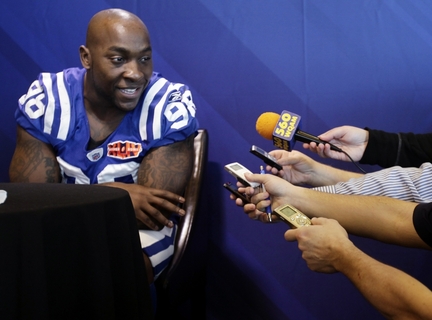
For the 2nd year in a row, Robert Mathis (pictured above), an alum of Alabama A&M University leads the list of highest paid HBCU NFL players.

HBCU Money™ FACTS:

  • NFL teams spent $3.9 billion of 2013’s $4.2 billion available.
  • HBCU NFL players combine for $57.1 million down 3.5 percent when HBCU NFL players earned $59.2 million in salaries. Estimated take home after taxes and agent/lawyer fees is $28.6 million.
  • Hampton University leads the way with 5 NFL players.
  • 15 HBCUs are represented in the NFL. Down from 19 in 2013.
  • MEAC conferences has 6 schools represented. The SWAC dropped to 2 schools represented after having 6 in 2013.
  • HBCU NFL players represent approximately 1.7 percent of roster positions available. Unchanged from 2013.
  • Average salary for HBCU NFL players is $2 million, a decrease from $2.1 million in 2013. In 2011, the average NFL salary was $1.9 million according to Bloomberg Businessweek.
  • Median salary for HBCU NFL players is $1 135 000, a 27 percent increase from 2013. In 2011, the median NFL salary was $777 000 according to Bloomberg Businessweek.
  • 4 players from 2013 are no longer on the list.

1 – Robert Mathis / DE / Indianapolis Colts – $8 750 000

(ALABAMA A&M) 

2 – Kendall Langford / DE / St. Louis Rams – $6 000 000

(HAMPTON) 

3 – Greg Toler  / CB / Indianapolis Colts – $4 833 333

(ST. PAUL’S)

4 – Sammie Hill / DT / Tennessee Titans – $4 066 666

(STILLMAN)                                                                                                           

5 – William Hayes / DE / St. Louis Rams – $3 845 000

(WINSTON-SALEM STATE)                                                                                  

6 – Jason Hatcher / DE / Washington Redskins – $3 750 000

(GRAMBLING STATE)                                                                                           

7 – Antoine Bethea / S / San Francisco 49ers – $3 000 000

(HOWARD)                                                                                                       

8 – Junior Galette / OLB / New Orleans Saints – $2 900 000

(STILLMAN)                                                                                                      

9 – D. Rodgers-Cromartie / CB / Denver Broncos – $2 750 000

(TENNESSEE STATE)                                                                                      

10 – Chris Baker / DL / Washington Redskins – $2 000 000

(HAMPTON)                                                                                                     

11 – Jacoby Jones / WR / Baltimore Ravens – $1 875 000

(LANE)                                                                                                                

12 – Rafael Bush / S / New Orleans Saints – $1 850 000

(SOUTH CAROLINA STATE)                                                                        

13 – Jason Durant / LB / Dallas Cowboys – $1 450 000

(HAMPTON)                                                                                                      

14 – Tarvaris Jackson / QB / Seattle Seahwaks – $1 250 000

(ALABAMA STATE)                                                                                         

15 – Rashean Mathis / CB / Detroit Lions – $1 020 000

(BETHUNE-COOKMAN)                                                                                

16 – Don Carey / S / Detroit Lions – $930 000

(NORFOLK STATE)                                                                                         

17 – Kenrick Ellis / DT / New York Jets – $797 500

(HAMPTON)                                                                                                      

18 – Phillip Adams / CB / New York Jets – $770 000

(SOUTH CAROLINA STATE)                                                                       

19 – Eric Weems / WR / Atlanta Falcons – $730 000

(BETHUNE-COOKMAN)                                                                               

20 – Terron Armstead / T / New Orleans Saints – $679 359

(TENNESSE STATE)                                                                                        

21 – Marquette King / P / Oakland Raiders – $570 334

(FORT VALLEY STATE)                                                                                  

22- Ryan Davis / DE / Jacksonville Jaguars – $495 000

(BETHUNE-COOKMAN)                                                                              

23 – Larry Donnell / TE / New York Giants – $495 000

(GRAMBLING STATE)                                                                                    

24 – Anthony Levine / S / Baltimore Ravens – $495 000

(TENNESSEE STATE)                                                                                      

25 – Bryan Tyms / WR / New England Patriots – $495 000

(FLORIDA A&M)                                                                                            

26 – Kadeem Edwards / T / Tampa Bay Buccaneers – $473 000

(TENNESSEE STATE)                                                                                    

27 – Isaiah Crowell / RB / Cleveland Browns – $423 333

(ALABAMA STATE)                                                                                        

28 – Michael Ola / T / Chicago Bears – $421 666

(HAMPTON)                                                                                                      

29 – Frank Kearse / DE / Washington Redskins – N/A

(ALABAMA A&M)

Sources: NFL.com, The Guardian, Spotrac

Webometrics’ 2014 Top 20 African Diaspora Colleges & Universities

HBCU Money™ presents the top 20 ranked African Diaspora colleges and universities. The rankings are based on the world rankings from Webometrics, an initiative of the Cybermetrics Lab, a research group belonging to the Consejo Superior de Investigaciones Científicas (CSIC), the largest public research body in Spain.

HIGHLIGHTS:

  • 10 of the 20 colleges and universities come from South Africa. An increase from 9 in 2013.
  • There are 6 new schools in the top 20 this year
  • African American colleges & universities (HBCUs) placed only 2 of the 20 colleges and universities present on the list after having 4 in 2013. Both universities that placed, Howard & Florida A&M, saw drops in their rankings.
  • The top ranked African Diaspora college/university in 2014 is up 31 places from top ranked African Diaspora college/university in 2013.
  • No African Diaspora colleges or universities are present in the top 100 in Webometrics’ world rankings.

image description

Below are the objective and methodology per the Webometrics website:

Objective: The original aim of the Ranking was to promote Web publication. Supporting Open Access initiatives, electronic access to scientific publications and to other academic material are our primary targets. However web indicators are very useful for ranking purposes too as they are not based on number of visits or page design but on the global performance and visibility of the universities.

Methodology: The Webometrics is the largest academic ranking of Higher Education Institutions. Since 2004 and every six months an independent, objective, free, open scientific exercise is performed by the Cybermetrics Lab (Spanish National Research Council, CSIC) for the providing reliable, multidimensional, updated and useful information about the performance of universities from all over the world based on their web presence and impact.

INSTITUTION – WORLD RANK (2013 RANKING) – COUNTRY

  1. University of Cape Town350 (391) – South Africa
  2. Cairo University358 (1206) – Egypt
  3. Stellenbosch University439 (462) – South Africa
  4. University of Pretoria444 (746) – South Africa
  5. University of the Witwatersrand580 (719) – South Africa
  6. University of Kwazulu Natal – 752 (N/A) – South Africa
  7. University of the West Indies – 774 (N/A) – Jamaica
  8. University of the Western Cape – 789 (834) – South Africa
  9. University of Nairobi907 (1624) – Kenya
  10. Mansoura University911 (1699) – Egypt
  11. Rhodes University968 (1191) – South Africa
  12. University of South Africa1058 (1545) – South Africa
  13. Makerere University1134 (696) – Uganda
  14. University of Johannesburg1204 (1749) – South Africa
  15. Alexandria University – 1223 (N/A) – Egypt
  16. Howard University – 1231 (753) – United States
  17. North West University – 1430 (N/A) – South Africa
  18. Benha University – 1493 (N/A) – Egypt
  19. Addis Ababa University – 1599 (N/A) – Ethiopia
  20. Florida A&M University1632 (1557) – United States

Source: Webometrics

The Race To The First Billion Dollar HBCU Endowment: Can Anyone Catch Howard?

By William A. Foster, IV

Whenever I may be tempted to slack up and let the business run for awhile on its own impetus, I picture my competitor sitting at a desk in his opposition house, thinking and thinking with the most devilish intensity and clearness, and I ask myself what I can do to be prepared for his next brilliant move. – H. Gordon Selfridge

brathwaite-photo-finish


There will be a lot of excitement whenever an HBCU finally reaches the magical one billion dollar endowment plateau. It will be unfounded excitement, but there will be excitement. By now, multiple HBCUs should have achieved billion dollar status, but a mixture of desegregation, poor financial literacy even among our educated alum, and arguably poor communication historically between the institutions themselves and alumni about the endowment and its value have stymied the growth of HBCU endowments. Many have the attitude that their attendance and tuition is all the “giving” they need to give to their HBCU. Some argue bad experiences while during matriculation also has made alumni adverse to giving, but that logic can be a bit dunce and short-sighted. This is because many of the poor experiences that the alum experienced were often a result of poor resources available to train staff better and antiquated software. Alas, this is not to remove the institutions’ responsibility. They certainly deserve their share for not making customer service the number one, two, and three priority. Too many HBCUs still are stuck in mimic mode of their HWCU counterparts in strategic behavior. This includes institutional outreach and advancement where often HBCUs did not and do not pay attention to the cultural differences in giving patterns between African Americans and other groups.

HBCUs in general lack a pool of high-quality and transformative donors. We define the former as “high-quality donors who give consistently and over their lifetime will probably give six to seven figures of donations” and the latter as “donations from transformative donors range from eight to nine figures.” The top ten donations to colleges last year were a combined $2.5 billion with Phil and Penelope Knight, the owners of Nike, putting $500 million in the lap of University of Oregon. HBCUs have missed accessing high-quality donors in the world of hip-hop and entertainment in my opinion at times because they have not wanted the association that comes with many of these artist and their image. Meanwhile, schools like Rice and Harvard University have welcomed the likes of Bun B of UGK and Nas into their wombs, respectively. The latter actually having a fellowship named after him at Harvard. This has cost HBCUs in terms of both finances and publicity. Publicity that is strongly needed to make up for the imbalance in being able to recruit today’s students also known as future donors.

So who is in the running to reach the billion dollar mark? Howard University comes in with the largest endowment at $513 million, which puts it a full $186 million ahead of number two rival Spelman who has a $327 million endowment. In third place, Hampton University with an endowment of $254 million and trailing Howard’s endowment by $259 million. Other notables who are long shots in the race are Meharry Medical College, Florida A&M University, and Tuskegee University with endowments of $124 million, $115 million, and $105 million, respectively. Before anyone ask where is Morehouse and its $130 million endowment, current president John Wilson himself pointed out that in terms of endowment-expense ratio, Spelman is 4:1 and Morehouse is at 1.3:1. Needless to say, while Morehouse needs to desperately build its endowment it appears to have bigger concerns that could leave it too unfocused to be a legit player. These are all of the HBCUs who have at least $100 million endowments. After them the drop off is so acute that it would take a transformative donation for any kind of consideration.

The big 3 of Howard, Spelman, and Hampton all have unique advantages and problems. Howard’s biggest advantage other than being halfway there is the Howard University Endowment Act sponsored by Dan Quayle in 1984. The act currently grants Howard $3.6 million currently in a matching endowment grant. According to Govtrack, “Requires the University, in order to receive such a grant, to deposit in the endowment an amount equal to such grant.” In other words, Howard University is working with a 1:1 match. What is not clear in the bill is if it is limited to specific type of donations from donors. If it does not have limitations, then that is one heck of a weapon. The school is also the only HBCU that is a full-service HBCU meaning it has both a medical school and law school. Something that allows it to produce higher earning alum than its counterparts. Unfortunately, with the good comes some bad. Howard has recently been in the news recently with downgrades by credit agencies for its debt, cutting about 200 staff positions, and public fighting between trustees in the media. Spelman, ranked number two, definitely benefited from what is today valued at a $40 million gift from Bill and Camille Cosby in 1988. An amount equivalent to 12 percent of today’s endowment. You can look at that as glass half full or empty. Full in that they have secured a transformative donation and could again or empty that to this day it still comprises a disproportionate amount of their endowment. On the negative, Spelman has struggled the past few years with their ROI returns for their endowment. The ROI ranking was been the lowest among all top ten HBCU Money endowments in 2013. There seems to be some serious questions about conflicts of interest with Spelman’s board of trustee, Theodore Aronson, who is also the head of their investment committee, his company AJO, and some of Spelman’s investments which have not faired near as well as other HBCUs over the past few years. That could allow Hampton to push pass who trails Spelman by $73 million. Another headwind facing Spelman is the lack of a graduate school which aforementioned in regards to Howard produces higher earning alumni on average. Lastly, Hampton would need to double its endowment or achieve a 100 percent ROI on its current endowment to catch up to Howard – lightning would strike Emancipation Oak twice before the latter would happen. Warren Buffett, considered the greatest investor of all-time, has historically managed around 20 percent annually for the past 45 years. However, given Hampton’s leadership in the form of president William Harvey, who has always kept Hampton fiscally aggressive by limiting the amount it takes from the endowment to 3 percent allowing for greater reinvestment than their peers. It would seem that financial talent and strategy is on Hampton’s side. Hampton is potentially too reliant on its investment strategy and not as much on its alumni development as the school’s giving rate is among the lowest among the big three. Their biggest donation still is from George Eastman, founder of Eastman Kodak, whose $1 million donation in 1924 is valued at approximately $13.8 million adjusted for inflation.

A major factor in all of this and at the heart of it is alumni. An examination of alumni giving rates since 2008 have seen Howard range in the 13-17 percent, Spelman in the 39-41 percent range, and Hampton with 10-16 percent. Percentages can be somewhat misleading giving alumni populations. Howard has by far the largest alumni base of the three schools followed by Hampton and then Spelman. Although the size of the alumni base can be offset by higher giving per alumni, so not too much should be read into these numbers, but it is better to know them than not if you are a development office.

So who do we think we get there first? It is honestly still too early to tell. Given the recent unsettled nature of HBCUs from the private elites to the state institutions to the small liberal arts HBCUs, it seems HBCUs are in a constant proverbial minefield. These three are the head and shoulders favorites, but a transformative donation among any number of HBCUs could change the landscape in a hurry. This could be as they say in the racing world a photo finish.

 

HBCU Money™ Histronomics: S.2510 – Howard University Endowment Act

Howard_University_seal

Sponsor: Dan Quayle (R-IN) – Introduced March 30, 1984

Summary:

Howard University Endowment Act – Authorizes the Secretary of Education to establish an endowment program for Howard University. Authorizes the Secretary, from funds available in any fiscal year for the University, to make grants into the endowment fund established under this Act at the University. Authorizes the Secretary to enter into agreements with the University, including provisions necessary to assure that the purposes of this Act will be achieved.

Requires the University, in order to receive such a grant, to: (1) deposit in the endowment fund an amount equal to such grant; and (2) administer the endowment fund in accordance with the requirements of this Act. Prohibits the source of funds for such institutional match from including Federal funds or funds derived from an existing endowment fund.

Limits the period of any such grant to 20 years. Prohibits the University from withdrawing or expending any of its endowment fund corpus during such grant period. Allows the University, upon expiration of such period, to use the endowment fund corpus plus any endowment fund income for any educational purpose.

Sets forth requirements for investments of the endowment fund corpus and endowment fund income.

Sets forth provisions relating to authorized withdrawals and expenditures of endowment fund income.

Sets forth provisions for enforcement of requirements under this Act.

Makes conforming amendments to specified Federal law relating to Howard University.

Source: Congress.gov

HBCU Money™ Presents: 2013’s HBCU Alumni NFL Players’ & Salaries

mathisjpg-5915c05f81e62761_large

The top earning HBCU NFL player is Alabama A&M’s Robert Mathis (pictured above)

HBCU Money™ FACTS:

  • NFL teams spent $3.5 billion of 2013’s $4 billion available.
  • HBCU NFL players combine for $59.2 million in salaries or 1.7 percent of salaries spent. Estimated take home after taxes and agent/lawyer fees is $29. 6 million.
  • Hampton University leads the way with 4 NFL players.
  • 19 HBCUs are represented in the NFL.
  • SWAC/MEAC conferences both have 6 schools represented.
  • HBCU NFL players represent approximately 1.7 percent of roster positions available.
  • Average salary for HBCU NFL players is $2.1 million. In 2011, the average NFL salary was $1.9 million according to Bloomberg Businessweek.
  • Median salary for HBCU NFL players is $895 000. In 2011, the median NFL salary was $777 000 according to Bloomberg Businessweek.
  1. Robert Mathis – DE – Indianapolis Colts – $10 750 000
    (Alabama A&M)

  2. Kendall Langford – DE – St. Louis Rams – $6 000 000
    (Hampton)

  3. Antoine Bethea – S – Indianapolis Colts – $5 750 000
    (Howard)

  4. Jacoby Jones – WR – Baltimore Ravens – $4 900 000
    (Lane)

  5. Dimitri Patterson – CB – Miami Dolphins – $4 600 000
    (Tuskegee)

  6. Greg Toler – CB – Indianapolis Colts – $4 333 333
    (St. Paul’s)

  7. D. Rodgers-Cromartie – CB – Denver Broncos – $2 900 000
    (Tennessee State)

  8. Sammie Hill – DT – Tennessee Titans – $2 766 666
    (Stillman)

  9. Jason Hatcher – DT – Dallas Cowboys – $2 600 000
    (Grambling State)

  10. William Hayes – DE – St. Louis Rams – $2 050 000
    (Winston-Salem State)

  11. Junior Galette – OLB – New Orleans Saints – $1 700 000
    (Stillman)

  12. Eric Weems – WR – Chicago Bears – $1 415 000
    (Bethune-Cookman)

  13. Chris Baker – NT – Washington Redskins – $1 323 000
    (Hampton)

  14. Justin Durant – LB – Dallas Cowboys – $950 000
    (Hampton)

  15. Tavaris Jackson – QB – Seattle Seahawks – $840 000
    (Alabama State)

  16. Kenrick Ellis – DT – New York Jets – $707 500
    (Hampton)

  17. Don Carey – S – Detroit Lions – $680 000
    (Norfolk State)

  18. Phillip Adams – CB – Oakland Raiders – $630 000
    (South Carolina State)

  19. Terron Armstead – T – New Orleans Saints – $559 359
    (Arkansas Pine-Bluff)

  20. Rafael Bush – S – New Orleans Saints – $555 000
    (South Carolina State)

  21. Rashean Mathis – DB – Detroit Lions – $555 000
    (Bethune-Cookman)

  22. Joe Anderson – WR – Chicago Bears – $480 000
    (Texas Southern)

  23. Anthony Levine – S – Baltimore Ravens – $480 000
    (Tennessee State)

  24. Larry Donnell – TE – New York Giants – $405 000
    (Grambling State)

  25. Marquette King – P – Oakland Raiders – $405 000
    (Fort Valley State)

  26. Kevin Elliot – WR – Buffalo Bills – $303 000
    (Florida A&M)

  27. Adrian Hamilton – OLB – Baltimore Ravens – $303 000
    (Prairie View A&M)

  28. Saeed Lee – CB – Atlanta Falcons – $288 000
    (Alabama State)

Sources: NFL.com, The Guardian, Spotrac