Tag Archives: black doctors

What If Bronny James Were A Doctor?

“Our children can’t be what they can’t see.” — Marian Wright Edelman
In August 2015, HBCU Money asked a provocative question: What if LeBron James were a doctor? It was more than a hypothetical. It was a cultural critique of how African American communities disproportionately invest their most visible male potential into athletics rather than professions like medicine, law, or academia. The premise was simple: what if the best of us were guided toward healing rather than hoops?

At that time, Bronny James was only 10 years old. He was already receiving national media coverage and projected to follow in the footsteps of his famous father. Ten years later, we know how the story unfolded: Bronny James is now 20 years old, an NBA player for the Los Angeles Lakers, having been selected 55th overall in the 2024 NBA Draft. He and LeBron have made history as the NBA’s first active father–son duo. But as we revisit that original question, we offer a new one for this moment:

What if Bronny James were a doctor?

The Pipeline That Still Leaks

In the decade since the original article, the numbers have moved very little. Black men remain just 2.9% of medical school applicants in the United States. While the total percentage of Black physicians has risen slightly to 5.2%, Black male doctors remain critically underrepresented in the field. The pipeline is still broken—too narrow, too leaky, and too unprotected.

Meanwhile, sports pipelines are expanding. Black male participation in college athletics remains high: 44% in NCAA Division I basketball and 40% in football. Yet only a fraction make it to the pros, and even fewer achieve career longevity. While Bronny James may earn an estimated $33 million over five years in the NBA, that sum when spread over a lifetime equates to about $750,000 annually pro-rated from age 21 to 65. By contrast, a primary care physician earning $280,000 annually over a 35-year career will earn nearly $10 million, with the added benefits of job security, community impact, and longevity.

Imagining Dr. Bronny James

What if Bronny James had chosen to study medicine instead of basketball?

He would now be entering his second year of medical school, perhaps at Morehouse, Howard, or Meharry. He would be poring over medical textbooks, studying cardiovascular anatomy, shadowing trauma surgeons, and preparing for his USMLE Step 1 exam. Instead of prepping for NBA Summer League, he’d be interning at the Cleveland Clinic or doing a rural health rotation through an HBCU pipeline program.

Bronny would not trend on Twitter. He would not have endorsement deals. But one day, he would help save lives. He might build a medical clinic in Akron, establish scholarships for Black boys in pre-med tracks, or serve as a thought leader in health equity. His white coat would carry power every bit as influential as his jersey and perhaps more transformative.

Investing in the Wrong Dream?

The culture of African American investment in financial, emotional, and institutional remains lopsided. Parents spend thousands each year on club sports, trainers, uniforms, and travel tournaments. The AAU circuit is a multi-billion-dollar enterprise. But few parents are encouraged or supported to invest similarly in chess clubs, science fairs, or summer medical programs. The problem isn’t sports. The problem is singularity. We teach Black boys to put all their ambition into the least likely path to success. That is not empowerment it is misallocation.

Sports should be one of the dreams. Not the dream.

And cultural influencers like celebrities, churches, schools, and even HBCUs must widen the lens of what is considered aspirational. Because when African American boys only see themselves celebrated on the court or field, they are conditioned to believe that’s the only route to greatness.

The Hospital That Could Change Everything

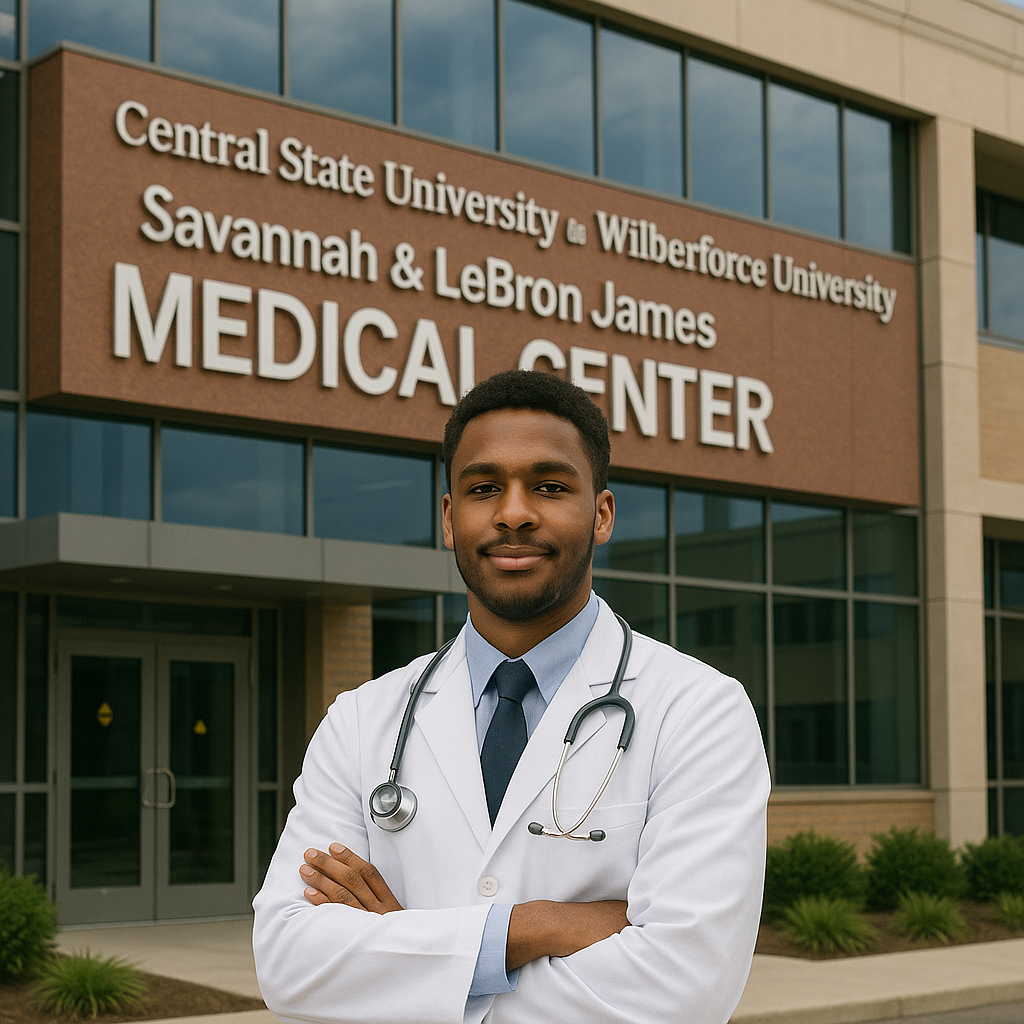
Now imagine a future where LeBron and Savannah James decide to reshape the health destiny of Black Ohio not just through education, but through medicine. In partnership with Central State University and Wilberforce University, the James family announces the creation of the Savannah & LeBron James Medical Center, a state-of-the-art teaching and research hospital in Dayton, Ohio. The hospital would be co-owned by the two HBCUs, offering an unprecedented model of HBCU institutional control and healthcare delivery.

At its helm? Dr. Bronny James, a board-certified trauma surgeon and hospital executive, returned from medical training with a mission not just to serve, but to system-build. Through a strategic pipeline, students from the I PROMISE School in Akron, established by the James family, would be funneled into dual-admissions programs at Wilberforce and Central State, beginning in middle school. African American students interested in health sciences would receive mentorship, MCAT preparation, research internships, and full scholarships in exchange for a five-year service commitment at the hospital.

The hospital would:

  • Serve as a Level 1 trauma center for the Midwest Black Belt.
  • Anchor a Black-owned HMO focused on preventive care and wellness.
  • House medical research departments focused on sickle cell, hypertension, and diabetes, disproportionately affecting Black populations.
  • Be staffed by a growing cadre of Black doctors, nurses, and technicians, trained from within the HBCU system.

It would be the first modern, Black-owned academic medical center in America in over a century.

Not just a facility but a movement.

HBCUs as Healthcare Engines

This is the next evolution for HBCUs. No longer content to only educate they must now employ, own, and lead. Currently, Meharry, Howard, and Morehouse are the most visible HBCU medical institutions, but they are not sufficient to serve a national population. HBCUs like Central State and Wilberforce can and should partner with philanthropists to enter the healthcare delivery space. Hospitals, urgent care clinics, dental schools, nursing programs—these are all industries HBCUs can lead, if given the capital and political will.

The Savannah & LeBron James Medical Center would become a model for how celebrity philanthropy can shift from access to ownership. The James family has built schools. Now they can build systems. Systems that outlast careers. Systems that create intergenerational empowerment. And Dr. Bronny James? He would not just be a doctor. He would be a symbol of new possibilities.

Culture, Media, and The Battle for Imagination

The Bronny we know exists because the culture invested in him—from trainers to scouts to sports media coverage. But imagine if that same investment were redirected into medicine.

What if:

  • ESPN tracked the top Black high school biology students?
  • SpringHill Company aired a documentary series on Black med students at HBCUs?
  • Nike sponsored lab coats instead of just sneakers?

Culture tells children what to value. The question is whether we value Black intellect enough to mass-produce it.

Father–Son Legacy: A New Kind of First

LeBron and Bronny made history as the NBA’s first active father-son duo. But what if they made history again this time as a father-son pair who reshaped African American health care? Imagine LeBron standing beside Bronny at the ribbon-cutting of the James Medical Center. One created legacy through sport. The other, through healing. That is a legacy few families could rival. That is the kind of dynasty African America needs now.

Final Thoughts: From Possibility to Policy

“What if Bronny James were a doctor?” is no longer a question about a single person. It is a challenge to families, schools, HBCUs, and philanthropists. It is a policy challenge: to build educational pipelines, mentorship structures, and HBCU-led medical institutions that keep Black talent from slipping through the cracks. It is a cultural challenge: to celebrate and invest in intellect and professionalism with the same intensity we invest in athletics. It is a power challenge: to shift from participation to ownership in one of the most critical sectors of our economy health care. The original article asked the question. Now, let us answer it—with vision, capital, and courage. Because if Bronny James were a doctor—and led a Black-owned hospital rooted in HBCU strength we would not just be saving lives.

We would be saving futures.
$6 Million Donation to University of the Virgin Islands Will Create First Public HBCU Medical School

“The human body experiences a powerful gravitational pull in the direction of hope. That is why the patient’s hopes are the physician’s secret weapon. They are the hidden ingredients in any prescription.” – Norman Cousins

The University of the Virgin Islands simply continues to impress. The HBCU that few people know or talk about as an HBCU keeps its head down and continues the vital work of African Diaspora building. In recent years, UVI has seen a meteoric rise into HBCU Money’s Top Ten HBCU Endowments seemingly out of nowhere. This time the University of the Virgin Islands leads once again showing the constitution of action and strategic planning with the creation of the HBCU Diaspora’s fifth medical school and first ever public medical school. The latter being long overdue.

While it would have been preferable that the medical school bear the name of a historical figure of African descent, Ianthe Blyden or Myrah Keating Smith, two Virgin Islander nurses who were renowned for their healthcare work. Instead, it appears the medical school will retain the name of its financial benefactor, Donald Sussman. Mr. Sussman, according to UVI’s press release, “the founder of Paloma Partners, was a member of the UVI Board of Trustees from 2008 to 2012.”

The public HBCU medical school’s importance can not be overstated. Public institutions represent a way for a group to extract their economic interest from an overall pool of funds that citizens pay into. In other words, Citizen A pays their taxes into an overall pool of taxes, politicians then decide how those funds will be disbursed to the public institutions representing the different interest of the citizenry. The problem that has plagued the interests of African Americans is that we pay into the system, but rarely have public institutions that are able to leverage pulling out funds from the pool to meet our social and economic needs. In this case, that social need is a vast investment in our health outcomes. UVI’s medical school will allow African Americans a significantly more affordable route to the community’s production of medical doctors and health professionals than can currently be offered by private institutions. That is because public institutions, through that tax pool, are able to subsidize the cost of the education they are providing. The lack of a public HBCU medical school has meant that many African American doctors are often forced to go after hospital positions that are well paid and more likely to cater to non-African American patients or medical facilities upon finishing medical school. Community health clinics become out of the question with six-figure student loan debts.

How dire is the situation for African American doctors and health professionals? Asian Americans have 1 doctor for every 117 people in its population, European Americans have 1 doctor for every 457 people in its population, and African Americans have 1 doctor for every 914 people in its population. Institutionally speaking, there is only one African American owned hospital left as well, run and operated by Howard University.

There is an over 25 percent greater chance if you are African American ages 18-49 that you will not see a doctor because of costs to our white counterparts and a 50 percent chance if you are 50-64 that you will not see a doctor because of cost compared to our white counterparts according to statistics gathered by the American Community Survey from 2014. It is without a doubt that the COVID-19 Pandemic and Recession has probably only exacerbated those statistics. With other factors impacting African American health such as unemployment which means no insurance, poverty, no home ownership, and more, one could argue that African America has been in a health crisis and in order to stop the proverbial “bleeding” then we need to address a severe shortage in doctors and nurses coming from our community. The new medical school at UVI will go a long way in doing just that.

HBCUs medical schools, however, must connect themselves more strongly to HBCU undergraduate pipelines to ensure the best of the best from our institutions remain within our institutional ecosystem. It would not hurt to develop a Pre-K to Medical School strategy either. This means that HBCU alumni from all institutions must support more endowed scholarships at these HBCU medical schools for HBCU undergraduates looking to go to medical school. It also means that we can not rest simply on having one public HBCU medical school. We need others, expeditiously. The building of a global Pan-African health system that is centric to our needs is something we need more of – again, expeditiously. The creation of HBCU medical schools will go a long way into the formation of doing our part in accomplishing that. Let us hope it is not another 55 years before the next one is created, but for now let us celebrate and support the wonderful accomplishment of our brothers and sisters at University of the Virgin Islands.

What If LeBron James Were A Doctor?

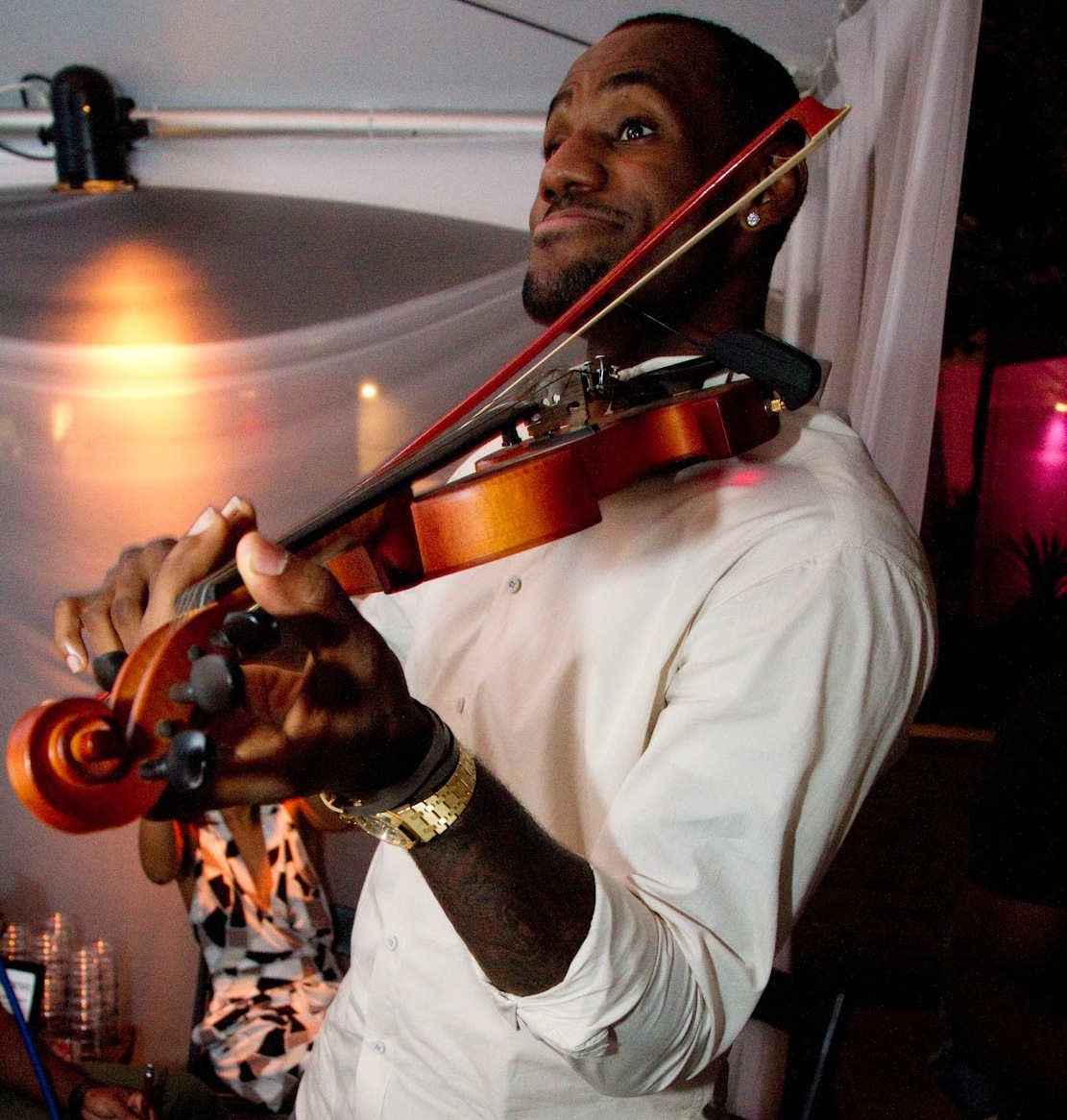
LeBron and Chris playing violin and singing.

The saddest thing in life is wasted talent. – Lorenzo Anello

Somewhere in an alternative universe a call goes out over the hospital intercom, “Paging Dr. James! Dr. James to operating room, please.” Into the operating room walks a 6’8 250 pound surgeon African American man who smiles at his surgical team, but sternly ask, “Has the patient been prepped?” The staff acknowledges to the doctor the patient has and thus the operation begins. For the next few hours it is a battle of skill, touch, and finesse. With nerves of steel it all comes down to a final cut. The doctor steps back, takes a deep breath, and goes in for the final incision. Success! The patient is responding  better than expected and the surgeon leaves the room to debrief the family. As he speaks with the family cheers and tears of rejoicing come from the crowd of family and friends gathered.

There are currently 5,005 and 1,015 African American males on college football and basketball Division 1 rosters on any given year, respectively. That means every year over 6,000 African American males believe either in the coming year or in a few years they will be eligible to become a professional athlete. The NCAA itself reports that only 1.7 percent of college football players will go on to play professionally and 1.2 percent of college basketball players will go to the NBA, respectively. That means that in any given year out of those 6,000 plus athletes, less than 100 will actually go pro. However, speaking with an ambassador at a local Division 1 program with around 100 players on their football roster just how many of his players believe they can go pro – he said at least half. Inquiring further how many really have a chance and he said maybe two. How can there be such a gulf between those two viewpoints? Warren Goldstein’s examination of William Rhoden’s book $40 Million Dollar Slaves offers us some insight, “Consequently, most black athletes lost their connection to a “sense of mission . . . of being part of a larger cause. Young athletes, in particular, dropped the thread that joins them to that struggle and became, instead, a “lost tribe,” adrift in the world of white coaches, boosters, agents, club officials, network executives — those profiting from black muscle and skill.”

African America is desperately in need of more doctors. The Agency for Healthcare Research and Quality reports there are 209,000 primary care physicians in the United States, but only 3.9 percent of that number are African American or a pinch over 8,000. An article in the Philadelphia Tribune reports, “Studies also indicate that when minority patients can select a health care professional, they are more likely to choose someone of their own racial and ethnic background.” That means at current, there is 1 African American physician for every 4,938 African Americans, but the nation as a whole has 1 physician for every 1,435 citizens in the United States. In order for African American to reach the national average, there would need to be an increase in the number of African American physicians by over 300 percent. The state of African American males in the medical field is even more acute according to the Journal of Blacks in Higher Education who recently reported, “A new report from the Association of American Medical Colleges (AAMC) finds that the number of Black males who are applying to medical school has not increased since 1978. In 1978, 1,410 Black males applied to U.S. medical schools. In 2014, the figure was 1,337. In 1978, 542 Black men matriculated at U.S. medical schools, compared to 515 in 2014.”

Unfortunately, basketball and football often detour thousands of African American males (those who do manage to escape prison) from childhood where they are warped early with promises of fame and riches with even the slightest hint of athleticism. This is not to say sports can not be a valuable part of a boys’ upbringing, but we have made it their central and primary focal point. With only 2,000 available slots to fill out all NFL and NBA rosters and even with turnover the odds of these young men finding their way onto one is virtually null. However, primary care physicians and dentist comprise 350 000 positions in the country combined and unlike athletics which is not expanding its rosters or number of teams, there is actually a growing demand for more doctors and dentist in the country. As for the pay, pro-rated until age 65, an NFL player makes a median salary of $34,200 and a NBA players makes a median salary of $144,000, while a primary care physician’s median salary is $220,000. And the economic cost to the community because of the physician shortage is $4.4 billion annually in just lost opportunity wages alone. Not including the lost wages our community suffers due to illness and poor access to primary physicians. Health is wealth takes on whole new meanings.

And it is not just the medical field that is suffering from this brain dumbing (drain). At a time when there is an acute need for Civil Rights lawyers’ in African America along with entrepreneurs, farmers, technologist, psychologist, and even those who can fill a myriad of new green vocational and professional jobs on the horizon, we are ghastly underrepresented in matters of the mind and overrepresented in matters of the body. Claims that the K-12 system fails these young boys would be correct, but then again so do the parents who are largely force their sons down these paths as they too believe it is the only option. 247Sports reports, “For the typical (AAU) program that is traveling to two national tournaments and one regional tournaments the costs end up being (approximately) $1,500-$2,000 per player.” Imagine if you will though that same $1,500-$2,000 per player being spent was on supplemental education for the boys in academic development. The current public elementary and secondary spending per student in the United States is $12,401. The use of the amount spent on them traveling alone if diverted to the aforementioned supplemental education would be an increase of 12 to 16 percent in the value of the education they receive annually and may have a significant impact on increasing the abysmal high school graduation rate for African American males which is currently 59 percent. We may not have an abundance of resources, but there needs to be a discussion and critique of how we are using what we have.

The repercussions of the dumbing down of African American males is already being felt through the social fabric of our communities. African America is the only ethnicity where females outnumber males in employment. This has consequences as it relates to marriage, crime, and a host of other social issues, but we are not paying attention to the damage we are doing to our boys often until it is too late. We are hypnotized by the LeBron Jameses as being the rule for our boys instead of realizing the exception. That most of these young men with athletic aspirations will never see a professional athlete’s paycheck and if they do the career’s are often short and communal impact is zero. We can kid ourselves into thinking that these athletes bring something to our community of value, but it is just entertainment and disillusioned opportunity. Nothing more and nothing less. Meanwhile, what happens to the thousands who do not make it, who lack the skills to do anything meaningful and substantive, to become a valuable asset to the social, economic, and political fabric of the building of African America. They fall by the wayside and we pay the brutal cost as a people, but are we not entertained?

For the same amount of money we dedicate to Pop Warner athletics, if we just took half of it and put it toward “Pop Warner” academics, STEM camps, chess clubs, and other initiatives that made little black boys feel that we value their minds just as much as their bodies we would see a paradigm shift in a generation. We lay so much blame on “others” for what is happening to our boys and take very little ownership or onus on ourselves for what is happening to them. Pimping them out for decades of their life with the hope of lottery style “winnings” instead of sustainable life and community development, then look perplexed when they and our communities lack the basic infrastructure to become viable. A wise man once said never put your destiny in the hands of others, yet we continue to do so at the expense of these young boys. We maybe entertained, but we are certainly not fulfilled.