
HBCU Medical Schools Lead Gifts Of $1 Million Or More To HBCUs in 2015

If you have something to give, give it now. – Mark Bezos

020214 hank aaron CC1

After only one donation of $1 million or more to HBCU in s 2013, in 2014 HBCUs landed an astounding nine, but the upward trend was not to continue. In 2015, HBCUs landed just four of the 530 donations that were of $1 million or more that found there way to American colleges and universities. That equates to 0.75 percent, while HBCUs constitute approximately three percent of the country’s higher education institutions. The nine donations in 2014 were a combined $20.5 million, while 2015’s foursome combined for $7 million.

Leading this year’s donors was Hammerin’ Hank Aaron with a donation of $3 million to the Morehouse School of Medicine. The baseball legend’s donation according to the press release by the school, “will be used to expand the Hugh Gloster Medical Education building and create the Billye Suber Aaron Student Pavilion.” However, the wealthiest donor among the group was billionaire Bill Gross, co-founder of the PIMCO investment firm with $1.5 trillion in assets under management, and his wife. Their donation was second among the group with a $2 million gift to Charles Drew University of Medicine & Science. HBCU medical schools are leaders within the HBCU research community constituting three of the top ten HBCU research institutions. These donations should only strengthen that resolve.

With African American owned banks seeing a huge engagement in 2016, it is possible that this may translate to institutional investments for HBCUs if the seeds of current sentiment are nurtured by leadership. This is an opportunity that HBCUs simply can not afford to miss, both financially and socially. Especially considering the higher education arms race for donors and the top four HWCU/PWI donations totaling $950 million in 2015. Building relationships with African American athletes and entertainers as donors as well as looking abroad in the African Diaspora would greatly increase the possibility of landing more of the eight and nine figure donations that are desperately needed.

The growth in the number of $1 million or more donations is a positive if it continues, but the amounts as well need to see dramatic increases as well for us to make sure our institutions are viable for generations to come.

1. Hank Aaron – $3 Million
Recipient: Morehouse School of Medicine
Source of Wealth: Transportation

2. William H. & Sue Gross – $2 Million
Recipient: Charles Drew University of Medicine & Science
Source of Wealth: Finance, Investments

3. Charles Barkley – $1 Million                                                                     Recipient: Morehouse College
Source of Wealth: Entertainment

4. Jimmie Edwards – $1 Million                                                                          Recipient: Dillard University
Source of Wealth: Chemicals

Source: The Center for Philanthropy
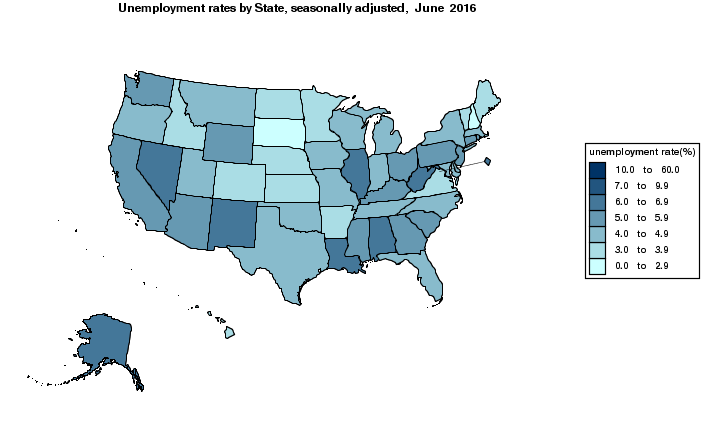
Unemployment Rate By HBCU State – June 2016

Screen Shot 2016-08-12 at 5.15.14 PM

STATES WITH RISING UNEMPLOYMENT: 7

STATES WITH DECLINING UNEMPLOYMENT: 12

STATES WITH UNCHANGED UNEMPLOYMENT: 5

LOWEST: VIRGINIA – 3.7%

HIGHEST – ILLINOIS & LOUISIANA – 6.2%

STATE – UNEMPLOYMENT RATE (PREVIOUS)*

ALABAMA –  6.0% (6.1%)

ARKANSAS – 3.8% (3.8%)

CALIFORNIA – 5.4% (5.2%)

DELAWARE – 4.2% (4.1%)

DISTRICT OF COLUMBIA – 6.0% (6.1%)

FLORIDA – 4.7% (4.7%)

GEORGIA – 5.1% (5.3%)

ILLINOIS – 6.2% (6.4%)

KENTUCKY – 5.0% (5.1%)

LOUISIANA – 6.2% (6.3%)

MARYLAND – 4.3% (4.5%)

MASSACHUSETTS – 4.2% (4.2%)

MICHIGAN – 4.6% (4.7%)

MISSISSIPPI – 5.9% (5.8%)

MISSOURI –  4.5% (4.3%)

NEW YORK – 4.7% (4.7%)

NORTH CAROLINA – 4.9% (5.1%)

OHIO – 5.0% (5.1%)

OKLAHOMA – 4.8% (4.7%)

PENNSYLVANIA – 5.6% (5.5%)

SOUTH CAROLINA – 5.4% (5.6%)

TENNESSEE – 4.1% (4.1%)

TEXAS – 4.5% (4.4%)

VIRGINIA – 3.7% (3.8%)

*Previous month in parentheses.

HBCU Money™ Business Book Feature – The Foundation: A Great American Secret

bookcover

Private foundations have been the dynamo of social change since their invention at the beginning of the last century. Yet just over 10 percent of the public knows they even exist; and for those who are aware of them, as well as even those who seek grants from them, their internal workings remain a complete mystery. Joel Fleishman knows the sector like few others, and in this groundbreaking book he explains both the history of foundations—with their fledgling beginnings in the era of the robber barons seeking social respectability—through to the present day. This book shows how, why foundations matters, and how the future of foundations can provide a vital spur to the engine of the American, and the world’s, economy—if they are properly established and run.

The HBCU Money™ Weekly Market Watch

Our Money Matters /\ August 12, 2016

A weekly snapshot of African American owned public companies and HBCU Money™ tracked African stock exchanges.

NAME TICKER PRICE (GAIN/LOSS %)

African American Publicly Traded Companies

Citizens Bancshares Georgia (CZBS) $7.15 (0.00% UNCH)

M&F Bancorp (MFBP) $3.02 (0.00% UNCH)

Broadway Financial Corporation (BYFC) $1.78 (1.11% DN)

Radio One (ROIA) $3.29 (2.95% DN)

African ETFs

Global X MSCI Nigeria (NGE) $4.43 (0.67% DN)

Market Vectors Africa (AFK) $21.16 (0.14% DN)

African Stock Exchanges

Bourse Regionale des Valeurs Mobilieres (BRVM)  285.79 (0.13% UP)

Botswana Stock Exchange (BSE)  9 597.26 (0.54% DN)

Ghana Stock Exchange (GSE)  1 807.71 (9.38% DN)*

Nairobi Stock Exchange (NSE)  143.86 (N/A)

Johannesburg Stock Exchange (JSE) 52 806.50 (0.93% UP)

International Stock Exchanges

New York Stock Exchange (NYSE) 10 812.30 (0.22% DN)

London Stock Exchange (LSE)  3 762.03 (0.13% UP)

Tokyo Stock Exchange (TOPIX)  1 323.22 (0.64% UP)

Commodities

Screen Shot 2016-08-12 at 1.36.20 PM

African America’s July Jobs Report – 8.4%

jobs

Overall Unemployment: 4.9% (4.9%)

African America Unemployment: 8.4% (8.6%)

Latino America Unemployment: 5.4% (5.8%)

European America Unemployment: 4.3% (4.4%)

Asian America Unemployment: 3.8% (3.5%)

Previous month in parentheses.

Analysis: Overall unemployment was unchanged. All groups except Asian America saw a decline in their unemployment rate, who saw a 30 basis point increase in their unemployment rate. Latino America led the way with the largest decrease of 40 basis points, followed by African America’s 20 basis points, and lastly, European America’s 10 basis points.

African American Male Unemployment: 8.2% (8.2%)

African American Female Unemployment: 7.3% (7.3%)

African American Teenage Unemployment: 25.7% (31.2%)

African American Male Participation: 67.7% (67.8%)

African American Female Participation: 61.0% (60.9%)

African American Teenage Participation: 27.7% (29.2%)

Analysis: African American men unemployment rate was unchanged, with 10 basis point decrease in their participation rate. African American women unemployment rate was also unchanged, but a 10 basis point increase in their participation rate. African American teenagers had an decrease of 550 basis points in their unemployment rate, but had a worrisome 150 basis point decrease in their participation rate.

CONCLUSION: The overall economy added 255 000 jobs in July. African America added only 31 000 jobs in July, a decline from June’s AAJR of 32 000. Again, two straight months of anemic jobs growth for African America after adding 122 000 jobs in May. However, these figures are in line with traditional jobs growth for African America, while May was an anomaly. If there is a current silver lining for African America, it is our banking industry. With an explosion in new deposits and demand for even more new deposits, African American owned banks and credit unions could see a need to increase employment to handle the new demand. That is the short term optimism, while the long term gain could be in new lending for African American small businesses.

African America currently needs 680 000 jobs to match America’s unemployment rate.