
Three Terms Hindering Africa America’s Institutional Development: Affirmative Action, Diversity, & Minority

By William A. Foster, IV

“All cruel people describe themselves as paragons of frankness.” – Tennessee Williams

This article will probably get me in trouble with the politically correct police and let’s all hold hands and get along crowd who typically have an idealistic view that all the resources in the world can magically be distributed evenly across all populations. However, truth is truth especially as it pertains to social, economic, and political (SEP) interest and until we have their idealistic world we have to consider that groups will continue to battle over power to control the resources much like what happens with every one of God’s other creations – imagine that. SEP interest drives every group’s institutional and individual decision-making except for one – African Americans. African America continues to chase the ever elusive ghost of assimilation and inclusion into the (European) American Dream to the expense of its own power. Below are the three terms that to me psychologically have and continue hamper our development and why.

Affirmative Action

Simply put this has been one of the most damaging policies toward a stronger African-American institutional power development. Affirmative Action was a bill pushed for by certain Civil Rights Movement (CRM) groups and was signed into law by Lyndon B. Johnson in 1965. It owes its roots to desegregation and the court case Brown v. Board of Education of Topeka, KS in 1954.

Desegregation’s ultimate culmination into the affirmative action law was all but the signature that wiped out African-American institutional development. Prior, we built towns such as “Black Wall Street” in Tulsa, OK and Rosewood, FL and countless self-sufficient African-American towns. These towns would be torn apart ultimately because of our lack of ability to obtain political retribution for social and economic attacks against us which is where the aim of the CRM should have been. Instead, a movement within the CRM decided that equality meant to be assimilated into European American owned and controlled institutions. We would all but abandon towns which we built, businesses we started, and colleges that were founded for our interest and then begin to define success not by what we owned or controlled anymore but by being the “first” to break through into institutions where we weren’t wanted and out flanked socially, economically, and politically. Despite an understanding that in capitalism the ultimate power lies in what you control directly or indirectly and what you own.

Today, less than 15% of African-Americans who can go to college attend HBCUs despite the institutional implications that a college and university can bring to a community as noted in The University of Power & Wealth. “Success” is defined as moving out of our neighborhoods and then we wonder why our elementary and secondary schools are weak. They are weak because the demand that drives home values up which in turn increases the amount of taxes available to fund our schools and then allows them to develop and pay quality teachers was abandoned so that we could live in a “good” neighborhood. The educated and professionals instead of being a permanent presence in the community for children to see (positive social capital) instead leave children to look up to those hanging on the corner (negative social capital). It use to be that our doctors, teachers, and other professionals lived in the community and therefore set the barometer of that community. Yet, we’ll claim they can find role models or they should seek out mentoring programs missing the point of setting the rule in a community for kids instead of hoping they’ll find a way to be the exception. Before affirmative action, we started companies like C.R. Patterson, the only African-American owned automobile manufacturing company. Now, most of define our success by the car we drive not the ones we build.

Minority

The problem for African America allowing itself to be labeled a minority are numerous but I’ll address specifically as it relates to economic policy and actions. In 2008, Dr. Verna Dauterive, alum of Wiley College, donated $25 million to the University of Southern California in memory of her late husband. The money would be used to fund a scholarship for minority students that pursued a doctorate in education. Who is a minority? The answer is simply anyone who is not a European-American male. That means the scholarships from that donation, at a school whose African-American population is not even five percent, never even have to be used for an African-American. It means that if USC so chose they could give that scholarship to anyone that’s not of African descent from here on out and they would be meeting the requirements of that donation. It should also be noted that USC has a $3.5 billion endowment while her undergraduate alma mater Wiley College has a reported $50 million endowment. To say the $25 million would have gone further at Wiley impacting African-Americans is without question.

Recently it was noted by Jarrett Carter, Editor of HBCU Digest, that many HBCUs lead their states in minority purchases. In fact, Prairie View A&M University, Mr. Carter noted leads the state of Texas with 38% of its contracts awarded to minority businesses. Again, it should be pointed out that does not mean $1 has to go to African-American businesses. As a former employee and graduate assistant at Prairie View A&M University it was not unusual for us to hear stories about European American families with businesses making the wife 51% owner of the business in order to access minority contracts. You have to love loopholes.

Diversity

Every year certain business magazines release “Most Diverse Companies” and they are always speaking of the labor that works for these major corporations. The reality is that while the labor might be diverse the ownership is still typically 99.9% European American. The current idea of diversity just means you were able to get the most talented of other groups to work for another group’s economic interest. Again, I can’t state enough that it is ownership who gets rewarded the most long-term not labor. We see this in college football where schools like the University of Texas have 50,000 students of which only 500 are African-American males and 50% of them are on the football or basketball team. A football team composed of almost 70% African-American males, and is the most profitable college football program in the United States. The profits then go into non-revenue athletic scholarships which are predominantly European American (see golf, softball, swimming, baseball, etc.), along with aiding research, faculty salaries, and much more. The 1% of the population with no SEP power at the university providing immensely to the 99% with all of the SEP power. Now that’s a change.

It is always important to note who is defining what. I always get annoyed by “diversity” often being hijacked and/or pigeon holed to only mean multiple cultures. Diversity is also always talked about from a European American majority. That is to say in a room of 10 people if you have 7 European Americans, 1 African-American, 1 Asian American, and 1 Latino American you have diversity. However, if you have 7 African-Americans, 1 European American, 1 Asian American, and 1 Latino American it is not perceived as diversity. This is the hurdle that HBCUs often face in perception by not only society as a whole but even sadder by African-Americans themselves. Every time a conversation about diversity comes up I have to point out there are a number of variables by which one can create a diverse setting beyond ancestry. If I have a room of eight people of African descent with two from Jamaica, two from Ghana, two from America, and two from Brazil and each of those two is a mixture of male/female then do I not have a diverse room? Yes, I do. I just happen to have one foundational link of ancestry. I can add variables such as but not limited to geographical upbringing, economic class, education, gender, etc. Just for the record HBCUs have always been willing to take poor and underserved European Americans and others. The reverse still is not true unless of course you can do something exceptional on a football field.

We must define things from our point of social, economic, and political interest and not just blindly follow someone else’s idea of what is “good” as their idea of “good” is always from their point of view and interest. I was on a radio show where one of the guests proclaimed to me that Martin Luther King, Jr. was fighting for our right to move into someone else’s neighborhood. A clear problem of what happens when you allow someone else to control your history. Even a man who screamed for our self-sufficiency as many seem to forget has had his image and message watered down over the years. In capitalism, everything is ownership or labor. This is neither good nor bad. It just is and we all know that knowing is half the battle.
HBCU Money™ B-School: Bond

A debt investment in which an investor loans money to an entity (corporate or governmental) that borrows the funds for a defined period of time at a fixed interest rate. Bonds are used by companies, municipalities, states and U.S. and foreign governments to finance a variety of projects and activities.

Bonds are commonly referred to as fixed-income securities and are one of the three main asset classes, along with stocks and cash equivalents.

The indebted entity (issuer) issues a bond that states the interest rate (coupon) that will be paid and when the loaned funds (bond principal) are to be returned (maturity date). Interest on bonds is usually paid every six months (semi-annually). The main categories of bonds are corporate bonds, municipal bonds, and U.S. Treasury bonds, notes and bills, which are collectively referred to as simply “Treasuries”.

Two features of a bond – credit quality and duration – are the principal determinants of a bond’s interest rate. Bond maturities range from a 90-day Treasury bill to a 30-year government bond. Corporate and municipals are typically in the three to 10-year range.

Learn more terms at http://www.investopedia.com/

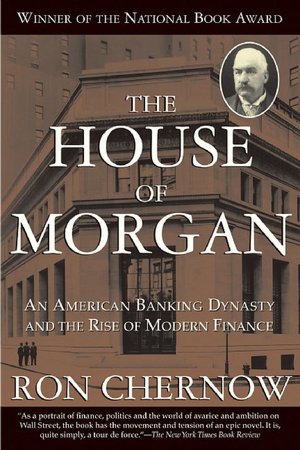
HBCU Money™ Business Book Feature – The House of Morgan: An American Banking Dynasty and the Rise of Modern Finance

The winner of the National Book Award and now considered a classic, The House of Morgan is the most ambitious history ever written about an American banking dynasty. Acclaimed by The Wall Street Journal as “brilliantly researched and written,” the book tells the rich, panoramic story of four generations of Morgans and the powerful, secretive firms they spawned. It is the definitive account of the rise of the modern financial world. A gripping history of banking and the booms and busts that shaped the world on both sides of the Atlantic, The House of Morgan traces the trajectory of the J. P. Morgan empire from its obscure beginnings in Victorian London to the crash of 1987. Ron Chernow paints a fascinating portrait of the private saga of the Morgans and the rarefied world of the American and British elite in which they moved. Based on extensive interviews and access to the family and business archives, The House of Morgan is an investigative masterpiece, a compelling account of a remarkable institution and the men who ran it, and an essential book for understanding the money and power behind the major historical events of the last 150 years.

HBCU Money™ B-School: Endowment

A financial asset donation made to a non-profit group or institution in the form of investment funds or other property that has a stated purpose at the bequest of the donor. Most endowments are designed to keep the principal amount intact while using the investment income from dividends for charitable efforts.

Endowments provide ongoing benefits for those that receive them by earning a market rate of interest while keeping the core endowment principal intact to fund future years of scholarships, or whatever efforts the donor sought to fund. In some cases, a certain percentage of the assets are allowed to be used each year, so the amount pulled out of the endowment could be a combination of interest income and principal. The ratio of principal to income would change year to year based on prevailing market rates.

Learn more terms at http://www.investopedia.com/

Dwayne Wayne And Ron Johnson Dropped The Ball – HBCUpreneurship

By William A. Foster, IV

The more an idea is developed, the more concise becomes its expression; the more a tree is pruned, the better is the fruit. — Alfred Bougeart

tumblr_m710k2fGEJ1qbrimro1_400

What if Sergey Brin and Larry page, founders of Google, went to Hillman? Would Google still have been created? Yes. Would they still become billionaires? Probably not. The two men combined are worth an estimated $37.4 billion. Their combined fortunes are greater than Harvard’s endowment, almost 30 times the size of all HBCU endowments, and over 90 times the size of all HBCU research expenditures combined. The last being vital because it was the very thing that allowed the two men, PhD research students at Stanford, to create the search engine that is now a verb. Instead, it could be argued they would end up creating a great new search engine and selling it for pennies on the dollar to Microsoft. Ensuring of course that whichever one (ended up being Dwayne) and wanted to work for said company would have secured themselves employment. Notice, I said very distinctly employment and not ownership.

It is in one of the final episodes of the legendary show “A Different World” Ron Johnson or Ron, the loveable sidekick and best friend of Dwayne Wayne, and ironically the one who has the most entrepreneurial spirit of all the characters on the show comes up with a video game concept that helps children learn. It is no coincidence that him growing up with a father who owned a car dealership inspires his constant risk taking, so the entrepreneurial bug pops up constantly throughout his time at Hillman. One of the more classic Ronpreneurial moments is when he and Mr. Gaines, who ran The Pit at the student center, purchase a nightclub together. An all too typical expression of African-American entrepreneurship and one that has little to no substantive impact. Dwayne Wayne on the other hand is the math genius who seems destined to “succeed” by programming amazing products for the likes of Kenishewa. In fact, in the episode this is exactly what happens as Dwayne takes Ron’s concept and uses his programming skills to bring the game to life. Dwayne tells Ron about bringing the concept to fruition and in the excitement Ron excitedly says “this could be the start of Wayne & Johnson”. For all of Dwayne Wayne’s brains his entrepreneurial IQ never got past zero. He never hesitated to cash in for the short-term payday, subsequently putting his friendship with Ron in jeopardy for not acknowledging it was his idea,  and never once thought about the long-term wealth and institutional impact their own company could have. The brains of these two men would have been the perfect balance that business relationships often need. Ron’s ability to create ideas, generate sales, and risk taking balanced with Dwayne’s ability to bring ideas to life, analytical strategy, and risk aversion would have made for an absolutely powerful business combo. Now, instead of this being the launching of a software company Dwayne Wayne runs with Ron’s concept develops it and simply sells it to Kenishewa and secures a job. Ownership? None. Paycheck? Sure. Bigger picture? Missed.

What could have been? One could ultimately imagine a very successful software company (See Google, Baby Einstein, Electronic Arts, or Microsoft) being born out of the Wayne & Johnson partnership. Years down the line Wayne & Johnson would be giving internships and employment opportunities for Hillman students and donating hundreds of millions back to Hillman for a new research facility, new stadium, higher faculty salaries, and scholarships to reduce Hillman student debt loads. Oh did I mention Wayne & Johnson becomes so successful that they end up acquiring Kenishewa?

No matter a student’s academic department at their HBCU there should be an entrepreneurship class specifically designed for their major and/or department that teaches them how to turn their major into a business that they can take back to our communities and build. From mathematics, engineers, psychology, and beyond every single major should be able to understand how to transform their entity into a business that they own and/or co-own. They should also be able know how to cross-pollinate with other majors. Biology major meets engineering major? What do they create? Behold a bioengineering firm. Mathematics meets sociology? I have no idea but the fact that the conversation is being had leads me to believe the brilliance in our students would come up with an answer and more important a company. We should not be producing labor but ownership as well from our institutions. Our HBCUs too often promote their “successful” students being those who go off and work for large European American companies (making their companies stronger and wealthier) while the masses of their students wait exorbitant amounts of time searching for employment hoping to become an affirmative action quota. It is ownership which will bring down our unemployment rate which is always double the national average, it will help close the wealth gap, provide the wealth to influence the political system in our favor instead of always begging for favor, and pump much-needed infrastructure capital back into our HBCUs and communities so we can compete. We know that when America catches a cold we catch pneumonia. If the latest AP report shows that 50% of recent graduates are unemployed or underemployed what do you think that number is for HBCU recent graduates? It is time for us to do for self as we know our ancestors did in places like Tulsa, Rosewood, and countless other African-American towns across this country. We can compete but we have to compete to be more than just labor. I’ve always said and continue to say capitalism doesn’t reward hard work. It rewards the ownership of hard workers.