
By William A. Foster, IV
“Power only steps back in the face of more power.” – Malcolm X
I always start with this example when discussing group power. Oprah Winfrey, who is roughly worth $2 billion, moves into a neighborhood of nine European Americans. Now for the sake of this example they could be Arab, Asian, Latino, or if you want to base it around gender with nine men and it would not change the dynamic and point. The neighborhood she moves into each household is worth $500 million and share the same fundamental and cultural values (social capital). Who has control of the neighborhood? Inevitably, because most people do not understand group dynamics and strategy they tend to assume Ms. Winfrey does. Let us examine why she does not from a SEP (social, economic, and political interest) point of view. Socially, she is the outsider who does not share the cultural or gender values of the group. This is not to say they have nothing in common but there are some fundamental differences that they differ on based on their social and cultural norms. Economically, from the outlook it seems as once again she is the winner. Wrong again, as the social values bind them it also binds their economics as a defense weapon against outsiders. In this case the nine households versus Ms. Winfrey equates to $4.5 billion against her $2 billion. Politically, it is pretty obvious to see she is at a loss. Any voting done on new neighborhood policies she would be outvoted 9-1 almost every time (see Supreme Court and party lines). This is not to imply these nine will always act in step. It is to say that the probability they do is highly increased in their favor and not in hers. Ultimately, that is what it is about. Ensuring the probability or odds are stacked in your favor for success whatever you deem that to be.
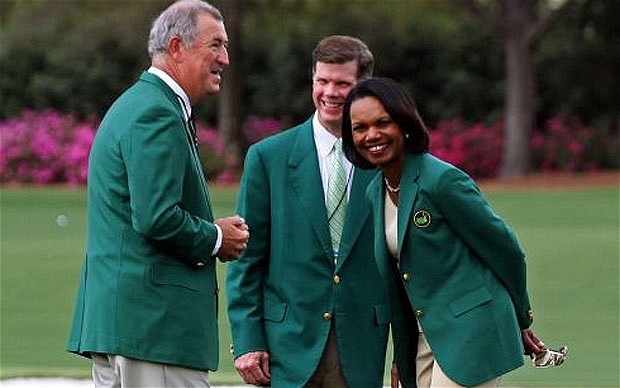
My views on Afrocentrism do not differ from my views on feminism. That is to say my view on any group that is seeking power will never gain the power it seeks if it is always seeking to force its way into institutions only to still be socially, economically, and politically outgunned as you saw in the example. Martha Burk would have you believe there was a victory in the admitting of two women at Augusta National Golf Club. I am going to examine the social, economic, and political realms as why I do not believe it is a victory and you can decide.
I have never believed in going anywhere I wasn’t wanted especially when I have the capacity to define where I want to go myself. The social implications of this situation didn’t empower women. It just re-validated that in order be of value you have to be where the men are. Are you still not giving the power to men? Yes, actually you are. If you wanted to impress upon the networking power that Augusta National Golf Club holds then these two women who were admitted would have said thank you but no thank you we can build our own. These women are going to socially be viewed as tokens that were admitted under public pressure and still will be social outsiders in the club. Just because you let someone in through the initial barrier does not mean you will not have different ways of excluding them. The beauty of protecting ones SEP interest is that as groups infringe on certain barriers you have created your strategy for creating new barriers evolves. I dare say the conversations that use to be had at the bar potentially now will only be had in the locker room. Are we to assume they will let the women in there as well? A more powerful statement would have been for young women to see those two women along with others in business form their own country club for women where they would be able to set the values of the club that promote the greatness of women in business and allow them to open networks with each other and discuss challenges as well as opportunities in industry amongst each other. To go even further would be a country club designed by a leading female architect, financed by a leading female banker, and anything else that would go into establishing of a place for women, built by women, and for women. What looks more powerful, two female members out of three hundred or three hundred out of three hundred and a foundation laid in every facet by women?
The economics of this admittance again we can examine the obvious. Dr. Condoleeza Rice is worth millions and Mrs. Darla Moore-Rainwater is worth based on her philanthropic donations in the hundreds of millions. Bill Gates and Warren Buffett who are members of Augusta are worth approximately a combined $100 billion. That’s just two of the two-hundred and ninety-eight men. Imagine now for a moment a golf club with the likes of Dr. Rice, Mrs. Moore-Rainwater, Sheryl Sandberg (COO of Facebook), Marissa Myers (CEO of Yahoo), Sheila Johnson (Co-Founder of BET), Linda Johnson-Rice (Owner of Johnson Publishing Company), and the list could go on and on. Now that is a room of economic might for women who dare I say would be able to make business deals among themselves and increasing the probability and opportunities for wealth into the arms of women. No separate locker room needed.
Politically this would boil down to the policies and outreach of the club. At current there is no LPGA Master’s Tournament. How hard do you think that would be able to get sponsored by a golf club that is socially and economically controlled by women? It would be like waking up in the morning and turning on the light switch. If you want it to be sponsored by the Augusta National Golf Club you would have to get 50% of the male membership to side with the two female members. Assuming they don’t feel socially pressured to not look like they are just voting for it because they are women. Now, where have I heard that accusation before? Again, if they control the club socially, economically, and politically nobody would question their motives because the motives are part of the very fabric of the club’s purpose.
As I stated in the beginning the unfortunate assumption that always kicking your way into an institution you would not have control over is somehow progress is missing the point of what capitalism is built on. Capitalism is built on ownership. As someone who has a teenage daughter I believe it is more powerful for her to see three hundred business women interacting with each other and making decisions in her interest than for her to see two women out of three hundred members where her interest for better or worse are marginalized. She no longer would feel like the odds are stacked against her. Success as a woman would be seen as the rule as opposed to the exception to it. She would know there is a place for her that doesn’t see her as a token they see her as just another businesswoman who is in the locker room headed out to the greens to network and maybe make the deal of the century. Tee-off ladies.


 HBCU Money