The HBCU Money™ Weekly Market Watch

Our Money Matters /\ January 25, 2013

NAME TICKER PRICE (GAIN/LOSS %)

African American Publicly Traded Companies

Citizens Bancshares Georgia (CZBS) $4.75 (UNCH)

Carver Bank New York (CARV) $4.21 (1.94% UP)

Radio One (ROIA) $1.25 (3.60% UP)

African Stock Exchanges

Bourse Regionale des Valeurs Mobilieres (BRVM)  172.43 (0.12% DN)

Botswana Stock Exchange (BSE)  7 655.99 (0.88% UP)

Ghana Stock Exchange (GSE)  1 254.68 (4.58% UP)*

Nairobi Stock Exchange (NSE)  103.03 (N/A)

Johannesburg Stock Exchange (JSE) 40 538.96 (0.16% DN)

International Stock Exchanges

New York Stock Exchange (NYSE) 8 879.79 (0.26% UP)

London Stock Exchange (LSE)  3 288.60 (0.17% UP)

Tokyo Stock Exchange (TOPIX)  917.09 (2.17% UP)

Commodities

Gold 1 660.60 (0.56% DN)

Oil 95.72 (0.24% DN)

*Ghana Stock Exchange shows current year to date movement. All others daily.

All quotes reported as of 12:00 PM Eastern Time Zone

African America’s Top 5 Highest Paid Media Personalities Of 2012

6a00d83451d69069e20133f2b15056970b-pi

How good is it to be the man with second ranked courtroom show and the longest running court show featuring an African American judge? It is good enough to ensure you make more money than the next 4 on our list combined. These 5 combine to bring in $34.5 million annually in salary and often have the ears and eyes of millions on a daily basis. A nice day’s work at the office – or in this case the studio.

1 – Judge Joe Brown (pictured above)

2012 Salary: $20 Million

Show: Judge Joe Brown Show

2 – Al Roker

2012 Salary: $7 Million

Show: NBC News

3 – Robin Roberts

2012 Salary: $6 Million

Show: ABC News

4 – Gayle King

2012 Salary: $2 Million

Show: CBS News

5 – Sherri Shepherd

Salary: $1.5 Million

Show: The View

Source: TV Guide; Daily Beast; Huffington Post

Mortgage Delinquency Rate Per HBCU State

From 2007 to 2009 there were 2 011 completed foreclosures per 10 000 loans. Of those 2 011 completed foreclosure, 40 percent were African Americans according to the Center for Responsible Lending. African America was second only to Latino America in terms of imminent risk of foreclosure with 21.4 percent and 21.6 percent, respectively, facing imminent foreclosure. Meanwhile, European and Asian America had 14.8 and 15.7 percent, respectively, facing imminent risk of foreclosure. Imminent risk is defined as borrowers who are two or more payments behind on their mortgage.

The Center for Responsible Lending also reports that the cost to the African American community between 2009-2012 due to foreclosures could be an estimated $194 billion. This is equivalent to an estimated 17.6 percent in value of African America’s current buying power for perspective. Below are the overall mortgage delinquency rates for each state that an HBCU is located in and not the mortgage delinquency rates for African Americans in that state.

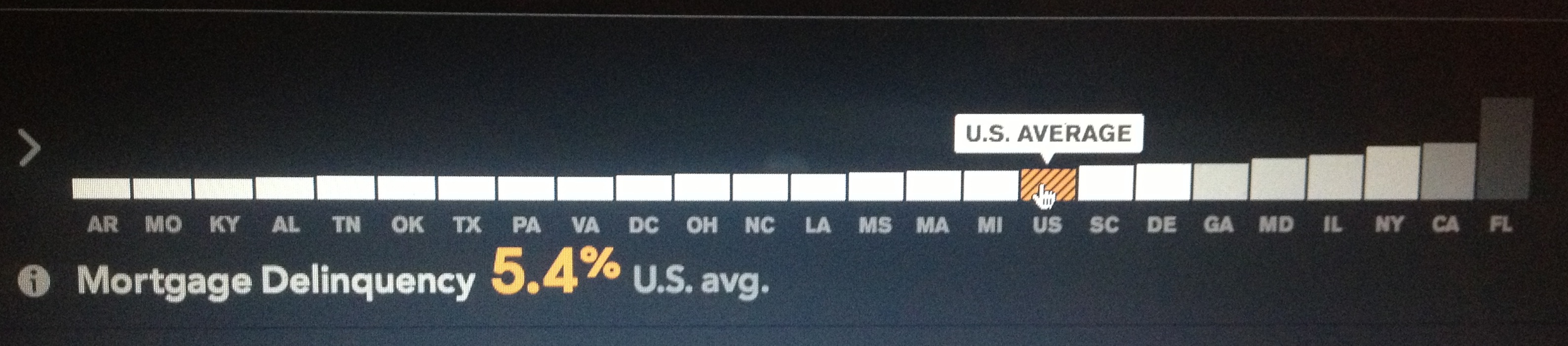
The overall mortgage delinquency rate has risen 54.3 percent from 2008 to 2012 (pictured below). 2008 showed only 10 of the 24 HBCU states and territory being below the national mortgage delinquency rate. 2012 shows 16 of the 24 HBCU states and territory below the national mortgage delinquency rate. South Carolina and Delaware saw rises of 85 percent and 83 percent in their mortgage delinquency rate, respectively, to lead the way in increases. No states saw declines.

morthbcu2008

December 2008

morthbcu

December 2012

STATE – MORTGAGE DELINQUENCY RATE December 2012 (2008)

Arkansas – 3.4% (2.5%)

Missouri – 3.4% (2.5%)

Kentucky – 3.4% (2.6%)

Alabama – 3.7% (2.7%)

Tennessee – 3.9% (2.6%)

Oklahoma – 3.9% (2.7%)

Texas – 4.0% (3.0%)

Pennsylvania – 4.0% (2.5%)

Virginia – 4.0% (3.5%)

Washington D.C. – 4.1% (2.6%)

Ohio – 4.5% (3.5%)

North Carolina – 4.6% (2.6%)

Louisiana – 4.7% (3.0%)

Mississippi – 4.8% (3.3%)

Massachusetts – 5.1% (3.8%)

Michigan – 5.3% (4.0%)

South Carolina – 6.1% (3.3%)

Delaware – 6.4% (3.5%)

Georgia – 6.6% (4.2%)

Maryland – 7.3% (4.9%)

Illinois – 7.9% (4.5%)

New York – 9.5% (5.3%)

California – 10.2% (7.7%)

Florida – 18.9% (12.4%)

Source: Bloomberg Visual Data; Center for Responsible Lending; HBCU Endowment Foundation

The HBCU Endowment Feature – Tennessee State University

Tennessee-State-University-30302E31

School Name: Tennessee State University

Median Cost of Attendance: $24 125

Undergraduate Population: 7 105

Endowment Needed: $3 428 162 560

Analysis: Tennessee State University needs approximately $3.4 billion to allow all of its students to attend debt free annually. The HBCU with the eight largest endowment going into 2012 is poised with new leadership at the helm – and fair or unfair some would say a continuing identity crisis. Leadership has challenged alumni chapters to raise what could be an estimated $3 million which could put Tennessee State University in striking distance of seventh place but would need to double its current endowment of $38 million to make a run at sixth place. Tennessee State University’s identity crisis seems to be an ongoing story leaving some to wonder can the university remain an HBCU or will it succumb to calls for “diversity” which most often end in gentrification or dilution of African American institutions. This is particularly true for a school like Tennessee State University where its European American population is already over 20 percent of the institution. A strategic problem when institutional concessions have to be made for a population whose social, wealth, and political power makes it the majority even in an institution where it is the “minority”. A conundrum worth watching. Historically, while European Americans have attended HBCUs it has been hard to identify them being consistent donors back to the institution in such a way that truly supports the HBCU mission of African American empowerment. Perhaps the new leadership at Tennessee State University has the magic sauce to unlock that door but if not danger looms for the university and its endowment. As the only public HBCU in Tennessee it would behoove the school to use that status to build its graduate school presence amongst the private HBCUs in Tennessee to increase its access to higher paid alumni over the long term. Ultimately, there is no reason Tennessee State University does not become a $50 million endowment within the decade especially given that it boast the second highest return on investment among the top ten HBCU endowments. The question of whether they can become a $100 million endowment lies largely in the school’s demographic makeup and what impact that will have on giving over the next ten years.

As always it should be noted that endowments provide a myriad of subsidies to the university for everything from scholarship, faculty & administration salaries, research, and much more.

HBCU Money™ Business Book Feature – Debt: The First 5,000 Years

debt

Before there was money, there was debt

Every economics textbook says the same thing: Money was invented to replace onerous and complicated barter systems—to relieve ancient people from having to haul their goods to market. The problem with this version of history? There’s not a shred of evidence to support it.

Here anthropologist David Graeber presents a stunning reversal of conventional wisdom. He shows that for more than 5,000 years, since the beginnings of the first agrarian empires, humans have used elaborate credit systems to buy and sell goods—that is, long before the invention of coins or cash. It is in this era, Graeber argues, that we also first encounter a society divided into debtors and creditors.

Graeber shows that arguments about debt and debt forgiveness have been at the center of political debates from Italy to China, as well as sparking innumerable insurrections. He also brilliantly demonstrates that the language of the ancient works of law and religion (words like “guilt,” “sin,” and “redemption”) derive in large part from ancient debates about debt, and shape even our most basic ideas of right and wrong. We are still fighting these battles today without knowing it.

Debt: The First 5,000 Years is a fascinating chronicle of this little known history—as well as how it has defined human history, and what it means for the credit crisis of the present day and the future of our economy.