
Category Archives: Lists

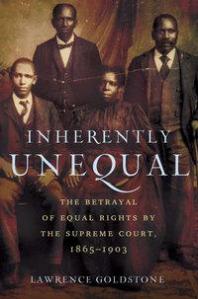
HBCU Money™ Business Book Feature – Inherently Unequal: The Betrayal of Equal Rights by the Supreme Court, 1865-1903

unequal

A potent and original examination of how the Supreme Court subverted justice and empowered the Jim Crow era.

In the years following the Civil War, the 13th Amendment abolished slavery; the 14th conferred citizenship and equal protection under the law to white and black; and the 15th gave black American males the right to vote. In 1875, the most comprehensive civil rights legislation in the nation’s history granted all Americans “the full and equal enjoyment” of public accommodations. Just eight years later, the Supreme Court, by an 8-1 vote, overturned the Civil Rights Act as unconstitutional and, in the process, disemboweled the equal protection provisions of the 14th Amendment. Using court records and accounts of the period, Lawrence Goldstone chronicles how “by the dawn of the 20th century the U.S. had become the nation of Jim Crow laws, quasi-slavery, and precisely the same two-tiered system of justice that had existed in the slave era.”

The very human story of how and why this happened make Inherently Unequal as important as it is provocative. Examining both celebrated decisions like Plessy v. Ferguson and those often overlooked, Goldstone demonstrates how the Supreme Court turned a blind eye to the obvious reality of racism, defending instead the business establishment and status quo–thereby legalizing the brutal prejudice that came to define the Jim Crow era.
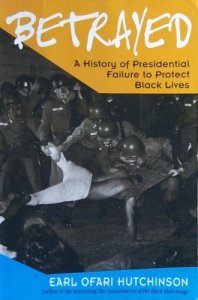
HBCU Money™ Business Book Feature – Betrayed: A History Of Presidential Failure To Protect Black Lives

betrayed

In this timely and eye-opening book, noted political analyst and media commentator Earl Ofari Hutchinson traces the root cause of the White House’s failure to protect the rights of African Americans. Drawing extensively from public and private presidential papers, private correspondence, personal interviews, and national archive documents, Hutchinson gives a rich historical account of the racial philosophy, policies, and practices of successive presidents from Warren G. Harding to Bill Clinton.Franklin D. Roosevelt is one example. The popular view is that Roosevelt was a friend to blacks because of his enactment of New Deal programs. But he was also a prisoner of the biased racial thinking of his times. He refused to actively support anti-lynching legislation and repeatedly curried political favor with racist southern Democrats.Lyndon B. Johnson is yet another example. He is known as a champion of civil rights, but Hutchinson details two crucial moments when Johnson shrank from using the full force of executive power to push Congress to enact new and tougher federal criminal civil rights statutes to punish racist violence.In this book, Hutchinson reveals that no American president has ever signed into law a federal antilynching bill despite a fifty-year campaign by the NAACP for presidential and congressional action. He documents how Nixon, Reagan, and Bush rolled back civil rights and affirmative action, failed to fully enforce equal protection provisions of the Fourteenth Amendment against police abuse and racial violence, encouraged conservative legal obstructionism, and fueled the rise of a repressive domestic security state. These actions in turn have reinforced institutionalized racism and continued the historical pattern of devaluing black lives in law and public policy.Finally, Hutchinson warns that the century-old failure by the White House to enforce federal law to protect black lives still has dangerous consequences for American society.

HBCU Money™ Business Book Feature – Breakpoint and Beyond: Mastering the Future Today

breakpoint

The founders of Leadership 2000, an international leadership development corporation whose clients include DuPont, IBM, 3M, and Sony, show how business professionals and organizations can adopt a new design for living in a dynamically changing world through new ways of creative thinking. 19 graphics.

HBCU Money™ Business Book Feature – Runaway America: Benjamin Franklin, Slavery, and the American Revolution

franklin

Scientist, abolitionist, revolutionary: that is the Benjamin Franklin we know and celebrate. To this description, the talented young historian David Waldstreicher shows we must add runaway, slave master, and empire builder. But Runaway America does much more than revise our image of a beloved founding father. Finding slavery at the center of Franklin’s life, Waldstreicher proves it was likewise central to the Revolution, America’s founding, and the very notion of freedom we associate with both.

Franklin was the sole Founding Father who was once owned by someone else and was among the few to derive his fortune from slavery. As an indentured servant, Franklin fled his master before his term was complete; as a struggling printer, he built a financial empire selling newspapers that not only advertised the goods of a slave economy (not to mention slaves) but also ran the notices that led to the recapture of runaway servants. Perhaps Waldstreicher’s greatest achievement is in showing that this was not an ironic outcome but a calculated one. America’s freedom, no less than Franklin’s, demanded that others forgo liberty.

Through the life of Franklin, Runaway America provides an original explanation to the paradox of American slavery and freedom.

HBCU Money™Business Book Feature – King of the Cats: The Life and Times of Adam Clayton Powell, Jr.

kingofthecats

Before Barack Obama, Colin Powell, and Martin Luther King, Jr., there was Adam Clayton Powell, Jr. — the most celebrated and controversial black politician of his generation. An astute businessman known as “Mr. Civil Rights,” he represented Harlem for twenty-four years in the House of Representatives. He was a man of the cloth and a civil rights leader, but Powell’s reputation for flamboyance, arrogance, and womanizing made him his own worst enemy. In this towering and definitive biography, acclaimed journalist Wil Haygood paints a vivid portrait of one of black America’s most memorable dignitaries.