Category Archives: Lists

HBCU Money™ B-School: How Is The Federal Reserve Board Selected?

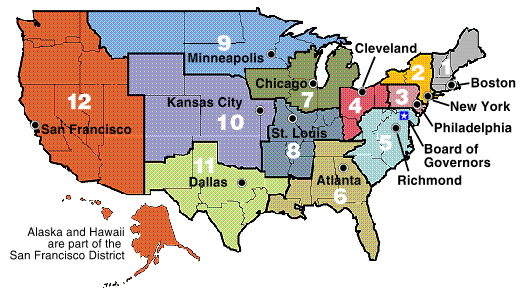
usmap3

Editor’s Note: There are HBCUs located in 11 of the 12 Federal Reserve Districts with the Minneapolis Federal Reserve District territory being the lone exception. Also, it should be noted that 8 of the 12 cities that house the primary headquarters of the respective Federal Reserve District have HBCUs in them with Cleveland, Kansas City, Minneapolis, and San Francisco being the exceptions.

The members of the Board of Governors are nominated by the President of the United States and confirmed by the U.S. Senate. By law, the appointments must yield a “fair representation of the financial, agricultural, industrial, and commercial interests and geographical divisions of the country,” and no two Governors may come from the same Federal Reserve District.

The full term of a Governor is 14 years; appointments are staggered so that one term expires on January 31 of each even-numbered year. A Governor who has served a full term may not be reappointed, but a Governor who was appointed to complete the balance of an unexpired term may be reappointed to a full 14-year term.

Once appointed, Governors may not be removed from office for their policy views. The lengthy terms and staggered appointments are intended to contribute to the insulation of the Board–and the Federal Reserve System as a whole–from day-to-day political pressures to which it might otherwise be subject.

In addition to serving as members of the Board, the Chairman and Vice Chairman of the Board serve terms of four years, and they may be reappointed to those roles and serve until their terms as Governors expire. The Chairman serves as public spokesperson and representative of the Board and manager of the Board’s staff. The Chairman also presides at Board meetings. Affirming the apolitical nature of the Board, recent Presidents of both major political parties have selected the same person as Board Chairman.

The Congress sets the salaries of the Board members. For 2012, the Chairman’s annual salary is $199,700. The annual salary of the other Board members (including the Vice Chairman) is $179,700.

Source: Federal Reserve

HBCU Money™ Business Book Feature – Financial Modeling

image001

Too often, finance courses stop short of making a connection between textbook finance and the problems of real-world business. Financial Modeling bridges this gap between theory and practice by providing a nuts-and-bolts guide to solving common financial models with spreadsheets. Simon Benninga takes the reader step by step through each model, showing how it can be solved using Microsoft Excel. The long-awaited third edition of this standard text maintains the “cookbook” features and Excel dependence that have made the first and second editions so popular. It also offers significant new material, with new chapters covering such topics as bank valuation, the Black-Litterman approach to portfolio optimization, Monte Carlo methods and their applications to option pricing, and using array functions and formulas. Other chapters, including those on basic financial calculations, portfolio models, calculating the variance-covariance matrix, and generating random numbers, have been revised, with many offering substantially new and improved material. Other areas covered include financial statement modeling, leasing, standard portfolio problems, value at risk (VaR), real options, duration and immunization, and term structure modeling. Technical chapters treat such topics as data tables, matrices, the Gauss-Seidel method, and tips for using Excel. The last section of the text covers the Visual Basic for Applications (VBA) techniques needed for the book. The accompanying CD contains Excel worksheets and solutions to end-of-chapter exercises.

HBCU Money™ Business Book Feature – Invisible Men: Mass Incarceration and the Myth of Black Progress

invisible-men-mass-incarceration-myth-black-progress-becky-pettit-hardcover-cover-art

For African American men without a high school diploma, being in prison or jail is more common than being employed–a sobering reality that calls into question post–Civil Rights era social gains. Nearly 70 percent of young black men will be imprisoned at some point in their lives, and poor black men with low levels of education make up a disproportionate share of incarcerated Americans. In Invisible Men, sociologist Becky Pettit demonstrates another vexing fact of mass incarceration: most national surveys do not account for prison inmates, a fact that results in a misrepresentation of U.S. political, economic, and social conditions in general and black progress in particular. Invisible Men provides an eye-opening examination of how mass incarceration has concealed decades of racial inequality.

Pettit marshals a wealth of evidence correlating the explosion in prison growth with the disappearance of millions of black men into the American penal system. She shows that, because prison inmates are not included in most survey data, statistics that seemed to indicate a narrowing black-white racial gap–on educational attainment, work force participation, and earnings–instead fail to capture persistent racial, economic, and social disadvantage among African Americans. Federal statistical agencies, including the U.S. Census Bureau, collect surprisingly little information about the incarcerated, and inmates are not included in household samples in national surveys. As a result, these men are invisible to most mainstream social institutions, lawmakers, and nearly all social science research that isn’t directly related to crime or criminal justice. Since merely being counted poses such a challenge, inmates’ lives including their family background, the communities they come from, or what happens to them after incarceration are even more rarely examined. And since correctional budgets provide primarily for housing and monitoring inmates, with little left over for job training or rehabilitation, a large population of young men are not only invisible to society while in prison but also ill-equipped to participate upon release.

Invisible Men provides a vital reality check for social researchers, lawmakers, and anyone who cares about racial equality. The book shows that more than a half century after the first civil rights legislation, the dismal fact of mass incarceration inflicts widespread and enduring damage by undermining the fair allocation of public resources and political representation, by depriving the children of inmates of their parents’ economic and emotional participation, and, ultimately, by concealing African American disadvantage from public view.

Becky Pettit is professor of sociology at the University of Washington.

HBCU Money™ Business Book Feature – An Economic Interpretation of the Constitution of the United States

images

A CONTROVERSIAL INTERPRETATION OF THE FOUNDERS INTENTIONS. Originally published: New York: The Macmillan Company, 1925. Beard’s interpretation proposes that the Framers of the Federal Constitution were motivated primarily by economic concerns. This argument was widely held until the late 1950s, when it was gradually undermined by later research, much of it stimulated by Beard’s work. Although most scholars today see the origins of the revolution in terms of the history of ideas, especially republicanism, Beard s work remains fundamental and has insured a continued focus on the economic aspect of the nation s establishment, as well as a wider awareness of the role of economic interests in history.

HBCU Money™ Business Book Feature – Beginner’s Guide to Creating Mobile Apps

Book_Coveramazon_copy.225x225-75

Beginner’s Guide to Creating Mobile Apps provides a one-stop repository with all of the information needed to successfully create and publish an iPhone/iPad and Android application to the App Store and Google Play.

Creating mobile applications is a great way to earn passive income, whether you are a stay-at-home parent, student, entrepreneur, or work in a traditional setting.

Several people have had the desire to create a mobile application based on a great idea, but never put action to it because of their lack of technical proficiency.

You do not need to be or become a technical expert in mobile development to create an application, and the author demonstrates how this can be accomplished step-by-step.

The author provides:

-Her experiences in developing her first application and pitfalls to avoid
-How to get established with Apple and Google
-How to choose the appropriate graphic design
-How to outsource the technical development and graphic design
-How to select a contractor
-A sample job announcement
-A sample non-disclosure agreement
-How to price and budget accordingly
-Recommended dos and don’ts
-Marketing tips