Category Archives: Lists

HBCU Money™ Business Book Feature – Age of Ambition: Chasing Fortune, Truth, and Faith in the New China

osnos age ambition

A vibrant, colorful, and revelatory inner history of China during a moment of profound transformation

From abroad, we often see China as a caricature: a nation of pragmatic plutocrats and ruthlessly dedicated students destined to rule the global economy—or an addled Goliath, riddled with corruption and on the edge of stagnation. What we don’t see is how both powerful and ordinary people are remaking their lives as their country dramatically changes.

As the Beijing correspondent for The New Yorker, Evan Osnos was on the ground in China for years, witness to profound political, economic, and cultural upheaval. In Age of Ambition, he describes the greatest collision taking place in that country: the clash between the rise of the individual and the Communist Party’s struggle to retain control. He asks probing questions: Why does a government with more success lifting people from poverty than any civilization in history choose to put strict restraints on freedom of expression? Why do millions of young Chinese professionals—fluent in English and devoted to Western pop culture—consider themselves “angry youth,” dedicated to resisting the West’s influence? How are Chinese from all strata finding meaning after two decades of the relentless pursuit of wealth?
Writing with great narrative verve and a keen sense of irony, Osnos follows the moving stories of everyday people and reveals life in the new China to be a battleground between aspiration and authoritarianism, in which only one can prevail.

HBCU Money™ Business Book Feature – The Richest Man In Babylon

1052

The Richest Man in Babylon : The Original Version, Restored and Revised
Travel back in time as George S. Clason takes you back to Babylon in his enlightening, insightful book on financial investment and fiscal success. The original version now restored and revised, this series of delightful short stories teaches economic tips and tools for financial success that have withstood the test of time and are applicable still today. Enjoy reading, and start saving today!

HBCU Money™ Business Book Feature – Another America: The Story of Liberia and the Former Slaves Who Ruled It

9780809095421_p0_v2_s260x420

The first popular history of the former American slaves who founded, ruled, and lost Africa’s first republic

In 1820, a group of about eighty African Americans reversed the course of history and sailed back to Africa, to a place they would name after liberty itself. They went under the banner of the American Colonization Society, a white philanthropic organization with a dual agenda: to rid America of its blacks, and to convert Africans to Christianity. The settlers staked out a beachhead; their numbers grew as more boats arrived; and after breaking free from their white overseers, they founded Liberia—Africa’s first black republic—in 1847.

James Ciment’s Another America is the first full account of this dramatic experiment. With empathy and a sharp eye for human foibles, Ciment reveals that the Americo-Liberians struggled to live up to their high ideals. They wrote a stirring Declaration of Independence but re-created the social order of antebellum Dixie, with themselves as the master caste. Building plantations, holding elegant soirees, and exploiting and even helping enslave the native Liberians, the persecuted became the persecutors—until a lowly native sergeant murdered their president in 1980, ending 133 years of Americo rule.

The rich cast of characters in Another America rivals that of any novel. We encounter Marcus Garvey, who coaxed his followers toward Liberia in the 1920s, and the rubber king Harvey Firestone, who built his empire on the backs of native Liberians. Among the Americoes themselves, we meet the brilliant intellectual Edward Blyden, one of the first black nationalists; the Baltimore-born explorer Benjamin Anderson, seeking a legendary city of gold in the Liberian hinterland; and President William Tubman, a descendant of Georgia slaves, whose economic policies brought Cadillacs to the streets of Monrovia, the Liberian capital. And then there are the natives, men like Joseph Samson, who was adopted by a prominent Americo family and later presided over the execution of his foster father during the 1980 coup.

In making Liberia, the Americoes transplanted the virtues and vices of their country of birth. The inspiring and troubled history they created is, to a remarkable degree, the mirror image of our own.

HBCU Money™ B-School: Lockup Agreements

By U.S. Securities & Exchange Commission

Lockup agreements prohibit company insiders—including employees, their friends and family, and venture capitalists—from selling their shares for a set period of time. In other words, the shares are “locked up.” Before a company goes public, the company and its underwriter typically enter into a lockup agreement to ensure that shares owned by these insiders don’t enter the public market too soon after the offering.

The terms of lockup agreements may vary, but most prevent insiders from selling their shares for 180 days. Lockups also may limit the number of shares that can be sold over a designated period of time. U.S. securities laws require a company using a lockup to disclose the terms in its registration documents, including its prospectus. Some states require lockup agreements under their “blue sky” laws.

If you are considering investing in a company that has recently conducted an initial public offering, you should determine whether the company has a lockup and when it expires. This is important information because a company’s stock price may drop in anticipation that locked up shares will be sold into the market when the lockup ends.

To find out whether a company has a lockup agreement, contact the company’s shareholder relations department to ask for its prospectus or obtain it online through the SEC’s EDGAR database. There are also free commercial websites that track when companies’ lockup agreements expire. The SEC does not endorse these websites and makes no representation about any of the information or services contained on these websites.

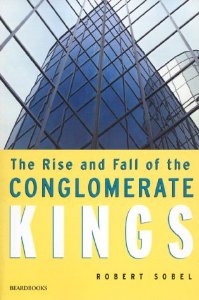
HBCU Money™ Business Book Feature – The Rise and Fall of the Conglomerate Kings

511ZRCPY08L._SY300_

This is the behind-the-scenes story of the financial wizards and bare-knuckled businessmen who created the conglomerates, the glamorous multi-form companies that marked the high noon of post-World War II American capitalism. Covering the period from the end of the war to 1983, Robert Sobel explains why and how the conglomerate movement originated, how it mushroomed, and what caused its startling and rapid decline.