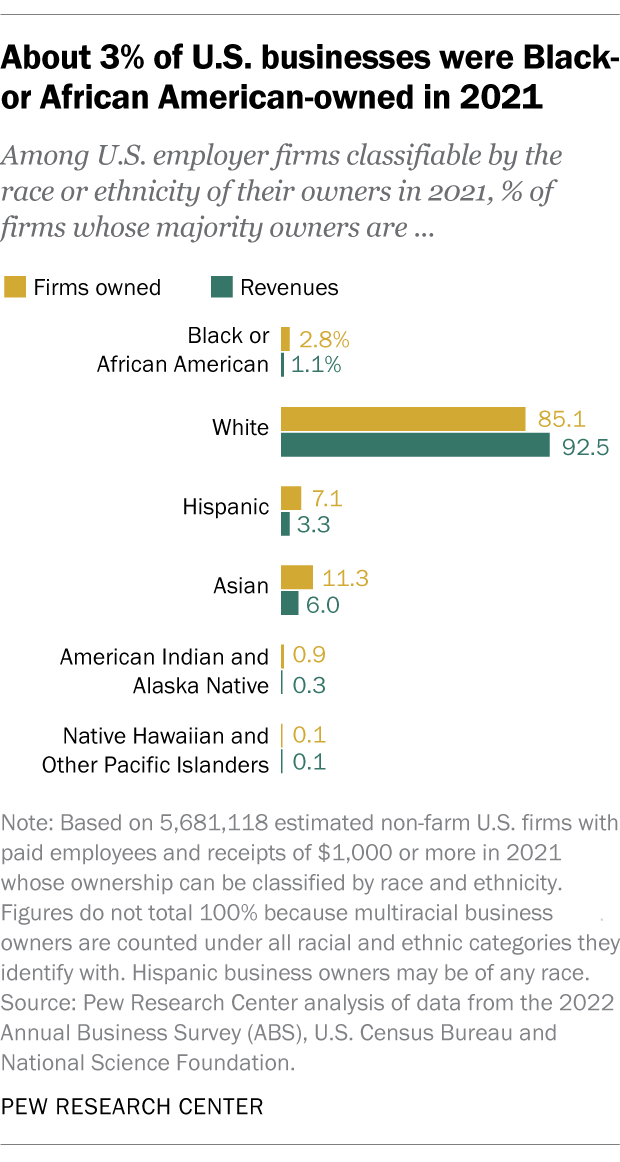
Pew Research Center highlights a look at the 161,031 U.S. firms with majority African American ownership as of 2021. Below are a few of the highlighted graphs that Pew Research showed in their report with HBCU Money commentary.
According to the SBA there were approximately 3.2 million African American-owned businesses as of 2018, but that is just the top layer. When you dig into the numbers by the Census of how many of those 3.2 million African American-owned businesses actually have paid employees and receipts exceeding $1,000 that number plummets to the previously mentioned 161,031 or only 5 percent of total African American-owned businesses.
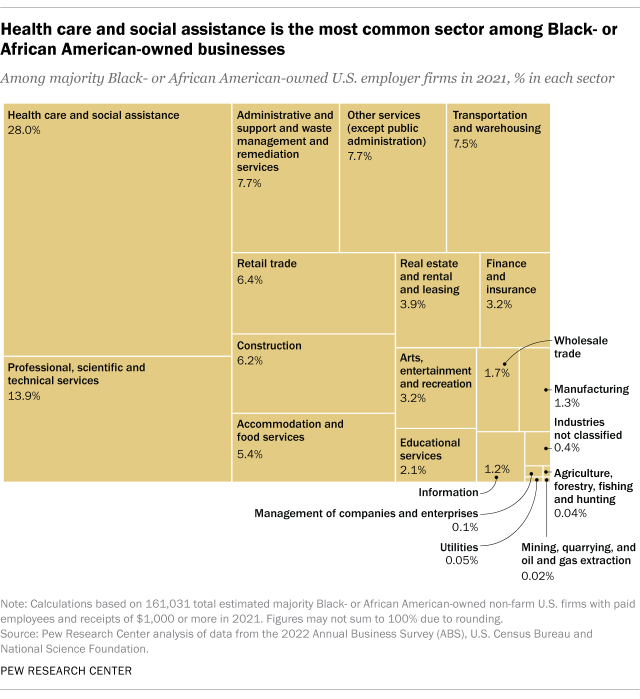
African American businesses are highly concentrated in health care and social assistance. Businesses that often have low scale potential and high risk often times due their clients being predominantly African American and higher probability of being uninsured. Where are the African American-owned energy companies? Manufacturing companies? Multinational firms? These are the questions that need to be asked, considered, and discussed by HBCU business schools and African American organizations like the HBCU Chamber of Commerce.
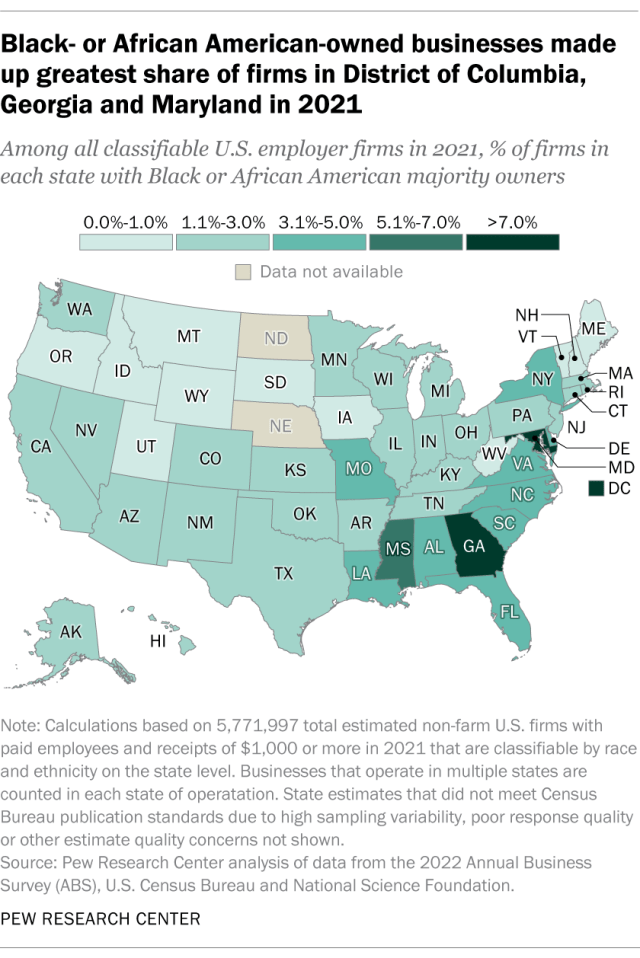
It is no surprise that the highest concentration of African American-owned businesses are in locations with higher African American density populations and high concentrations of HBCUs. HBCUs and HBCU alumni unfortunately are not doing enough to create investment infrastructure to ensure the businesses are able to go into less explored and more profitable areas as the aforementioned graph highlighted.
For the full Pew Research Center report click here.
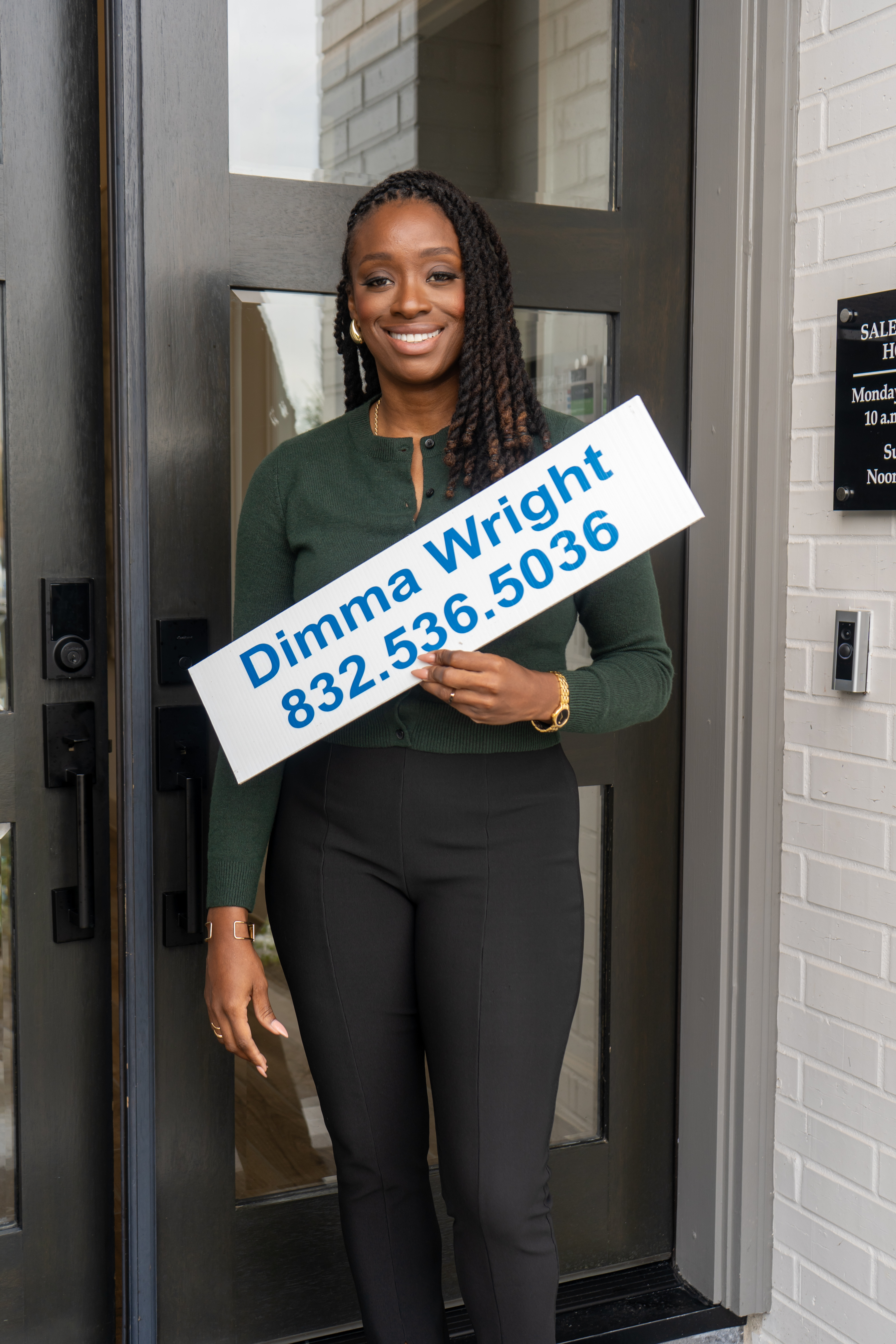
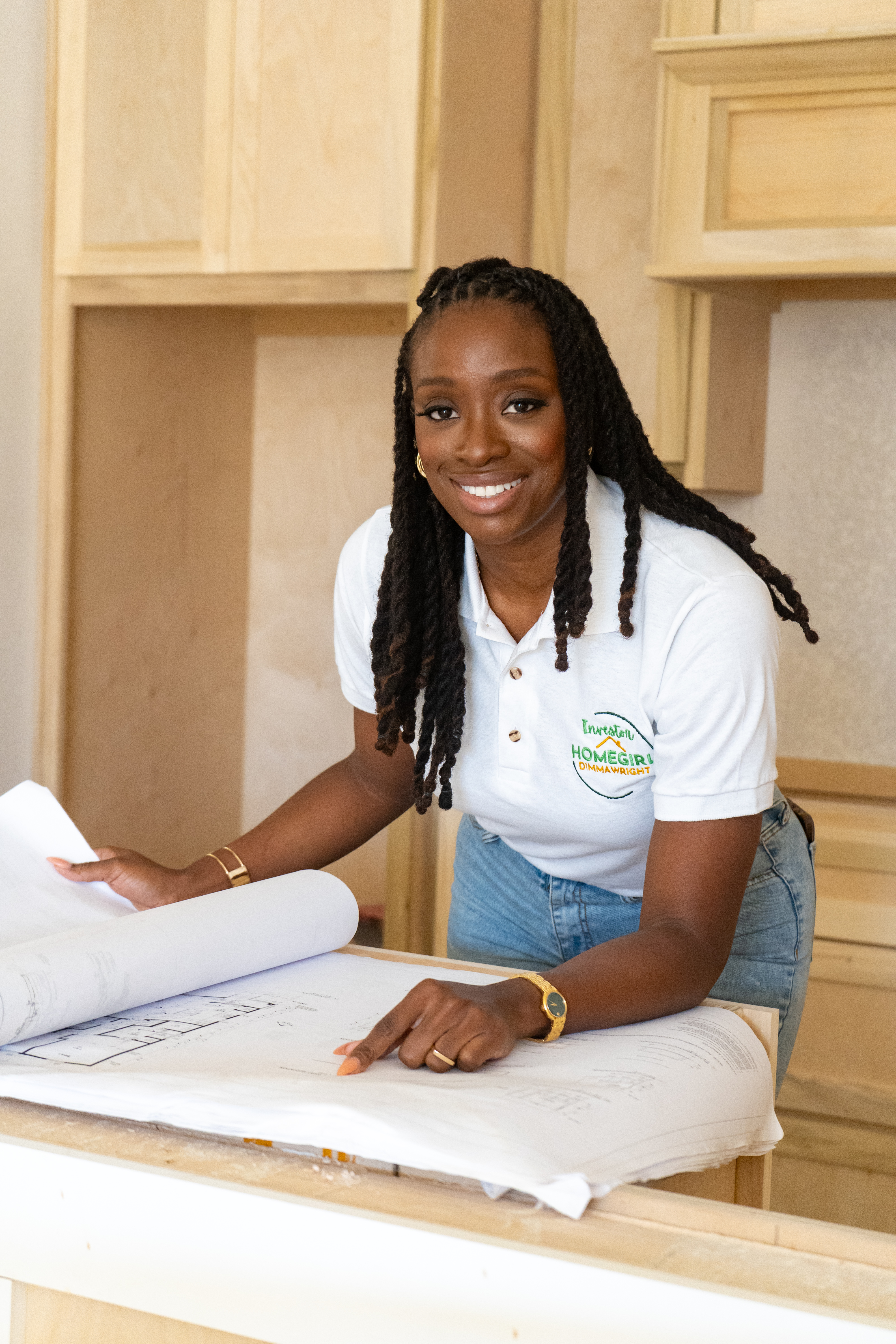
How long have you been in real estate investment? 6 years
What has been the most exciting and/or fearful moment during your HBCUpreneur career? The moment I decided to leave my full time job as a senior physical therapist at a top tier hospital and become a full time entrepreneur and manifest my destiny!
What made you want to start real estate investing? I wanted to create wealth and have the freedom with my time to spend it how I wanted.
How do you handle complex problems? I simplify them to the basics on what is necessary to complete first then move to the least and unimpactful item last.
Who was the most influential person/people for you during your time in college? My professors, they were always encouraging and talked real life aspects to prepare me for the real world outside of school.
What is something you wish you had known prior to your first real estate investment? That I should have started investing in real estate ever since I was working and living at home with my mother after I graduated. I didn’t have to have all the pieces in place before I started.
Would you advise someone to buy a primary home or investment property first? I would advise them to do both. A primary home can be utilized to be your investment property, can house hack with a duplex or a single family home large enough to rent out rooms if you desired. Or purchase a primary home that allows you to save for down payment to another investment property or home to move into and rent your current one out.
What is one current trend in real estate investing, and how can investors take advantage of it? The updated fannie mae conventional loan to buy a multi-family (2-4 door unit), allows 5% down payment. Before it required 20-25% down payment, that is why all opted for FHA 3.5% down payment, now you can scale to more properties as a primary residence without having to refinance out of FHA loan every year or so.
Artificial Intelligence is everywhere and its presence in real estate is certainly likely to grow like everywhere else. How do you see it impacting real estate investing in particular? I would want it to underwrite a deal for me quick and fast or I upload a video of the house and it tells me all the repairs needed and estimated costs, that would be cool.
Do you see any potential headwinds that maybe facing real estate investors in the near future? No, true investors learn to adapt in any environment and any obstacle. As long as your mind is right, you will persevere.
Is there anything you read or follow in order to stay an informed real estate investor? I listen to podcasts all on the real estate subject, I take webinars and active at different networking events.
How do you believe HBCUs can help spur more aptitude for understanding real estate investment while their students are in school either as undergraduate or graduate students? I would say to offer more financial literacy courses, help students to understand you can make money but if you are not smart with those decisions Uncle Sam and bad habits will leave you with nothing. Also, to understand all the different taxes that come out of paycheck, it helps to offset extra money with an llc.
How do you deal with rejection? I smile and say thank you for your time.
When you have down time how do you like to spend it? I spend it being harassed by my kids and/or watching movies.
What was your most memorable HBCU memory? I met my husband at a local nightclub in Tallahassee. He was also at FAMU grad school, different major than me.
Lastly, is there any advice you have for budding HBCUpreneurs in real estate? Discipline leads to habits, habits lead to consistency, consistency leads to growth. Changing your mindset will open more doors for you!
You are the bows from which your children as living arrows are sent forth. – Khalil Gibran
Building wealth in this country is hard. Building African American wealth in this country feels like trying to send a man to the moon, but airplanes have not even been invented yet, you are blind, your hands are tied behind your back, and there is a constant threat of someone threatening to kill you because you breathed wrong that day – as you try to send a man to the moon. This is not just hyperbolic speak. The Brookings Institution reported that European Americans in the bottom 20th percentile have a 500 percent greater chance of reaching the top than their bottom 20th percentile African American counterparts.
This is in large part rooted in two key economic moments in African America’s economic history. First, post Civil War when African Americans were supposed to be given what would be equivalent to 160 million acres of land, Andrew Johnson reneged in typical European American fashion as the Native Americans can attest to on seemingly every treaty they tried to agree to. The 160 million acres of land is impossible to truly value in some ways in today’s dollars because of opportunities for development and where exactly that land would have been is unknown. However, using the USDA’s land valuation as an elementary measuring stick, “The United States farm real estate value, a measurement of the value of all land and buildings on farms, averaged $3,800 per acre for 2022, up $420 per acre (12.4 percent) from 2021.” Based on that $3,800 per acre valuation holding constant, then African America’s 160 million acres would be worth $608 billion. Again, this is just a valuation of that land holding constant as farm land. Given the urbanization of the United States over the past 150 years, it is safe to say that a good portion of that 160 million acres would have been developed and could move the value of that land into the trillions. The $608 billion would be worth almost $15,000 per every African American man, woman, and child today. It is in fact almost 40 percent of African America’s $1.6 trillion in buying power alone and almost 25 percent of African America’s $2.6 trillion in real estate holdings today.
Then there is the grand slam policy that truly dug a grave for African America’s economic future, America’s post World War II G.I. Bill that Russell Huxtable, Dr. Huxtable’s father and army veteran in the 761st tank battalion (Season 3 Episode 11 “War Stories), would have been likely denied along the rest of the 1.5 million African American soldiers who served in World War II. The G.I. Bill arguably built the wealth gap today as we known it because it provided government funds in a way never seen before and not seen since to a group in this particular case to European American veterans to go to college, buy homes that today are alone worth trillions to their descendants, start companies which have created trillions in wealth. It should be noted that a good deal of that wealth has flowed back into PWIs coffers over the years, where there are today more PWI endowments with $1 billion or more in value than there are HBCUs – who have yet to see even one of our institutions reach such endowment value. The government sponsored leverage to European Americans and denial to African Americans contributes today to the institutional depletion of African American owned banks that have dwindled from 134 to just 16 left as of 2023, African American owned hospitals from 500 to 1, African American boarding schools from 100 to 4, and the list goes on and on. And while Russell and Anna Huxtable did well for their children, the denial of those early access to capital would show up generations later in the form of fear that would have Dr. and Mrs. Huxtable encouraging their child and her partner to choose security over risk. It also causes Sandra and Elvin to be irrationally independent and not look to the Huxtables as initial investors in their wilderness store.
It is one of the more memorable storylines told within The Cosby Show’s universe. Elvin Thibodeaux and his bride the former Sandra Huxtable inform Dr. Huxtable and Mrs. Huxtable, Esq. that they are both abandoning the tried and true formula of doctor and lawyer professions to be entrepreneurs. After Mrs. Huxtable talks Dr. Huxtable off the cliff from Elvin’s announcement, it is then Dr. Huxtable’s turn to do the same for Mrs. Huxtable, Esq. who learns that her daughter plans to join her husband in their entrepreneurial journey and to quote Mrs. Huxtable’s feelings about her daughter’s husband “dragging” her daughter into this endeavor, “and ruin what is potentially the greatest legal mind of this century”. Mrs. Huxtable demands that Sandra repay her $79,648.22, the amount the Huxtables paid for Sandra to attend Princeton. Today, that same Princeton education would cost $83,140 per year or $332,560 for four years for perspective. Not only do Sandra and Elvin push forward with extreme begrudging support the Huxtables they do so as Sandra is pregnant with what everyone believes is one child that we know turns out to be twins who are aptly named, Winnie and Nelson as an ode to the Mandelas. Sondra and Elvin refusal to ask for any help or initially take any help finds them living in a slum apartment with a slumlord where the water coming out of the faucet is brown and a myriad of other problems. Ironically, it is Denise who brings the warring parties together and both sides apologize, make amends, and Sondra and Elvin agree (for the sake of the babies) that they will seek new housing with financial assistance from the Huxtables.
However, The Thibodeaux Wilderness Store (TWS) viewed through the lens of a sporting goods store would be part of an industry in the United States alone that has grown from $15.6 billion in 1992 to $64.5 billion as of 2021 according to Statista. An increase of over 400 percent. Led by the U.S. largest publicly traded sporting goods store, Dick’s Sporting Goods valued at $10 billion. The largest individual shareholder is the son of the founder, Edward Stack who has a 10 percent ownership of the company and a net worth of $1.9 billion according to Forbes. Now imagine for a moment instead of Dick Stack’s grandmother giving him a loan of $300 to start Dick Sporting Goods that the Huxtables give Sandra and Elvin the amount needed to start The Thibodeaux Wilderness Store that becomes worth $10 billion and would be the most valuable publicly traded African American owned company. Whereby, the Huxtable-Thibodeaux family clan is worth $1.9 billion and making them solidly among African America’s wealthiest.
Thibodeaux Wilderness Store as a company is easily the largest employer of African Americans in the country employing over 50,000 workers. Dr. and Mrs. Huxtable, Esq. become Hillman’s largest donors with the Huxtable name adorning Hillman’s medical school and Hanks (Claire’s maiden name) adorning the Hillman law school transforming Hillman into the only second full service HBCU along with Howard University. They are taken public by an African American investment banking firm and a percentage of the company’s stock is purchased and held by Hillman and other HBCU endowments. Their corporate banking sits with an African American owned bank that allows the bank to in turn provide loans to thousands of small African American businesses and potential African American homebuyers. This is the power of transformative wealth – it quite literally can transform if it is in the hands of the right people. However, as we see it takes a family taking the risk to build a firm backed by the capital, security, and support of the family and community around them. The latter is exactly what the Huxtables had to offer Elvin and Sondra as they sought to build their company.
Encouraging firm building within African American/HBCU families is vital to build generational wealth. Dr. and Mrs. Huxtable, Esq.’s jobs as doctor and lawyer, respectively allows a family to build up the capital base and stability needed to take on the risk of starting a firm. To take the family to the next level requires both their stability and their willingness to see their children and grandchildren take risk the stability provides. We often lose sight of this in thinking that high paying jobs are the thing that will build generational wealth when they are still ultimately just that – jobs. In both respects the Huxtables are vital and Sondra and Elvin are vital in the evolution of a family’s resources. Fighting the urge to settle is hard for many African American families because stability has been and is still a generational fight for many African American families with over 20 percent of African American families still trying to climb out of poverty, the largest among any ethnic group in the U.S., is easy to understand the reluctance. Yet, that reluctance is costing us greatly in our ability to create generational wealth for our families and transformative wealth for African American institutions and communities. Sondra and Elvin ultimately needed to embrace the help of the Huxtables and the Huxtables needed to embrace the risk of Sondra and Elvin. This is how we move forward, this is how we close the gap, and this is how we change the lives of 40 plus million that make up African America.
A report by Merchant Maverick, a comparison site that reviews small business software and services, highlighted the top ten states for African American entrepreneurs in 2022. The results showed that eight of those states were home to HBCUs and the other two were Nevada and New Mexico, respectively. It certainly is likely that HBCUpreneurs are driving the African American entrepreneurship in these states. Unfortunately, it maybe more indirectly than intentionally. It does suggest though that with more intentional infrastructure these states could see even more boom in entrepreneurship for HBCUpreneurs. What is that intentional infrastructure? Incubators, accelerators, mentorship, and financing programs located on the campuses of HBCUs or through their alumni associations in partnership with African American Financial Institutions (AAFIs).
Virginia: Thanks to a trio of top five metrics, Virginia ranks soundly in the No. 1 spot. Black-run businesses employ 2.18% of the Old Dominion’s workforce (2nd nationally), and there are 755 Black-owned employer businesses per 1 million people (3rd nationally). Black-owned businesses also average an annual payroll of $437K, which ranks 5th overall. The state previously fared well in some of our other data reports — Virginia finished as the 4th-best state for Black women-owned businesses, and it ranked 10th in our recent best states for women-led startup report. In an effort to grow local minority-run businesses and encourage contracts with those businesses, the Virginia state government operates a directory of all certified small businesses within the state.
Maryland: With Black residents comprising 31% of the population, Maryland has the highest percentage of Black residents of any state on the East Coast, and the 4th-highest in the nation. As such, it shouldn’t be much of a surprise that Maryland has many Black business owners. The Free State ranks 1st nationally for the most Black-owned businesses per 1 million people (1,213), and also ranks 1st in percent of the workforce employed by Black-owned businesses (3.49%). Black-owned Maryland businesses additionally average a very respectable annual payroll of $465K, which is the 4th-highest in the nation. The state government offers several tools for minority business owners, including funding, small business certifications, and assistance programs.
Texas: While no metric clearly stands out, Texas ranks highly thanks to consistency. Black entrepreneurs may find it profitable to start a business in the Lone Star State — Black business owners average an annual income of $64,240 (10th overall) and Black-run businesses in the state average an annual payroll of $337K (17th overall). All of this cash can go further in Texas because the state lacks income tax. Resources available to local Black businesses include the Texas Black Expo and the Dallas Black Chamber of Commerce, both of which are organizations that aim to assist underserved businesses.
For the full report, visit Merchant Maverick here.
Among households with income between $30,000 and $50,000, 8.0 percent of African American households were unbanked compared with 1.7 percent of European American households.
Despite being the lowest unbanked group at 1.7 percent, African Americans earning $75,000 or more are still almost 600 percent more unbanked than their European American counterparts at the same income level. The largest gap among all income levels reported.
Among households with income between $50,000 and $75,000, 64.8 percent of African American households had a credit card or bank personal loan, whereas 81.3 percent of European American households did so.
Unbanked among African Americans has dropped from 16.8 percent in 2017 down to 11.3 percent in 2021. A reduction of almost 33 percent. European Americans have the lowest unbanked rate at 2.1 percent followed by Asian Americans at 2.9 percent.
21.4 percent of African American single-mother households were unbanked in 2021, compared with 8.0 percent of European American single-mother households.
Interest in having a bank account was also higher among African American unbanked households (32.0 percent were very or somewhat interested in having an account in 2021).
African American households comprised 12.8 percent of the overall household population, they made up 41.1 percent of the recently unbanked.
Use of Prepaid Cards by Bank Account Ownership and Selected Household Characteristics was highest among African Americans at 12.3 percent and lowest among Asian Americans at 4.6 percent.
Three in four African American banked households (76.5 percent) used bank accounts to save or keep money safe, a lower share than among households of other races and ethnicities. For example, 85.2 percent of European American banked households saved or kept money safe using bank accounts in 2021.
African American banked households saved or kept money safe using prepaid cards compared with 1.2 percent of European American banked households.
In 2021, 49.9 percent of African American households had a credit card or bank personal loan, compared with 78.8 percent of European American households.
36 percent of African American households are underbanked/unbanked.
Rent-to-Own Service or Payday, Pawn Shop, Tax Refund Anticipation, or Auto Title Loan is used by 7.6 percent of African American households.
To read the full FDIC National Survey of Unbanked and Underbanked Households, click here.



 HBCU Money