-
Recent Posts
- America’s $100 Trillion Real Estate Empire: The Hidden Power Beneath the Ground
- The DEI Distraction: Why Black Business Leaders Are Defending the Wrong Battlefield
- Two Pillars Fall: The Loss of Columbia Savings and Adelphi Bank and What It Means for African American Communities
- HBCU Money’s 2025 African American Owned Bank Directory
- Mapping the Gap: The Geography of African American Banks and Credit Unions in 2025
Archives
- March 2026
- February 2026
- January 2026
- December 2025
- November 2025
- October 2025
- September 2025
- August 2025
- July 2025
- June 2025
- May 2025
- April 2025
- March 2025
- February 2025
- January 2025
- December 2024
- October 2024
- August 2024
- July 2024
- June 2024
- May 2024
- April 2024
- March 2024
- February 2024
- January 2024
- December 2023
- November 2023
- October 2023
- September 2023
- August 2023
- July 2023
- June 2023
- May 2023
- April 2023
- March 2023
- February 2023
- January 2023
- December 2022
- November 2022
- October 2022
- September 2022
- August 2022
- June 2022
- May 2022
- April 2022
- March 2022
- January 2022
- November 2021
- October 2021
- May 2021
- March 2021
- February 2021
- January 2021
- December 2020
- November 2020
- September 2020
- August 2020
- July 2020
- June 2020
- May 2020
- April 2020
- February 2020
- December 2019
- November 2019
- October 2019
- September 2019
- August 2019
- July 2019
- June 2019
- May 2019
- April 2019
- March 2019
- February 2019
- January 2019
- December 2018
- November 2018
- October 2018
- September 2018
- August 2018
- June 2018
- April 2018
- March 2018
- February 2018
- October 2017
- September 2017
- August 2017
- July 2017
- June 2017
- May 2017
- April 2017
- March 2017
- February 2017
- January 2017
- December 2016
- November 2016
- October 2016
- September 2016
- August 2016
- July 2016
- June 2016
- May 2016
- April 2016
- March 2016
- February 2016
- December 2015
- November 2015
- October 2015
- September 2015
- August 2015
- July 2015
- June 2015
- May 2015
- April 2015
- March 2015
- February 2015
- January 2015
- December 2014
- November 2014
- October 2014
- September 2014
- August 2014
- July 2014
- June 2014
- May 2014
- April 2014
- March 2014
- February 2014
- January 2014
- December 2013
- November 2013
- October 2013
- September 2013
- August 2013
- July 2013
- June 2013
- May 2013
- April 2013
- March 2013
- February 2013
- January 2013
- December 2012
- November 2012
- October 2012
- September 2012
- August 2012
- July 2012
- June 2012
- May 2012
- April 2012
- March 2012
- February 2012
- December 2011
- November 2011
Categories
Meta
Author Archives: hbcumoney
Currencies Of The African Diaspora – Comoros
One of the world’s poorest countries, Comoros is made up of three islands that have inadequate transportation links, a young and rapidly increasing population, and few natural resources. The low educational level of the labor force contributes to a subsistence level of economic activity, high unemployment, and a heavy dependence on foreign grants and technical assistance. Agriculture, including fishing, hunting, and forestry, contributes 50% to GDP, employs 80% of the labor force, and provides most of the exports. Export income is heavily reliant on the three main crops of vanilla, cloves, and ylang-ylang; and Comoros’ export earnings are easily disrupted by disasters such as fires. The country is not self-sufficient in food production; rice, the main staple, accounts for the bulk of imports. The government – which is hampered by internal political disputes – lacks a comprehensive strategy to attract foreign investment and is struggling to upgrade education and technical training, privatize commercial and industrial enterprises, improve health services, diversify exports, promote tourism, and reduce the high population growth rate. Political problems have inhibited growth. Remittances from 150,000 Comorans abroad help supplement GDP. In December 2012, IMF and the World Bank’s International Development Association supported $176 million in debt relief for Comoros, resulting in a 59% reduction of its future external debt service over a period of 40 years.
Source: Economy overview provided by CIA Factbook
A Progressive Minimum Wage: Fair To Business And Labor
By William A. Foster, IV
Most everyone wants to do what’s fair, right, and good, but knowing what that is is often the tough part. – Malcolm Forbes
Recently, I was accused of being in support of slavery by the AFL-CIO’s chief economist in an exchange on Twitter for not supporting the minimum wage hike. Our discussion stemmed from my article on how a higher minimum wage would hurt African American small business growth capability. While other groups have many times our resources and wealth and since labor cost are the highest expense for any business I was simply pointing out that as a group having limited resources and higher expenses would make it harder for us to start businesses. This compounds a problem of wealth creation through business ownership and favorable taxes for ownership with employment, since businesses tend to hire within their own community, especially small businesses. By the end of the exchange he resorted to telling me I was only concerned about racism and not slavery. Oddly, I thought we were having a conversation about the minimum wage, not about racism or slavery. I sympathize with his position, but let us not throw the baby out with the bath water.
In a more macro example of why I think a blanket minimum wage hike is a problem is based on business size. Home Depot has a market cap of $110 billion, annual revenues of almost $80 billion, profits of $5 billion, and 300 000 employees of which the vast majority are paid minimum wage or close to it. In comparison, around two-thirds of small businesses, the SBA defines a small business as 500 or less employees, generate less than 100 000 annually in revenue and 88 percent of small businesses have 20 employees or less. Are we to treat these small businesses with the same stick as Home Depot and other national retailers? To bump the minimum wage up on a business with a 20 hour a week worker adds almost $2 800 annually to the cost per worker, which is no small bump to businesses making only 100 000 or less annually in revenue. However, make no mistake the SBA’s definition of a small business does propose a bit of a problem.
Enter asset and capital firms. Hedge funds, private equity, and other asset and capital firms are notoriously small. Appaloosa Management, David Tepper’s firm, reportedly only has 32 employees. Obviously, this qualifies them as a “small” business according to the SBA’s definition. The problem as it were, David Tepper himself made $2.2 billion in earnings through his hedge fund in 2012. A firm which had $25 billion in assets under management in 2012. Why is this problem? Because someone is cleaning Appaloosa’s offices. More than likely the work is contracted out and more than likely that person doing the cleaning is being paid minimum wage to do so – if that. So as you see just defining a business as “small” by its employees can leave a number of loopholes. If you have not been able to tell by the conundrums around the Affordable Care Act, businesses definitely will look for the loopholes to save money.
A better solution to the minimum wage is a progressive wage in the same way the United States has a progressive tax rate. As companies grow revenues, then so should their minimum wage requirement. Even this though is no small cost, even to big companies. If all of Home Depot’s 300 000 employees, of course not all are minimum wage earners, received a $2.85 bump in pay for every 20 hours per week they worked it would equate to an $820 million dollar increase in labor expense or 16 percent of the companies net income. This increase would be passed along to customers which is usually the case when business expenses rise anyway. I would not dare call for a lowering of the minimum wage at small businesses with smaller revenues, but it could be justified if burden were evenly spread out across a simple revenue and net income calculation. This would still raise the overall minimum wage without harming those small businesses at the very bottom trying to grow. It would also require the aforementioned firms like capital firms to ensure any contracted work they pay meets a minimum wage. For instance, if a hedge fund is contracting out its janitorial work and the employer is paying $7.25 a hour to the janitor, then the hedge fund would be responsible for the other $2.85 or whatever range that particular firm falls in based on the progressive minimum wage. This ensures the actual small business based on revenue is not bearing the burden of the higher labor cost.
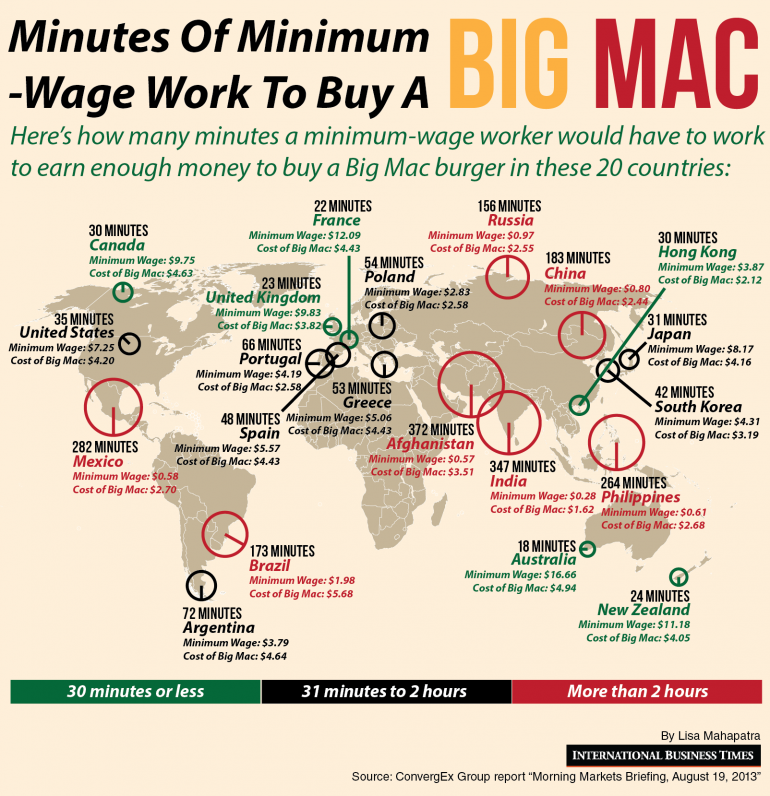
The populous argument would say 16 percent is no big deal, but most populous arguments have rarely been business owners or investors. They do not take into account capital flight and other things that potentially could cause capital to flee from these companies. This is a problem if your 401(K) happens to have investments in one of these companies, which most often they do. There goes retirement, but at least I can buy that Big Mac today (see below). The high cost of labor is what set auto companies in the United States back as they struggled to compete against foreign manufacturers who could produce the same quality car for a much cheaper price. Save for a government bailout, all of those jobs would be gone today in a true capitalist system or free market economy. Again, be careful what you wish for.
However, one of the things that could be done to offset income disparity is to give companies who are active in managing the ratio between their lowest earning full-time worker and total CEO compensation based on a five year rolling average could receive special tax breaks. The latter is important for those companies who love to give obscene golden parachutes to outgoing CEOs, which often leaves investors just as frustrated as employees. I am by no means in favor of capping anyone’s compensation, but I do believe that maintaining a proper balance between maximum-minimum is important to the overall health of businesses, labor, and the economy. Currently, the ratio between CEO compensation and the average worker of a S&P 500 company is 354:1 according to a recent report by the AFL-CIO. In 1981, the ratio was closer to 40:1 (see below).
Unfortunately we exist in a social, economic, and political climate in America currently that everything exist in extremes. The answer in the middle could restore balance, but it would take the belief that there is an actual win-win scenario for both parties also known as compromise. If we do not tax someone who makes millions the same as someone who makes thousands, then why can not the same logic be applied to businesses? Hopefully, we can find moderation because we knows what happens to a boat that leans too much to one side. Now, where did I put my life preserver?

Every Little Step We Take: When Should Young Couples Talk Finances?
By Garrick & Maya Kebede
No matter what your friends try to tell ya, We were made to fall in love
And we will be together, any kind of weather, It’s like that, it’s like that….
If only it was this easy to discuss finances in a relationship, Bobby.
Deciding when to discuss money in a relationship is not an easily navigated task. However, sans one’s spiritual values it is probably the single most important conversation any young couple can have.
There is no formula to solve this equation and it will vary depending on the couple and the individual characters involved. For the sake of this piece and brevity we will make some basic assumptions. These assumptions are: Both are adults whom are relatively responsible with respect to money (pay bills on time, save somewhat moderately, etc). These are two adults who have reasonably defined financial goals (paying off debt, not buying more home than they can afford, etc.) If you do not have either of these traits then do yourself a favor. DO NOT GET INTO A RELATIONSHIP UNTIL YOU DO. If you are already in a relationship and lack these traits then DEVELOP THEM IMMEDIATELY.
Now that these assumptions are out of the way lets examine the question at hand.
When should a young couple first discuss finances? For Maya and I this conversation actually began after our first couple dates. I actually initiated the conversation by plainly asking her where she saw herself in 10 years. A little secret about finances is they effect every aspect of our lives so if her answer made no mention of finances, then I would have asked her where she saw herself from a financial aspect over that time. Luckily, for me she made it clear that one of her goals was to pay off her student loans and her only credit card. Once she expressed that intention I plainly stated that I also wanted to have my student loans paid off over that time and was currently sacrificing to pay mine off over the next five years. I then mentioned that another goal of mine was to actually save up six figures by age 40 and become a cash millionaire by age 50. This led to a more in depth conversation about how we were going to accomplish these individual goals. The key things to take away from this conversation were that we both CONFIDENTLY and IN PLAIN ENGLISH stated to each other our primary financial goals EARLY ON.
What are the benefits of this type of intentional conversation?
Being this intentional this early has some surprising tangible and intangible benefits. The first benefit is that it takes pressure off both parties involved later on when discussing things such as budgeting and major purchases such as a home. They have already established an open line of communication henceforth, both parties feel secure with being open and honest. The second benefit is security. It is a secure feeling when one knows that your partner has the same value as you. It gives a feeling of never being apart mentally even if you are miles away from each other physically. A price can not be placed on that. The final benefit is level of respect that other people give you. Between Facebook, blog comments, emails and face to face conversations we have received hundreds of statements from people affirming that what we are doing inspires them set similar goals. In that regard we have created a mini movement that we hope other people join.
Every little step I take, You will be there
Every little step I make, We’ll be together
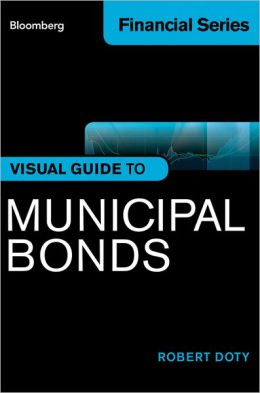
HBCU Money™ Business Book Feature – Bloomberg Visual Guide to Municipal Bonds
A hands-on visual guide to understanding and investing in an important and consistently safe investment vehicleBloomberg Visual Guide to Municipal Bonds offers step-by-step guidance to the nature and diversity of municipal securities credit structures. This valuable guide demonstrates the dependability of the overwhelming majority of municipal securities, and points out particular market sectors that may yield greater rewards, but also present greater risks.This book also directs readers to good sources of up-to-date information as well as new market tools, byproducts of recent market enhancements, so as to assist you in making informed investment decisions.
- Filled with reliable and highly accessible information needed for making sound decisions when investing in municipal securities
- Author Robert Doty is a noted expert on municipal securities
- A valuable addition to the new Bloomberg Visual Series
Engaging and informative, this reliable resource is an easy-to-use “how to” guide to municipal securities that will help you create more effective investment strategies.
HBCU Money™ Dozen 3/10 – 3/14
Did you miss HBCU Money™ Dozen via Twitter? No worry. We are now putting them on the site for you to visit at your leisure. We have made some changes here at HBCU Money™ Dozen. We are now solely focused on research and central bank articles from the previous week.
Research
How Risky Is It To Invest In Oil Stocks? l Clean Technica http://dlvr.it/57rXCH
If Microsoft gives away Windows Phone 8, will anyone take it? l Networkworld http://ow.ly/uzp6a
Google shrinks Drive cloud storage prices l CIOonline http://trib.al/rQ2KfE9
SiNode raises seed funding to give batteries more juice l Argonne http://tcrn.ch/1ewXUfI
Snowden revelations raise interest in smartphone spyware for business l Computerworld http://ow.ly/uzpsS
Ecosystem-based fisheries could provide a better way of managing the Ches Bay’s living resources l MD Sea Grant http://bit.ly/1fVZRb2
Federal Reserve, Central Banks, & Financial Departments
In extreme poverty, women’s labor force participation is more about survival than choice. l World Bank http://wrld.bg/uwMVf
After two months of decline, retail and food services sales rose 0.3% in February l St. Louis Fed http://bit.ly/1lClOeI
Tools to help with major financial decisions — paying for college, buying a home & retirement l Richmond Fed http://ow.ly/uzr97
Apartment rents rising faster than home prices in 6 major cities l Housing Wire http://hwi.re/57pxPJ
From the Vault 1987: The minimum wage: No minor matter for teens. l Chicago Fed http://ow.ly/uzcqQ
Teachers: Atlanta & St. Louis Feds offer three professional development options. l Econ Lowdown http://bit.ly/1iG22S9
Thank you as always for joining us on Saturday for HBCU Money™ Dozen. The 12 most important research and finance articles of the week.
Posted in Finance & Tech Review
Tagged extreme poverty, fisheries, google cloud, minimum wage, oil stocks, snowden, windows phone 8
![cn-map[1]](https://hbcumoney.com/wp-content/uploads/2014/03/cn-map1.gif?w=278&h=300)