Author Archives: hbcumoney

Unemployment Rate By HBCU State – June 2014

Screen Shot 2014-08-06 at 3.59.16 PM

NUMBER OF STATES WITH RISING UNEMPLOYMENT: 7

NUMBER OF STATES WITH DECLINING UNEMPLOYMENT: 10

NUMBER OF STATES WITH UNCHANGED UNEMPLOYMENT: 7

LOWEST: OKLAHOMA – 4.5%

HIGHEST – MISSISSIPPI – 7.9%

ALABAMA –  6.8% (6.8%)

ARKANSAS – 6.2% (6.4%)

CALIFORNIA – 7.4% (7.6%)

DELAWARE – 6.1% (5.9%)

DISTRICT OF COLUMBIA – 7.4% (7.5%)

FLORIDA – 6.2% (6.3%)

GEORGIA – 7.4% (7.2%)

ILLINOIS – 7.1% (7.5%)

KENTUCKY – 7.4% (7.7%)

LOUISIANA – 5.0% (4.9%)

MARYLAND – 5.8% (5.6%)

MASSACHUSETTS – 5.5% (5.6%)

MICHIGAN – 7.5% (7.5%)

MISSISSIPPI – 7.9% (7.7%)

MISSOURI –  6.5% (6.6%)

NEW YORK – 6.6% (6.7%)

NORTH CAROLINA – 6.4% (6.4%)

OHIO – 5.5% (5.5%)

OKLAHOMA – 4.5% (4.6%)

PENNSYLVANIA – 5.6% (5.6%)

SOUTH CAROLINA – 5.3% (5.3%)

TENNESSEE – 6.6% (6.4%)

TEXAS – 5.1% (5.1%)

VIRGINIA – 5.3% (5.1%)

Previous month in parentheses.

HBCU Money™ Business Book Feature -State of Peril: Race and Rape in South African Literature

9780199796373

Considering fiction from the colonial era to the present, State of Peril offers the first sustained, scholarly examination of rape narratives in the literature of a country that has extremely high levels of sexual violence.

Lucy Graham demonstrates how, despite the fact that most incidents of rape in South Africa are not interracial, narratives of interracial rape have dominated the national imaginary. Seeking to understand this phenomenon, the study draws on Michel Foucault’s ideas on sexuality and biopolitics, as well as Judith Butler’s speculations on race and cultural melancholia. Historical analysis of the body politic provides the backdrop for careful, close readings of literature by Olive Schreiner, Sol Plaatje, Sarah Gertrude Millin, Njabulo Ndebele, J.M. Coetzee, Zoë Wicomb and others.

Ultimately, State of Peril argues for ethically responsible interpretations that recognize high levels of sexual violence in South Africa while parsing the racialized inferences and assumptions implicit in literary representations of bodily violation.

HBCU Money™ Dozen 8/4 – 8/8

12

Did you miss HBCU Money™ Dozen via Twitter? No worry. We are now putting them on the site for you to visit at your leisure. We have made some changes here at HBCU Money™ Dozen. We are now solely focused on research and central bank articles from the previous week.

Research

Report: Snowden allowed to stay in Russia for three more years l CIOonline trib.al/krX7qJJ

How hackers used Google in stealing corporate data l CSOonline bit.ly/1r3xMjp

How well do horses and humans communicate? l KY Equine Research ow.ly/A5AHR

IBM’s new brain chip could power the Internet of things l CIOonline trib.al/CxWj1yJ

Pacific dead zone has been shrinking for a century l New Scientist ow.ly/A5B4v

Accelerating Application Modernization at Airlines Reporting Corporation l CIOonline trib.al/KLlhUoJ

Federal Reserve, Central Banks, & Financial Departments

Consumer Confidence Soars to Near 7-Year High l CU Magazine swyy.co/7wU7qgb

Number of banks in the U.S. continues to decline, falling by 49 in Q2 to 5,693 l St. Louis Fed bit.ly/1urVmsH

Revealed: The secret why these 10 markets will grow the most in 3Q l Housing Wire hwi.re/6Y41Zj

Puerto Rico’s population has been falling for a decade. What are the causes and consequences? l NY Fed nyfed.org/1ogA1m6

Comparison of the data on those working part time involuntarily after the past two recessions l St. Louis Fed bit.ly/1kMzbqV

Report on the economic well-being of U.S. households l Federal Reserve go.usa.gov/NfMj

Thank you as always for joining us on Saturday for HBCU Money™ Dozen. The 12 most important research and finance articles of the week.

The HBCU Money™ Weekly Market Watch

Our Money Matters /\ August 8, 2014

A weekly snapshot of African American owned public companies and HBCU Money™ tracked African stock exchanges.

NAME TICKER PRICE (GAIN/LOSS %)

African American Publicly Traded Companies

Citizens Bancshares Georgia (CZBS) $8.59 (0.00% UNCH)

M&F Bancorp (MFBP) $5.00 (0.00% UNCH)

Radio One (ROIA) $3.03 (3.77% UP)

African Stock Exchanges

Bourse Regionale des Valeurs Mobilieres (BRVM)  241.84 (0.31% UP)

Botswana Stock Exchange (BSE)  9 409.27 (0.41% UP)

Ghana Stock Exchange (GSE)  2 266.48 (5.65% UP)*

Nairobi Stock Exchange (NSE)  154.53 (N/A)

Johannesburg Stock Exchange (JSE) 50 669.95 (0.01% DN)

International Stock Exchanges

New York Stock Exchange (NYSE) 10 681.94 (0.93% UP)

London Stock Exchange (LSE)  3 503.69 (0.38% DN)

Tokyo Stock Exchange (TOPIX)  1 228.26 (2.37% DN)

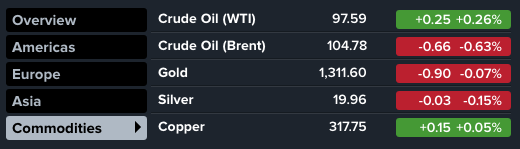
Commodities

Screen Shot 2014-08-08 at 2.47.51 PM

HBCU Money™ B-School: Types of Brokerage Accounts

banner_overview_brokerage_acct

By Investor.gov & Securities Exchange Commission

A cash account is a type of brokerage account in which the investor must pay the full amount for securities purchased. In a cash account, you are not allowed to borrow funds from your broker to pay for transactions in the account.

A margin account is a type of brokerage account in which your brokerage firm can lend you money to buy securities, with the securities in your portfolio serving as collateral for the loan. As with any other loan, you will incur interest costs when you buy securities on margin.

There are risks involved in purchasing securities on margin. For example, if you buy on margin and the value of your securities declines, your brokerage firm can require you to deposit cash or securities to your account immediately. It can also sell any of the securities in your account to cover any shortfall, without informing you in advance. The brokerage firm decides which of your securities to sell. Even if the brokerage firm notifies you that you have a certain number of days to cover the shortfall, it still may sell your securities before then. A brokerage firm may at any time change the threshold at which customers are subject to a margin call.