
Author Archives: hbcumoney

Akon Lighting Africa and the Potential of HBCUs In Africa’s Development

“If you want to go quickly, go alone. If you want to go far, go together.” ~ African proverb

akon-blog-600-1-of-1-940x940

My travels to West African countries (Benin, Togo, & Ghana) in a study abroad program in 2006 were the highlight of my graduate education. However, the unfortunate aspect of the trip was that we, as students, weren’t provoked to consider our role in the global economy, specifically Africa. This would have been an opportune time in our intellectual development to challenge us to assess critically how we could become change agents as we encountered the host of social and structural issues of each country. For instance, in each country we visited, we witnessed many residents of the rural towns and villages using kerosene for lighting their homes and businesses. Unbeknown to us, approximately 22 million people in sub-Saharan Africa were living without electricity at the time. There are many opportunities present in rural Africa, and students should be at the center of entrepreneurial conversations, solutions, and building of partnerships.

As an educator, I am concerned that students, and Historically Black Colleges and University (HBCU) students in particular, are not having transformative conversations and experiences regarding entrepreneurship and using academic knowledge and resources to empower the African Diaspora. This conversation is necessary if we are truly interested in preparing our students to be at the forefront of global issues. HBCUs have the unique opportunity to develop students’ social and economic competencies to meet global needs that they may only be privileged to receive during the course of their higher education.

Many HBCUs have community-based programs such as study abroad programs, service-learning projects, and civic engagement activities that are focused on various African countries, which they do a good job of exposing students to African heritage, language, culture, dance, and ethnic cuisines. This knowledge and cultural exposure should only be the foundation to inculcating entrepreneurial and transformative thinking to students. To the contrary, most of these community-based programs simply focus on students’ exposure and consumption of “authentic” African culture without helping students to facilitate and develop entrepreneurial initiatives that would socially and economically enhance the place they are visiting. Instead, students leave Africa with masks, artwork, mud cloths, statues, and other cultural goods without understanding civic and global engagement that leads to sustainable solutions.
maxresdefault

The most recent community initiative by a hip hop artist, Akon, made me re-evaluate the role HBCU administrators, alumni, students, and entrepreneurs. Akon is well known for his entrance in the hip hop music scene in 2004 with the release of his hit song “Locked Up.” However, Akon’s most impressive work is his current agenda to provide electricity to rural areas of Africa along with his partners Samba Bathily and Thione Niang under the Akon Lighting Africa Foundation. The Akon Lighting Africa Foundation has developed relationships with international banks to provide immediate electricity services to eleven African countries and counting by using available solar energy, which is a readily abundant resource in the continent. So where do HBCUs fit in such a community initiative?

This solar electricity initiative requires a host of skills, knowledge, and expertise in banking, community and global development, technical skills in installation, and knowledge of solar and clean energy. The aforementioned community-based programs offered at many HBCUs should consider developing partnerships with their alumni, community business leaders, and faculty to re-design these programs in order challenge students to design solutions that would benefit underdeveloped and economically marginalized communities. Not only would these communities benefit from such programs, but students would exit their institutional globally aware, marketable for employment, enhanced understanding of civic engagement, and a portfolio of work that demonstrates their skills and knowledge.

HBCUs also have the opportunity to capitalize off of such programming. One, action-oriented community programs would garner international attention and enhance the image of HBCUs worldwide, which would attract diverse students and faculty of the African Disapora. Two, this could attract potential donors like Nigerian billionaire Akilo Dangote and others to contribute to institutional endowments. Three, this is a great method for strengthening the relationship between alumni and their institution, socially and financially. Four, there would be an increase in faculty engaged in government-funded sponsored research. Five, HBCU administrators would have the opportunity to develop beneficial relationships with business leaders and entrepreneurs. And certainly not the last, HBCUs would achieve and extend their mission by truly changing the social and economic profile of the communities and students they serve providing an impetus for connecting the ecosystem of the African Diaspora.
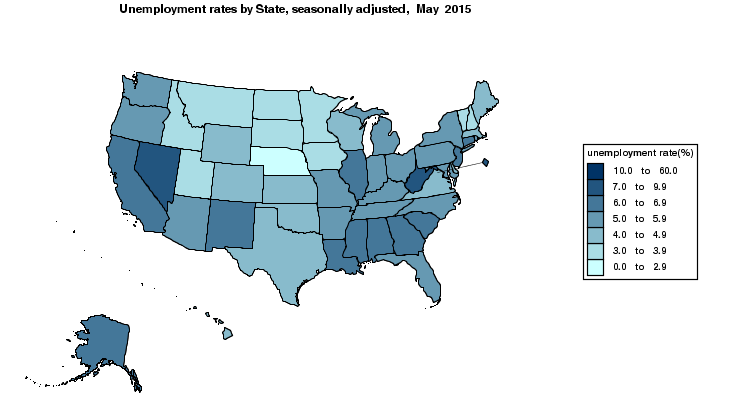
Unemployment Rate By HBCU State – May 2015

Screen Shot 2015-07-06 at 2.28.46 PM

STATES WITH RISING UNEMPLOYMENT: 14

STATES WITH DECLINING UNEMPLOYMENT: 3

STATES WITH UNCHANGED UNEMPLOYMENT: 7

MEDIAN UNEMPLOYMENT (HBCU TERRITORIES) – 5.7%

LOWEST: OKLAHOMA & TEXAS – 4.3%

HIGHEST – DISTRICT OF COLUMBIA – 7.3%

STATE – UNEMPLOYMENT RATE (PREVIOUS)*

ALABAMA –  6.1% (5.8%)

ARKANSAS – 5.7% (5.7%)

CALIFORNIA – 6.4% (6.3%)

DELAWARE – 4.6% (4.5%)

DISTRICT OF COLUMBIA – 7.3% (7.5%)

FLORIDA – 5.7% (5.6%)

GEORGIA – 6.3% (6.3%)

ILLINOIS – 6.0% (6.0%)

KENTUCKY – 5.1% (5.0%)

LOUISIANA – 6.6% (6.6%)

MARYLAND – 5.3% (5.3%)

MASSACHUSETTS – 4.6% (4.7%)

MICHIGAN – 5.5% (5.4%)

MISSISSIPPI – 6.7% (6.6%)

MISSOURI –  5.8% (5.7%)

NEW YORK – 5.7% (5.7%)

NORTH CAROLINA – 5.7% (5.5%)

OHIO – 5.2% (5.2%)

OKLAHOMA – 4.3% (4.1%)

PENNSYLVANIA – 5.4% (5.3%)

SOUTH CAROLINA – 6.8% (6.7%)

TENNESSEE – 5.8% (6.0%)

TEXAS – 4.3% (4.2%)

VIRGINIA – 4.9% (4.8%)

*Previous month in parentheses.

African America’s June Jobs Report – 9.5%

jobs

Overall Unemployment: 5.3% (5.5%)

African America Unemployment: 9.5% (10.2%)

Latino America Unemployment: 6.6% (6.7%)

European America Unemployment: 4.6% (4.7%)

Asian America Unemployment: 3.8% (4.4%)

Previous month in parentheses.

Analysis: Overall unemployment dropped 20 basis points. All groups saw declines in their unemployment rate with African and Asian America seeing the most significant declines at 70 and 60 basis points, respectively. Latino and European America both saw declines of 10 basis points.

African American Male Unemployment: 9.5% (10.2%)

African American Female Unemployment: 7.9% (8.8%)

African American Teenage Unemployment: 31.8% (30.1%)

African American Male Participation: 67.6% (68.5%)

African American Female Participation: 62.0% (61.9%)

African American Teenage Participation: 28.6% (28.7%)

Previous month in parentheses.

Analysis: African American male unemployment dropped 70 basis points, while the participation rate dropped 90 basis points. African American female unemployment dropped 90 basis points, while the participation rate rose 10 basis points. African American teenage unemployment rate spiked 170 basis points, while the participation rate dropped 10 basis points.

CONCLUSION: The overall economy added 223 000 jobs in June. African America added 60 000 jobs. Everything that glitters is not gold. Despite job gains, African America saw 82 000 people leave the work force in June, which is in combination with the job gains pushed the unemployment rate back into the single digits. Not the combination you want to see given labor force is an indictor of employment optimism or pessimism. Wages overall in the country also remain stubbornly unmoved. African American females remain the cornerstone of economic health in the community adding 100 000 jobs, but males and teenagers lost 25 000 and 14 000, respectively. Things are not bad (by normal African American standards), but they are not getting better. The economy seems to be in a holding pattern of uncertainty. African America’s trends are largely stagnant over the past five months with continued gains and losses from month to month, while currently needing to pick up 820 000 jobs to move African America’s unemployment rate in line with the country’s average.

HBCU Money™ Business Book Feature – Corporate Warriors: The Rise of the Privatized Military Industry

51yhbDLmK+L._SY344_BO1,204,203,200_

Some have claimed that “War is too important to be left to the generals,” but P. W. Singer asks “What about the business executives?” Breaking out of the guns-for-hire mold of traditional mercenaries, corporations now sell skills and services that until recently only state militaries possessed. Their products range from trained commando teams to strategic advice from generals. This new “Privatized Military Industry” encompasses hundreds of companies, thousands of employees, and billions of dollars in revenue. Whether as proxies or suppliers, such firms have participated in wars in Africa, Asia, the Balkans, and Latin America. More recently, they have become a key element in U.S. military operations. Private corporations working for profit now sway the course of national and international conflict, but the consequences have been little explored. In this book, Singer provides the first account of the military services industry and its broader implications. Corporate Warriors includes a description of how the business works, as well as portraits of each of the basic types of companies: military providers that offer troops for tactical operations; military consultants that supply expert advice and training; and military support companies that sell logistics, intelligence, and engineering. In an updated edition of P. W. Singer’s classic account of the military services industry and its broader implications, the author describes the continuing importance of that industry in the Iraq War. This conflict has amply borne out Singer’s argument that the privatization of warfare allows startling new capabilities and efficiencies in the ways that war is carried out. At the same time, however, Singer finds that the introduction of the profit motive onto the battlefield raises troubling questions—for democracy, for ethics, for management, for human rights, and for national security.

HBCU Money™ Dozen 6/29 – 7/3

12

Did you miss HBCU Money™ Dozen via Twitter? No worry. We are now putting them on the site for you to visit at your leisure. We have made some changes here at HBCU Money™ Dozen. We are now solely focused on research and central bank articles from the previous week.

Research

A better way to hire programmers? Engineering a better way to hire programmers l Computerworld http://ow.ly/P6P4P

Meet the dogs that can sniff out cancer l New Scientist http://ow.ly/P633h

From building B-17 bombers to building fish habitat: reshaping of an industrial Seattle river. l NOAA Ocean http://bit.ly/1T2bWM8

No Fracking In New York, Says DEC l Clean Technica

Fishing nations could change future for Pacific’s top predators l Pew Environment http://bit.ly/1RM2Ctn

Now this is extreme farming. Growing strawberries in balloon gardens beneath the waves l New Scientist http://ow.ly/P65uw

Federal Reserve, Central Banks, & Financial Departments

How a lack of #sleep affects the #brain l World Economic Forum http://wef.ch/1K6kqAr

VIDEO: #Africa is the next great investment destination. See why l World Bank http://wrld.bg/P2QJL

How are asset returns affected by financial crises? l World Economic Forum http://wef.ch/1BwBlZH

Wealth #redistribution, is it efficient? l San Francisco Fed http://bit.ly/1GyNAll

Global food prices dropped by 14% since August 2014 l World Bank http://wrld.bg/P5JVn

This is how illegal #drugs flow around the world l World Economic Forum http://wef.ch/1LzKHX4

Thank you as always for joining us on Saturday for HBCU Money™ Dozen. The 12 most important research and finance articles of the week.