Monthly Archives: October 2014

The HBCU Money™ Weekly Market Watch

Our Money Matters /\ October 17, 2014

A weekly snapshot of African American owned public companies and HBCU Money™ tracked African stock exchanges.

NAME TICKER PRICE (GAIN/LOSS %)

African American Publicly Traded Companies

Citizens Bancshares Georgia (CZBS) $8.60 (0.00% UNCH)

M&F Bancorp (MFBP) $4.96 (0.00% DN)

Radio One (ROIA) $2.59 (2.37% UP)

African Stock Exchanges

Bourse Regionale des Valeurs Mobilieres (BRVM)  247.41 (1.24% DN)

Botswana Stock Exchange (BSE)  9 566.70 (0.06% DN)

Ghana Stock Exchange (GSE)  2 216.87 (3.34% UP)*

Nairobi Stock Exchange (NSE)  160.42 (N/A)

Johannesburg Stock Exchange (JSE) 47 836.69 (2.04% UP)

International Stock Exchanges

New York Stock Exchange (NYSE) 10 264.84 (1.39% UP)

London Stock Exchange (LSE)  3 369.59 (1.84% UP)

Tokyo Stock Exchange (TOPIX)  1 177.22 (1.53% DN)

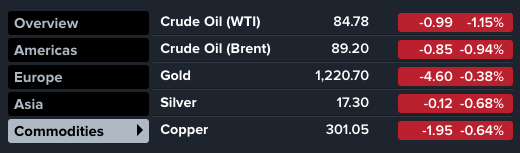
Commodities

Screen Shot 2014-10-17 at 12.19.58 PM

Unemployment Rate By HBCU State – August 2014

Screen Shot 2014-10-13 at 8.35.18 PM

NUMBER OF STATES WITH RISING UNEMPLOYMENT: 15

NUMBER OF STATES WITH DECLINING UNEMPLOYMENT: 7

NUMBER OF STATES WITH UNCHANGED UNEMPLOYMENT: 2

LOWEST: OKLAHOMA – 4.7%

HIGHEST – GEORGIA – 8.1%

ALABAMA –  6.9% (7.0%)

ARKANSAS – 6.3% (6.2%)

CALIFORNIA – 7.4% (7.4%)

DELAWARE – 6.5% (6.2%)

DISTRICT OF COLUMBIA – 7.6% (7.4%)

FLORIDA – 6.3% (6.2%)

GEORGIA – 8.1% (7.8%)

ILLINOIS – 6.7% (6.8%)

KENTUCKY – 7.1% (7.4%)

LOUISIANA – 5.8% (5.4%)

MARYLAND – 6.4% (6.1%)

MASSACHUSETTS – 5.8% (5.6%)

MICHIGAN – 7.4% (7.7%)

MISSISSIPPI – 7.9% (8.0%)

MISSOURI –  6.3% (6.5%)

NEW YORK – 6.4% (6.6%)

NORTH CAROLINA – 6.8% (6.5%)

OHIO – 5.7% (5.7%)

OKLAHOMA – 4.7% (4.6%)

PENNSYLVANIA – 5.8% (5.7%)

SOUTH CAROLINA – 6.4% (5.7%)

TENNESSEE – 7.4% (7.1%)

TEXAS – 5.3% (5.1%)

VIRGINIA – 5.6% (5.4%)

Previous month in parentheses.

HBCU Money™ Business Book Feature – The African American Entrepreneur: Then and Now


9780313351112_500X500

African American entrepreneurship has been an integral part of the American economy since the 1600s. On the eve of the Civil War, the collective wealth of free blacks was approximately $50 million. In 2006, African Americans earned a whopping $744 billion, a figure that exceeds the gross domestic product of all but 15 nations of the 192 independent countries in the world. As W. Sherman Rogers so ably demonstrates, African Americans have achieved these economic gains under difficult circumstances. Slavery, segregation, and legally limited access to property, education, and other opportunities have taken a heavy toll, even to this day. Besides providing a penetrating glimpse into the world of black entrepreneurship both past and present, this book urges African Americans to gain financial independence as entrepreneurs. Business ownership, Rogers argues, will bring security, wealth that can be passed to successive generations, and educated offspring with much greater earning power.

The African American Entreprenuer: Then and NoW</i> explores the lower economic status of black Americans in light of America’s legacy of slavery, segregation, and rampant discrimination. Its main purpose is to shine a light on the legal, historical, sociological and political factors that together help to explain the economic condition of black people in America from their arrival in America to the present. In the process, the book spotlights the many amazing breakthroughs made by black entrepreneurs even before the Civil War and Emancipation. Profiles of business people from the Post-civil War period through today include Booker T. Washington, pioneer banker and insurer A.G. Gaston, hair care entrepreneur Madame C.J. Walker, Ebony publisher John H. Johnson, Black Entertainment Television founder Robert L. Johnson, publisher Earl Graves, music producer Damon Dash, rapper Sean Combs, former basketball stars Dave Bing and Magic Johnson, food entrepreneur Michelle Hoskins, broadcast personality Cathy Hughes, former Beatrice Foods head Reginald Lewis, Oprah Winfrey, and many more. As Rogers points out, reading about remarkable African American entrepreneurs can inspire readers to adopt an entrepreneurial mindset. To further that goal and help readers take the plunge, he outlines many of the skills, tools and information necessary for business success-success that can help chart a new path to prosperity for all African Americans.

HBCU Money™ Dozen 10/6 – 10/10

MDM_12-12-2012_ROP_03_candles_t460

Did you miss HBCU Money™ Dozen via Twitter? No worry. We are now putting them on the site for you to visit at your leisure. We have made some changes here at HBCU Money™ Dozen. We are now solely focused on research and central bank articles from the previous week.

Research

Hard drives can be wiped. DVDs degrade. So do like Superman and save memories in glass shards l New Scientist http://ow.ly/Cw4J3

Hidden gems: 10 Python tools too good to overlook l Infoworld http://ow.ly/Cw4Ud

Lameness is most common problem in endurance riding l KY Equine Research http://ow.ly/Cw53o

200-Mile Electric Car Confirmed By GM l Clean Technica http://dlvr.it/78d3W6

Teach Kids the Triple R’s (of review, refresh and remind) – a mantra as part of their asthma plan l US EPA http://ow.ly/Cw5uQ

An inside look at Russian cybercriminals l CSOonlinehttp://ow.ly/Cw5Jy

Federal Reserve, Central Banks, & Financial Departments

Students in our Keys program gain over 60% in their personal finance knowledge l Philly Fed http://ow.ly/Cw5Xx

Cost to rent rising faster than home prices l Housing Wire http://hwi.re/78dVVw

Wells Fargo reaches $5M settlement over maternity discrimination l Housing Wire http://hwi.re/78ZzY8

What can we learn from the grassroots fight against Ebola? l World Economic Forum http://wef.ch/1w1dAkL

How real is the African growth miracle? l World Economic Forum http://wef.ch/1w0PIhi

Should we be concerned about the economic impact of immigration on native U.S. labor? l St. Louis Fed http://bit.ly/1rQbcyn

Thank you as always for joining us on Saturday for HBCU Money™ Dozen. The 12 most important research and finance articles of the week.

The HBCU Money™ Weekly Market Watch

Our Money Matters /\ October 10, 2014

A weekly snapshot of African American owned public companies and HBCU Money™ tracked African stock exchanges.

NAME TICKER PRICE (GAIN/LOSS %)

African American Publicly Traded Companies

Citizens Bancshares Georgia (CZBS) $8.79 (0.00% UNCH)

M&F Bancorp (MFBP) $4.92 (0.00% DN)

Radio One (ROIA) $2.34 (3.07% UP)

African Stock Exchanges

Bourse Regionale des Valeurs Mobilieres (BRVM)  255.01 (0.18% UP)

Botswana Stock Exchange (BSE)  9 526.58 (0.13% UP)

Ghana Stock Exchange (GSE)  2 221.73 (3.57% UP)*

Nairobi Stock Exchange (NSE)  162.54 (N/A)

Johannesburg Stock Exchange (JSE) 47 092.24 (2.16% DN)

International Stock Exchanges

New York Stock Exchange (NYSE) 10 375.20 (0.33% DN)

London Stock Exchange (LSE)  3 389.84 (1.10% DN)

Tokyo Stock Exchange (TOPIX)  1 243.09 (01.40% DN)

Commodities

Screen Shot 2014-10-10 at 10.27.30 AM