Monthly Archives: November 2013

The HBCU Money™ Weekly Market Watch

Our Money Matters /\ November 15, 2013

A weekly snapshot of African American owned public companies and HBCU Money™ tracked African stock exchanges.

NAME TICKER PRICE (GAIN/LOSS %)

African American Publicly Traded Companies

Citizens Bancshares Georgia (CZBS) $5.61 (0.00% UNCH)

M&F Bancorp (MFBP) $3.35 (0.00% UNCH)

Radio One (ROIA) $3.37 (0.59% DN)

African Stock Exchanges

Bourse Regionale des Valeurs Mobilieres (BRVM)  217.08 (1.30% UP)

Botswana Stock Exchange (BSE)  8 788.19 (0.06% DN)

Ghana Stock Exchange (GSE)  2 127.79 (77.36% UP)*

Nairobi Stock Exchange (NSE)  135.13 (N/A)

Johannesburg Stock Exchange (JSE) 45 174.18 (0.60% UP)

International Stock Exchanges

New York Stock Exchange (NYSE) 10 167.44 (0.37% UP)

London Stock Exchange (LSE)  3 560.76 (0.33% UP)

Tokyo Stock Exchange (TOPIX)  1 239.04 (1.68% UP)

Commodities

Gold 1 288.10 (0.14% UP)

Oil 93.96 (0.21% UP)

*Ghana Stock Exchange shows current year to date movement. All others daily.

All quotes reported as of 2:00 PM Eastern Time Zone

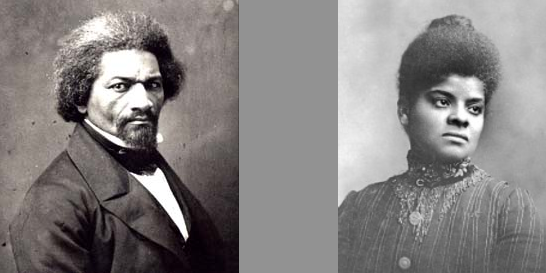
HBCU Money™ Histronomics: Frederick Douglass Letter to Ida B. Wells

fredouglassidawells4.10 AM

Dear Miss Wells:

Let me give you thanks for your faithful paper on the lynch abomination now generally practiced against colored people in the South. There has been no word equal to it in convincing power. I have spoken, but my word is feeble in comparison. You give us what you know and testify from actual knowledge. You have dealt with the facts with cool, painstaking fidelity and left those naked and uncontradicted facts to speak for themselves.

Brave woman! you have done your people and mine a service which can neither be weighed nor measured. If American conscience were only half alive, if the American church and clergy were only half christianized, if American moral sensibility were not hardened by persistent infliction of outrage and crime against colored people, a scream of horror, shame and indignation would rise to Heaven wherever your pamphlet shall be read.

But alas! even crime has power to reproduce itself and create conditions favorable to its own existence. It sometimes seems we are deserted by earth and Heaven–yet we must still think, speak and work, and trust in the power of a merciful God for final deliverance.

Very truly and gratefully yours,

FREDERICK DOUGLASS.
Cedar Hill, Anacostia, D.C., Oct. 25, 1892

Currencies Of The African Diaspora – Botswana

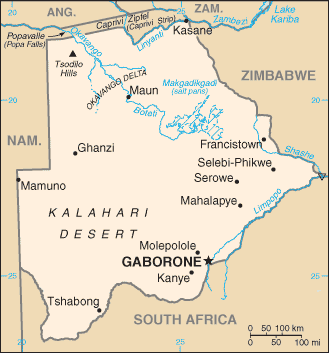
bc-map

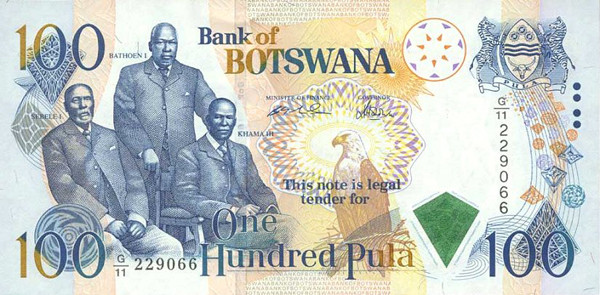
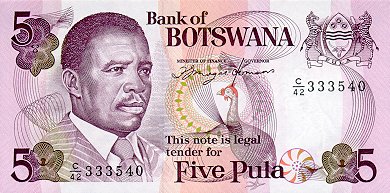
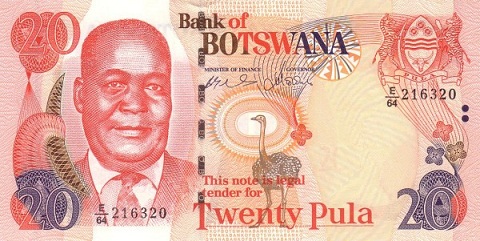
Botswana has maintained one of the world’s highest economic growth rates since independence in 1966. However, economic growth was negative in 2009, with the industrial sector shrinking by 30%, after the global crisis reduced demand for Botswana’s diamonds. Although the economy recovered in 2010, GDP growth has again slowed. Through fiscal discipline and sound management, Botswana transformed itself from one of the poorest countries in the world to a middle-income country with a per capita GDP of $16,800 in 2012. Two major investment services rank Botswana as the best credit risk in Africa. Diamond mining has fueled much of the expansion and currently accounts for more than one-third of GDP, 70-80% of export earnings, and about one-third of the government’s revenues. Botswana’s heavy reliance on a single luxury export was a critical factor in the sharp economic contraction of 2009. Tourism, financial services, subsistence farming, and cattle raising are other key sectors. According to official government statistics, unemployment reached 17.8% in 2009, but unofficial estimates run much higher. The prevalence of HIV/AIDS is second highest in the world and threatens Botswana’s impressive economic gains. An expected leveling off in diamond production within the next two decades overshadows long-term prospects. A major international diamond company signed a 10-year deal with Botswana in 2012 to move its rough stone sorting and trading division from London to Gaborone by the end of 2013. The move may support Botswana’s downstream diamond industry.

bwp-100-botswana-pulas-2

Botswana5Pula92

Botswana tourism destinations

Botswana_money_coins

Source: Economy overview provided by CIA Factbook

African America’s October Unemployment Report – 13.1%

jobs_pic

Overall Unemployment: 7.3% (7.2%)

African America Unemployment: 13.1% (12.9%)

Latino America Unemployment: 9.1% (9.0%)

European America Unemployment: 6.3% (6.3%)

Asian America Unemployment: 5.2% (5.3%)

Previous month in parentheses.

Analysis: Overall unemployment ticked up by 10 basis points. African and Latino American unemployment rate ticked upward by 20 and 10 basis points, respectively. European American unemployment rate remained unchanged. Asian Americans were the only group to see a decline in their unemployment rate. African America remains the only group with double digit unemployment.

African American Male Unemployment: 13.0% (14.0%)

African American Female Unemployment: 11.5% (10.0%)

African American Teenage Unemployment: 36.0% (35.1%)

African American Male Participation: 66.8% (67.9%)

African American Female Participation: 61.3% (61.2%)

African American Teenage Participation: 27.3% (29.4%)

Previous month in parentheses.

Analysis: African American male unemployment drops, but male participation rate also declines by 110 basis points. African American female unemployment see the inverse of males with unemployment rising, while female participation rate bumps up 10 basis points. African American teenagers suffered a double blow of of a rising unemployment rate, while their participation rate dropped by 210 basis points.

Conclusion: The overall economy added 204 000 jobs in October. However, African America saw a decline of 184 000 jobs. The uncertain pattern going into last month has cleared up, but unfortunately the certainty that has come is grimace. Four key employment metrics: labor force, number of employed, employment-population ratio, and participation rate are all at five month lows. The number of unemployed is at its second highest in five months. There is no lipstick to put on this current pig. The best hope there is right now is temporary hiring due to the holidays the next few months, but there is very little in the way for optimism based on current employment patters in African America.

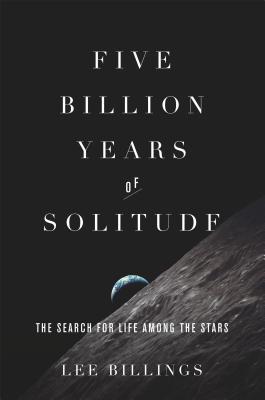
HBCU Money™ Business Book Feature – Five Billion Years Of Solitude

17707637

An intimate history of Earth and the quest for life beyond the solar system

For 4.6 billion years our living planet has been alone in a vast and silent universe. But soon, Earth’s isolation could come to an end. Over the past two decades, astronomers have discovered thousands of planets orbiting other stars. Some of these exoplanets may be mirror images of our own world. And more are being found all the time.

Yet as the pace of discovery quickens, an answer to the universe’s greatest riddle still remains just out of reach: Is the great silence and emptiness of the cosmos a sign that we and our world are somehow singular, special, and profoundly alone, or does it just mean that we’re looking for life in all the wrong places? As star-gazing scientists come closer to learning the truth, their insights are proving ever more crucial to understanding life’s intricate mysteries and possibilities right here on Earth.

Science journalist Lee Billings explores the past and future of the “exoplanet boom” through in-depth reporting and interviews with the astronomers and
planetary scientists at its forefront. He recounts the stories behind their world-changing discoveries and captures the pivotal moments that drove them forward in their historic search for the first habitable planets beyond our solar system. Billings brings readers close to a wide range of fascinating characters, such as:

FRANK DRAKE, a pioneer who has used the world’s greatest radio telescopes to conduct the first searches for extraterrestrial intelligence and to transmit a message to the stars so powerful that it briefly outshone our Sun.

JIM KASTING, a mild-mannered former NASA scientist whose research into the Earth’s atmosphere and climate reveals the deepest foundations of life on our planet, foretells the end of life on Earth in the distant future, and guides the planet hunters in their search for alien life.

SARA SEAGER, a visionary and iron-willed MIT professor who dreams of escaping the solar system and building the giant space telescopes required to discover and study life-bearing planets around hundreds of the Sun’s neighboring stars.

Through these and other captivating tales, Billings traces the triumphs, tragedies, and betrayals of the extraordinary men and women seeking life among the stars. In spite of insufficient funding, clashing opinions, and the failings of some of our world’s most prominent and powerful scientific organizations, these planet hunters will not rest until they find the meaning of life in the infinite depths of space. Billings emphasizes that the heroic quest for other Earth-like planets is not only a scientific pursuit, but also a reflection of our own culture’s timeless hopes and fears.