
Monthly Archives: May 2012

HBCU Money™ Histronomics: Special Field Orders No. 15 “40 Acres And A Mule”

Order by the Commander of the Military Division of the Mississippi

IN THE FIELD, SAVANNAH, GA., January 16th, 1865.

SPECIAL FIELD ORDERS, No. 15.

I. The islands from Charleston, south, the abandoned rice fields along the rivers for thirty miles back from the sea, and the country bordering the St. Johns river, Florida, are reserved and set apart for the settlement of the negroes now made free by the acts of war and the proclamation of the President of the United States.

II. At Beaufort, Hilton Head, Savannah, Fernandina, St. Augustine and Jacksonville, the blacks may remain in their chosen or accustomed vocations–but on the islands, and in the settlements hereafter to be established, no white person whatever, unless military officers and soldiers detailed for duty, will be permitted to reside; and the sole and exclusive management of affairs will be left to the freed people themselves, subject only to the United States military authority and the acts of Congress.  By the laws of war, and orders of the President of the United States, the negro is free and must be dealt with as such.  He cannot be subjected to conscription or forced military service, save by the written orders of the highest military authority of the Department, under such regulations as the President or Congress may prescribe.  Domestic servants, blacksmiths, carpenters and other mechanics, will be free to select their own work and residence, but the young and able-bodied negroes must be encouraged to enlist as soldiers in the service of the United States, to contribute their share towards maintaining their own freedom, and securing their rights as citizens of the United States.

Negroes so enlisted will be organized into companies, battalions and regiments, under the orders of the United States military authorities, and will be paid, fed and clothed according to law.  The bounties paid on enlistment may, with the consent of the recruit, go to assist his family and settlement in procuring agricultural implements, seed, tools, boots, clothing, and other articles necessary for their livelihood.

III. Whenever three respectable negroes, heads of families, shall desire to settle on land, and shall have selected for that purpose an island or a locality clearly defined, within the limits above designated, the Inspector of Settlements and Plantations will himself, or by such subordinate officer as he may appoint, give them a license to settle such island or district, and afford them such assistance as he can to enable them to establish a peaceable agricultural settlement.  The three parties named will subdivide the land, under the supervision of the Inspector, among themselves and such others as may choose to settle near them, so that each family shall have a plot of not more than (40) forty acres of tillable ground, and when it borders on some water channel, with not more than 800 feet water front, in the possession of which land the military authorities will afford them protection, until such time as they can protect themselves, or until Congress shall regulate their title.  The Quartermaster may, on the requisition of the Inspector of Settlements and Plantations, place at the disposal of the Inspector, one or more of the captured steamers, to ply between the settlements and one or more of the commercial points heretofore named in orders, to afford the settlers the opportunity to supply their necessary wants, and to sell the products of their land and labor.

IV. Whenever a negro has enlisted in the military service of the United States, he may locate his family in any one of the settlements at pleasure, and acquire a homestead, and all other rights and privileges of a settler, as though present in person.  In like manner, negroes may settle their families and engage on board the gunboats, or in fishing, or in the navigation of the inland waters, without losing any claim to land or other advantages derived from this system.  But no one, unless an actual settler as above defined, or unless absent on Government service, will be entitled to claim any right to land or property in any settlement by virtue of these orders.

V. In order to carry out this system of settlement, a general officer will be detailed as Inspector of Settlements and Plantations, whose duty it shall be to visit the settlements, to regulate their police and general management, and who will furnish personally to each head of a family, subject to the approval of the President of the United States, a possessory title in writing, giving as near as possible the description of boundaries; and who shall adjust all claims or conflicts that may arise under the same, subject to the like approval, treating such titles altogether as possessory.  The same general officer will also be charged with the enlistment and organization of the negro recruits, and protecting their interests while absent from their settlements; and will be governed by the rules and regulations prescribed by the War Department for such purposes.

VI. Brigadier General R. SAXTON is hereby appointed Inspector of Settlements and Plantations, and will at once enter on the performance of his duties.  No change is intended or desired in the settlement now on Beaufort [Port Royal] Island, nor will any rights to property heretofore acquired be affected thereby.

BY ORDER OF MAJOR GENERAL W. T. SHERMAN:

Special Field Orders, No. 15, Headquarters Military Division of the Mississippi, 16 Jan. 1865, Orders & Circulars, ser. 44, Adjutant General’s Office, Record Group 94, National Archives.
Three Terms Hindering Africa America’s Institutional Development: Affirmative Action, Diversity, & Minority

By William A. Foster, IV

“All cruel people describe themselves as paragons of frankness.” – Tennessee Williams

This article will probably get me in trouble with the politically correct police and let’s all hold hands and get along crowd who typically have an idealistic view that all the resources in the world can magically be distributed evenly across all populations. However, truth is truth especially as it pertains to social, economic, and political (SEP) interest and until we have their idealistic world we have to consider that groups will continue to battle over power to control the resources much like what happens with every one of God’s other creations – imagine that. SEP interest drives every group’s institutional and individual decision-making except for one – African Americans. African America continues to chase the ever elusive ghost of assimilation and inclusion into the (European) American Dream to the expense of its own power. Below are the three terms that to me psychologically have and continue hamper our development and why.

Affirmative Action

Simply put this has been one of the most damaging policies toward a stronger African-American institutional power development. Affirmative Action was a bill pushed for by certain Civil Rights Movement (CRM) groups and was signed into law by Lyndon B. Johnson in 1965. It owes its roots to desegregation and the court case Brown v. Board of Education of Topeka, KS in 1954.

Desegregation’s ultimate culmination into the affirmative action law was all but the signature that wiped out African-American institutional development. Prior, we built towns such as “Black Wall Street” in Tulsa, OK and Rosewood, FL and countless self-sufficient African-American towns. These towns would be torn apart ultimately because of our lack of ability to obtain political retribution for social and economic attacks against us which is where the aim of the CRM should have been. Instead, a movement within the CRM decided that equality meant to be assimilated into European American owned and controlled institutions. We would all but abandon towns which we built, businesses we started, and colleges that were founded for our interest and then begin to define success not by what we owned or controlled anymore but by being the “first” to break through into institutions where we weren’t wanted and out flanked socially, economically, and politically. Despite an understanding that in capitalism the ultimate power lies in what you control directly or indirectly and what you own.

Today, less than 15% of African-Americans who can go to college attend HBCUs despite the institutional implications that a college and university can bring to a community as noted in The University of Power & Wealth. “Success” is defined as moving out of our neighborhoods and then we wonder why our elementary and secondary schools are weak. They are weak because the demand that drives home values up which in turn increases the amount of taxes available to fund our schools and then allows them to develop and pay quality teachers was abandoned so that we could live in a “good” neighborhood. The educated and professionals instead of being a permanent presence in the community for children to see (positive social capital) instead leave children to look up to those hanging on the corner (negative social capital). It use to be that our doctors, teachers, and other professionals lived in the community and therefore set the barometer of that community. Yet, we’ll claim they can find role models or they should seek out mentoring programs missing the point of setting the rule in a community for kids instead of hoping they’ll find a way to be the exception. Before affirmative action, we started companies like C.R. Patterson, the only African-American owned automobile manufacturing company. Now, most of define our success by the car we drive not the ones we build.

Minority

The problem for African America allowing itself to be labeled a minority are numerous but I’ll address specifically as it relates to economic policy and actions. In 2008, Dr. Verna Dauterive, alum of Wiley College, donated $25 million to the University of Southern California in memory of her late husband. The money would be used to fund a scholarship for minority students that pursued a doctorate in education. Who is a minority? The answer is simply anyone who is not a European-American male. That means the scholarships from that donation, at a school whose African-American population is not even five percent, never even have to be used for an African-American. It means that if USC so chose they could give that scholarship to anyone that’s not of African descent from here on out and they would be meeting the requirements of that donation. It should also be noted that USC has a $3.5 billion endowment while her undergraduate alma mater Wiley College has a reported $50 million endowment. To say the $25 million would have gone further at Wiley impacting African-Americans is without question.

Recently it was noted by Jarrett Carter, Editor of HBCU Digest, that many HBCUs lead their states in minority purchases. In fact, Prairie View A&M University, Mr. Carter noted leads the state of Texas with 38% of its contracts awarded to minority businesses. Again, it should be pointed out that does not mean $1 has to go to African-American businesses. As a former employee and graduate assistant at Prairie View A&M University it was not unusual for us to hear stories about European American families with businesses making the wife 51% owner of the business in order to access minority contracts. You have to love loopholes.

Diversity

Every year certain business magazines release “Most Diverse Companies” and they are always speaking of the labor that works for these major corporations. The reality is that while the labor might be diverse the ownership is still typically 99.9% European American. The current idea of diversity just means you were able to get the most talented of other groups to work for another group’s economic interest. Again, I can’t state enough that it is ownership who gets rewarded the most long-term not labor. We see this in college football where schools like the University of Texas have 50,000 students of which only 500 are African-American males and 50% of them are on the football or basketball team. A football team composed of almost 70% African-American males, and is the most profitable college football program in the United States. The profits then go into non-revenue athletic scholarships which are predominantly European American (see golf, softball, swimming, baseball, etc.), along with aiding research, faculty salaries, and much more. The 1% of the population with no SEP power at the university providing immensely to the 99% with all of the SEP power. Now that’s a change.

It is always important to note who is defining what. I always get annoyed by “diversity” often being hijacked and/or pigeon holed to only mean multiple cultures. Diversity is also always talked about from a European American majority. That is to say in a room of 10 people if you have 7 European Americans, 1 African-American, 1 Asian American, and 1 Latino American you have diversity. However, if you have 7 African-Americans, 1 European American, 1 Asian American, and 1 Latino American it is not perceived as diversity. This is the hurdle that HBCUs often face in perception by not only society as a whole but even sadder by African-Americans themselves. Every time a conversation about diversity comes up I have to point out there are a number of variables by which one can create a diverse setting beyond ancestry. If I have a room of eight people of African descent with two from Jamaica, two from Ghana, two from America, and two from Brazil and each of those two is a mixture of male/female then do I not have a diverse room? Yes, I do. I just happen to have one foundational link of ancestry. I can add variables such as but not limited to geographical upbringing, economic class, education, gender, etc. Just for the record HBCUs have always been willing to take poor and underserved European Americans and others. The reverse still is not true unless of course you can do something exceptional on a football field.

We must define things from our point of social, economic, and political interest and not just blindly follow someone else’s idea of what is “good” as their idea of “good” is always from their point of view and interest. I was on a radio show where one of the guests proclaimed to me that Martin Luther King, Jr. was fighting for our right to move into someone else’s neighborhood. A clear problem of what happens when you allow someone else to control your history. Even a man who screamed for our self-sufficiency as many seem to forget has had his image and message watered down over the years. In capitalism, everything is ownership or labor. This is neither good nor bad. It just is and we all know that knowing is half the battle.

HBCU Money™ B-School: Bond

A debt investment in which an investor loans money to an entity (corporate or governmental) that borrows the funds for a defined period of time at a fixed interest rate. Bonds are used by companies, municipalities, states and U.S. and foreign governments to finance a variety of projects and activities.

Bonds are commonly referred to as fixed-income securities and are one of the three main asset classes, along with stocks and cash equivalents.

The indebted entity (issuer) issues a bond that states the interest rate (coupon) that will be paid and when the loaned funds (bond principal) are to be returned (maturity date). Interest on bonds is usually paid every six months (semi-annually). The main categories of bonds are corporate bonds, municipal bonds, and U.S. Treasury bonds, notes and bills, which are collectively referred to as simply “Treasuries”.

Two features of a bond – credit quality and duration – are the principal determinants of a bond’s interest rate. Bond maturities range from a 90-day Treasury bill to a 30-year government bond. Corporate and municipals are typically in the three to 10-year range.

Learn more terms at http://www.investopedia.com/

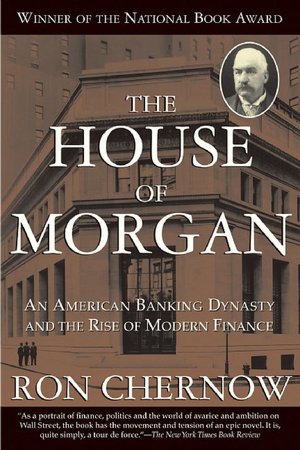
HBCU Money™ Business Book Feature – The House of Morgan: An American Banking Dynasty and the Rise of Modern Finance

The winner of the National Book Award and now considered a classic, The House of Morgan is the most ambitious history ever written about an American banking dynasty. Acclaimed by The Wall Street Journal as “brilliantly researched and written,” the book tells the rich, panoramic story of four generations of Morgans and the powerful, secretive firms they spawned. It is the definitive account of the rise of the modern financial world. A gripping history of banking and the booms and busts that shaped the world on both sides of the Atlantic, The House of Morgan traces the trajectory of the J. P. Morgan empire from its obscure beginnings in Victorian London to the crash of 1987. Ron Chernow paints a fascinating portrait of the private saga of the Morgans and the rarefied world of the American and British elite in which they moved. Based on extensive interviews and access to the family and business archives, The House of Morgan is an investigative masterpiece, a compelling account of a remarkable institution and the men who ran it, and an essential book for understanding the money and power behind the major historical events of the last 150 years.

HBCU Money™ B-School: Endowment

A financial asset donation made to a non-profit group or institution in the form of investment funds or other property that has a stated purpose at the bequest of the donor. Most endowments are designed to keep the principal amount intact while using the investment income from dividends for charitable efforts.

Endowments provide ongoing benefits for those that receive them by earning a market rate of interest while keeping the core endowment principal intact to fund future years of scholarships, or whatever efforts the donor sought to fund. In some cases, a certain percentage of the assets are allowed to be used each year, so the amount pulled out of the endowment could be a combination of interest income and principal. The ratio of principal to income would change year to year based on prevailing market rates.

Learn more terms at http://www.investopedia.com/