
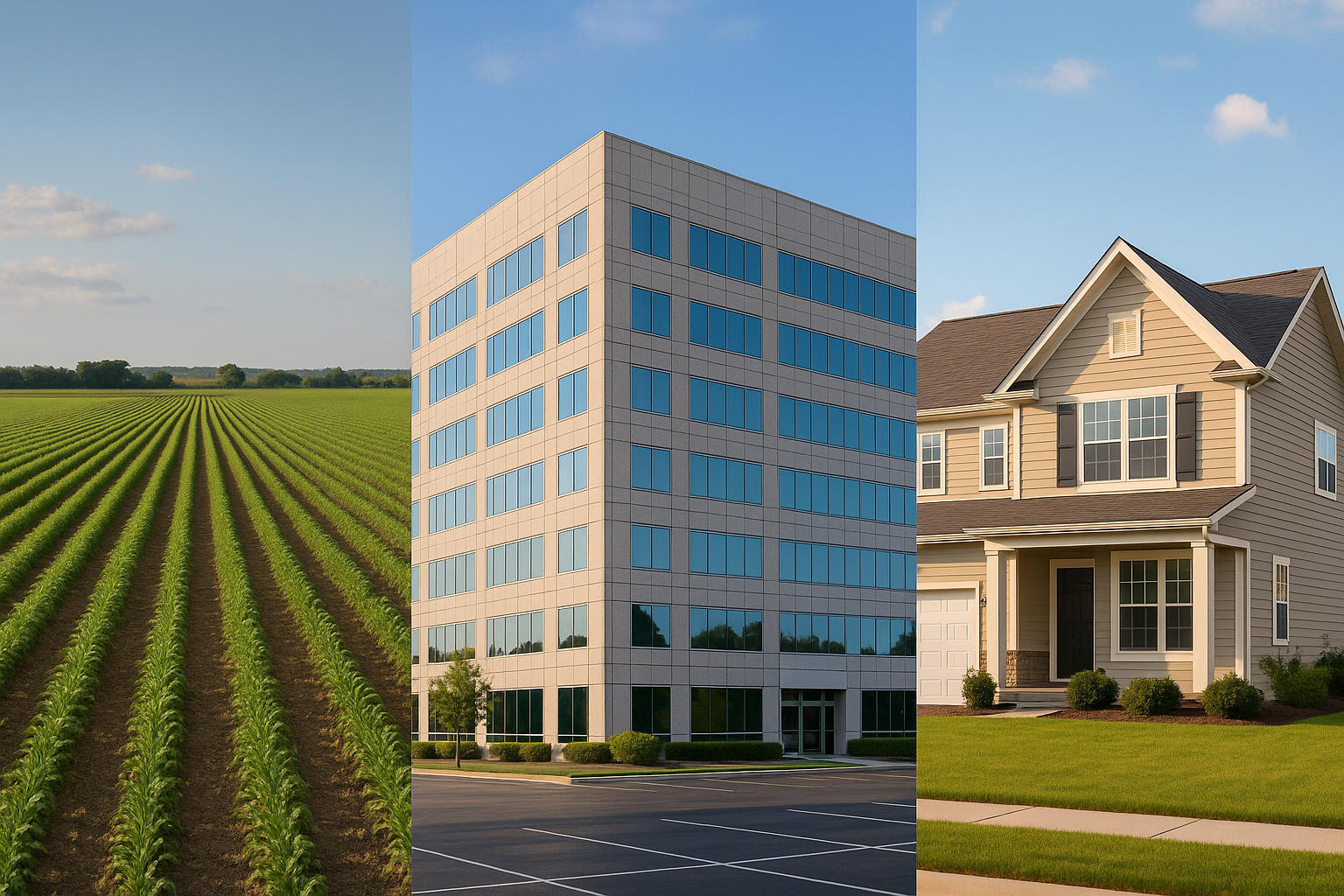
The United States, a land famed for its abundance and ambition, sits atop one of the most valuable portfolios of real estate in the world. From the towering commercial properties of Manhattan to the suburban sprawl of Phoenix and the vast, untouched stretches of prairie and desert in between, the collective valuation of U.S. real estate has breached an astonishing threshold: $100 trillion.
According to recent estimates, the total value of U.S. residential real estate hovers around $50 trillion, while commercial real estate accounts for an additional $22.5 to $26.8 trillion. Less visible but equally consequential is the nation’s unimproved land—agricultural acreage, forests, deserts, and raw parcels—with a market value estimated at $23 trillion. Together, these segments reveal a profound truth about the American economy: it is built quite literally on a foundation of land wealth that continues to define its structure, resilience, and long-term power.
The Residential Bedrock
Homeownership, long considered the American Dream, is more than a cultural aspiration—it is the foundation of household wealth and the gravitational center of the U.S. economy. Redfin estimates that American homes are now worth a cumulative $50 trillion, a figure that has surged nearly 50% since 2020, when the pandemic-era monetary policy and fiscal stimulus unleashed a flurry of homebuying and refinancing activity.
This valuation includes not only primary residences but also investment properties and vacation homes. Approximately 65% of Americans own homes, and for most, their house remains their single largest asset. According to the Federal Reserve’s Survey of Consumer Finances, real estate comprises more than 50% of household net worth among the middle class, making housing prices not just a matter of market speculation but a critical economic indicator.
But the recent surge in interest rates has cast a shadow. The Federal Reserve’s aggressive tightening campaign to combat inflation has pushed mortgage rates above 7%, slowing home sales and triggering price corrections in overheated markets. Nevertheless, inventory shortages and strong labor markets have kept residential property values elevated. Analysts believe this plateau—rather than a crash—will be the new normal, as housing markets recalibrate in a high-rate environment.
Commercial Real Estate’s Reckoning
The U.S. commercial real estate (CRE) market, estimated to be worth between $22.5 trillion and $26.8 trillion according to the Federal Reserve Bank of St. Louis, finds itself at a crossroads. Office towers, retail strips, multifamily developments, and industrial warehouses are being repriced in real time as remote work, e-commerce, and rising interest rates challenge legacy models.
Office vacancies in major cities like San Francisco, Chicago, and Washington, D.C. have climbed to record highs—some surpassing 30%—as companies consolidate physical footprints. This has sparked what some are calling a “silent crisis” for CRE. Valuations have dropped precipitously in certain metro areas, and regional banks with significant exposure to commercial mortgages have found themselves vulnerable.
But it is not all doom and gloom. Industrial and logistics properties—particularly those near ports, rail hubs, and urban fulfillment centers—continue to outperform, benefiting from the growth of e-commerce and reshoring of manufacturing. Meanwhile, multifamily housing has emerged as a relative safe haven, with demand bolstered by rising mortgage costs that have priced many out of homeownership.
Institutional investors, from pension funds to private equity giants, are rebalancing portfolios, shedding underperforming assets while doubling down on high-performing sub-sectors. The great repricing of commercial property could ultimately yield a leaner, more sustainable industry.
America’s Undervalued Treasure: Unimproved Land
Beyond the skyscrapers and suburbs lies the nation’s quietest giant—its unimproved land, whose estimated value of $23 trillion remains largely outside the public imagination. This figure, derived from the Bureau of Economic Analysis and academic research, encompasses the total value of raw, undeveloped land, including forests, deserts, wetlands, farmland, and government-owned acreage.
Unimproved land is often overlooked in discussions of wealth, yet it plays a central role in climate resilience, national food security, conservation, and future development. It is the terra firma upon which cities expand, solar farms rise, and conservation easements are negotiated. It also serves as collateral in trillions of dollars of financing across industries.
Yet unlike residential and commercial properties, unimproved land lacks a robust national marketplace or transparent pricing. It is often subject to local zoning laws, speculative investment, and environmental regulation—making it both a store of untapped value and a highly complex asset class. With climate change accelerating, land with access to water, resilience to extreme weather, and proximity to urban centers is already commanding premium valuations.
Land is also becoming a focus for sovereign wealth funds, family offices, and climate-conscious investors. “Farmland and timberland are now being seen as long-duration, inflation-resistant assets,” says Daniel Krueger, managing director of a Colorado-based land investment firm. “We’re at the early stages of a global land rush driven by food, carbon, and water scarcity.”
A National Portfolio of Strategic Assets
Taken together, the U.S. real estate sector functions as a $100 trillion national portfolio, integral not just to individuals and corporations but to the state itself. Local governments rely on property taxes for more than 70% of their operating budgets, while real estate assets underpin infrastructure financing through municipal bonds. The U.S. government also owns about 640 million acres of land—roughly 28% of the country—much of which is leased for energy, timber, and recreation, generating billions in annual revenue.
Real estate also serves as the backbone of U.S. capital markets. Mortgage-backed securities, REITs, and land-based derivatives are woven into the financial system, linking Wall Street to Main Street. In a typical year, real estate transactions account for more than 17% of GDP when including construction, financing, insurance, and brokerage services.
Yet this vast portfolio is not without its vulnerabilities. Natural disasters, rising sea levels, zoning bottlenecks, affordability crises, and infrastructure underinvestment all threaten the productivity of American land. Moreover, decades of racially discriminatory policies in housing and land access continue to cast a long shadow, leaving millions of Americans excluded from the benefits of land ownership.
The Geopolitics of Land
In a global economy defined increasingly by resources, logistics, and sovereignty, America’s real estate advantage is also geopolitical. With a vast and varied landscape, stable legal system, deep capital markets, and strong property rights, U.S. land remains an attractive destination for foreign capital. Investors from Canada, Germany, Singapore, and the Middle East have spent billions acquiring trophy assets in cities like New York, Los Angeles, and Miami, as well as farmland in the Midwest and ranches in Texas.
But the rise of China, strategic concerns around food and data security, and the politicization of foreign ownership have made real estate an arena of national interest. Several states have passed or are considering legislation restricting land purchases by foreign governments or their proxies. Meanwhile, the Committee on Foreign Investment in the United States (CFIUS) has widened its scope to include real estate transactions near sensitive military or infrastructure sites.
These developments suggest a growing recognition that land—long viewed as inert and apolitical—is in fact a strategic resource requiring oversight and planning.
The Sustainability Imperative
In the 21st century, the full value of real estate can no longer be measured in dollars alone. Sustainability, resilience, and carbon sequestration are emerging as parallel dimensions of value. Developers are increasingly required to meet environmental standards, and landowners are being incentivized to conserve forests, wetlands, and grasslands as carbon sinks.
The Inflation Reduction Act of 2022 poured billions into climate-smart land use initiatives, including tax credits for renewable energy on farmland and funding for urban tree canopies. These programs aim to make the American landscape more resilient while tying land use directly to climate goals.
Urban planning is also being reimagined. Cities like Portland, Denver, and Austin are investing in zoning reform to allow for greater density, affordability, and transit-oriented development. Meanwhile, rural communities are embracing land trusts and cooperative ownership models to prevent land loss and promote inclusive growth.
The Repricing of the American Dream
As the United States approaches a new demographic, environmental, and economic era, the notion of land as a static store of wealth is evolving. The repricing of American real estate—spurred by demographic shifts, financial innovation, and climate change—will redefine value for the next generation.
For homeowners, it means contending with climate risk disclosures and insurance volatility. For developers and institutional investors, it entails navigating rising construction costs, policy uncertainty, and ESG mandates. For policymakers, it means rethinking land taxation, infrastructure planning, and public land stewardship.
Yet the fundamental truth remains: the United States possesses one of the most valuable and versatile land portfolios in the world. With judicious management, equitable access, and forward-looking investment, that $100 trillion empire can continue to generate prosperity for decades to come.
In an age of intangibles—from cloud computing to cryptocurrencies—the solidity of land and property remains unmatched. America’s $100 trillion real estate empire is not just a measure of wealth; it is a reflection of national identity, economic philosophy, and strategic foresight. How the country chooses to steward this land—who gets to own it, how it is used, and whether it serves the public good—will shape the next chapter of the American experiment.
Sidebar: By the Numbers – U.S. Real Estate Valuations
- Residential Real Estate: $50 trillion (Redfin, 2024)
- Commercial Real Estate: $22.5–$26.8 trillion (Federal Reserve Bank of St. Louis, 2024)
- Unimproved Land: $23 trillion (BEA estimates, 2023)
- Total: Approx. $100–$103 trillion
- Government-Owned Land: 640 million acres (~28% of U.S. territory)
- Property Tax Revenue (Local Governments): ~$550 billion annually
- Real Estate Contribution to U.S. GDP: ~17% (including indirect industries)
In an age of intangibles—from cloud computing to cryptocurrencies—the solidity of land and property remains unmatched. America’s $100 trillion real estate empire is not just a measure of wealth; it is a reflection of national identity, economic philosophy, and strategic foresight. How the country chooses to steward this land—who gets to own it, how it is used, and whether it serves the public good—will shape the next chapter of the American experiment.
Disclaimer: This article was assisted by ChatGPT
 HBCU Money