Tag Archives: jobs

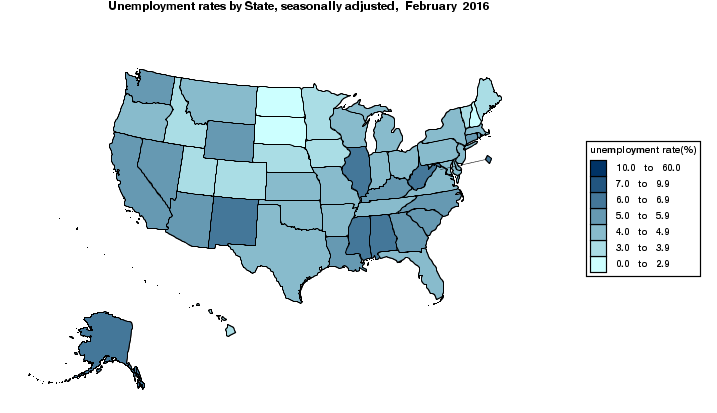
Unemployment Rate By HBCU State – February 2016

Screen Shot 2016-04-04 at 9.55.06 PM

STATES WITH RISING UNEMPLOYMENT: 5

STATES WITH DECLINING UNEMPLOYMENT: 17

STATES WITH UNCHANGED UNEMPLOYMENT: 2

LOWEST: VIRGINIA – 4.1%

HIGHEST – DISTRICT OF COLUMBIA & MISSISSIPPI – 6.5%

STATE – UNEMPLOYMENT RATE (PREVIOUS)*

ALABAMA –  6.2% (5.9%)

ARKANSAS – 4.2% (5.1%)

CALIFORNIA – 5.5% (5.8%)

DELAWARE – 4.6% (5.1%)

DISTRICT OF COLUMBIA – 6.5% (6.6%)

FLORIDA – 4.9% (5.1%)

GEORGIA – 5.4% (5.7%)

ILLINOIS – 6.4% (5.4%)

KENTUCKY – 5.8% (4.9%)

LOUISIANA – 5.9% (6.2%)

MARYLAND – 4.7% (5.1%)

MASSACHUSETTS – 4.5% (4.6%)

MICHIGAN – 4.8% (5.0%)

MISSISSIPPI – 6.5% (5.9%)

MISSOURI –  4.2% (5.0%)

NEW YORK – 4.8% (4.8%)

NORTH CAROLINA – 5.5% (5.7%)

OHIO – 4.9% (4.4%)

OKLAHOMA – 4.2% (4.3%)

PENNSYLVANIA – 4.6% (5.1%)

SOUTH CAROLINA – 5.5% (5.6%)

TENNESSEE – 4.9% (5.6%)

TEXAS – 4.4% (4.4%)

VIRGINIA – 4.1% (4.2%)

*Previous month in parentheses.

African America’s March Jobs Report – 9.0%

jobs

Overall Unemployment: 5.0% (4.9%)

African America Unemployment: 9.0% (8.8%)

Latino America Unemployment: 5.6% (5.4%)

European America Unemployment: 4.3% (4.3%)

Asian America Unemployment: 4.0% (3.8%)

Previous month in parentheses.

Analysis: Overall unemployment rose slightly in the month of March from the previous month. No group to experienced a decline, while European America was the only group to go unchanged. All other groups saw 20 basis point increases in their unemployment rates.

African American Male Unemployment: 8.7% (8.6%)

African American Female Unemployment: 8.0% (7.9%)

African American Teenage Unemployment: 25.3% (23.3%)

African American Male Participation: 67.2% (67.5%)

African American Female Participation: 61.5% (62.0%)

African American Teenage Participation: 30.5% (28.8%)

Previous month in parentheses.

Analysis:African American males had a 10 basis point increase in their unemployment rate and a 30 basis point decrease in their participation rate. African American females had a 10 basis point increase in their unemployment rate and a 50 basis point decrease in their participation rate. African American teenagers unemployment rate increased 200 basis points and participation rate experienced an increase of 170 basis points.

CONCLUSION: The overall economy added 215 000 jobs in March. African America lost 92 000 jobs in March marking the first decrease in the past five months. The African American labor force also pulled back with a decline of almost 60 000 after three months of growth. Thankfully, participation rate over the past five months remains virtually unchanged meaning that African America’s employment situation is basically doggy paddling in the middle of the economic ocean, still. While some believe that improving job conditions are pulling the rest of the nation off the sideline, it appears to be sending African American to it. This could be largely dependent on the types of jobs and where African America is concentrated. An unusual rise for African American teenagers participation rate, while the adults declined. The market and economy are showing modest growth, but the true sustainability of it remains to be seen with so many negative marks in the global macroeconomic environment.

African American needs an increase of 779 000 jobs to match the country’s unemployment rate – an increase of 20 000 jobs from the previous month.

African America’s November Jobs Report – 9.4%

jobs

Overall Unemployment: 5.0% (5.0%)

African America Unemployment: 9.4% (9.2%)

Latino America Unemployment: 6.4% (6.3%)

European America Unemployment: 4.3% (4.4%)

Asian America Unemployment: 3.9% (3.5%)

Previous month in parentheses.

Analysis: Overall unemployment went unchanged in the month of November from the previous month. All groups saw rises in their unemployment rates, except European America who saw a 10 basis point decline.

African American Male Unemployment: 9.9% (9.2%)

African American Female Unemployment: 8.0% (8.1%)

African American Teenage Unemployment: 23.7% (25.6%)

African American Male Participation: 66.7% (67.0%)

African American Female Participation: 62.8% (62.5%)

African American Teenage Participation: 27.4% (27.0%)

Previous month in parentheses.

Analysis:African American males had a 70 basis point increase in their unemployment rate and a 30 basis point decrease in their participation rate. African American females had a 10 basis point decrease in their unemployment rate and a 30 basis point increase in their participation rate. African American teenagers  unemployment rate declined 190 basis points and participation rate experienced an increase of 40 basis points.

CONCLUSION: The overall economy added 211 000 jobs in November. African America added a mere 11 000 jobs in November. The African American labor force is at a five month high, but this is more likely due to confidence in seasonal hiring. The participation rate over the past five months remains virtually unchanged meaning that African America’s employment situation is basically doggy paddling in the middle of the economic ocean. Just how much optimism can be put into this current economy with the Federal Reserve set to raise rates for the first time in a decade and uncertainty of how companies will respond is tough to get a pulse on. Many believe the more expensive debt even by only 25 basis points could squeeze the public sector where African America is overly concentrated in employment. The economy’s response to the rate hike could say a lot for the coming year as it relates to African American employment for better or worse. African American needs an increase of 756 000 jobs to match the country’s unemployment rate. A decrease of 61 000 from October’s number.

African America’s October Jobs Report – 9.2%

jobs

Overall Unemployment: 5.0% (5.1%)

African America Unemployment: 9.2% (9.2%)

Latino America Unemployment: 6.3% (6.4%)

European America Unemployment: 4.4% (4.4%)

Asian America Unemployment: 3.5% (3.6%)

Previous month in parentheses.

Analysis: Overall unemployment dropped 10 basis points in the month of October from the previous month. African and European American both saw unchanged unemployment rates. Asian and Latino America both saw decreases of 10 basis points.

African American Male Unemployment: 9.2% (8.9%)

African American Female Unemployment: 8.1% (8.0%)

African American Teenage Unemployment: 25.6% (31.5%)

African American Male Participation: 67.0% (66.9%)

African American Female Participation: 62.5% (62.1%)

African American Teenage Participation: 27.0% (28.7%)

Previous month in parentheses.

Analysis:African American males had a 30 basis point increase in their unemployment rate and a 10 basis point increase in their participation rate. African American females had a 10 basis point increase in their unemployment rate and a 40 basis point increase in their participation rate. African American teenagers  unemployment rate declined 590 basis points and participation rate also experienced a decline of 170 basis points.

CONCLUSION: The overall economy added 271 000 jobs in October. African America added 47 000 jobs in October. African America’s economy is stagnant. Very little movement in key factors like the participation rate have basically gone unchanged the past five months. Despite this, the labor force continues to see a steady increase the past five months. Going into the holiday season should be helpful to seasonal hiring and improve the employment numbers. African American needs an increase of 817 000 jobs to match the country’s unemployment rate. An increase of 15 000 from September’s number.

Unemployment Rate By HBCU State – August 2015

Screen Shot 2015-10-06 at 12.37.50 PM

STATES WITH RISING UNEMPLOYMENT: 2

STATES WITH DECLINING UNEMPLOYMENT: 15

STATES WITH UNCHANGED UNEMPLOYMENT: 7

LOWEST: TEXAS – 4.1%

HIGHEST – DISTRICT OF COLUMBIA – 6.8%

STATE – UNEMPLOYMENT RATE (PREVIOUS)*

ALABAMA –  6.2% (6.2%)

ARKANSAS – 5.4% (5.6%)

CALIFORNIA – 6.1% (6.2%)

DELAWARE – 4.9% (4.7%)

DISTRICT OF COLUMBIA – 6.8% (6.8%)

FLORIDA – 5.3% (5.4%)

GEORGIA – 5.9% (6.0%)

ILLINOIS – 5.6% (5.8%)

KENTUCKY – 5.2% (5.2%)

LOUISIANA – 6.0% (6.2%)

MARYLAND – 5.1% (5.2%)

MASSACHUSETTS – 4.7% (4.7%)

MICHIGAN – 5.1% (5.3%)

MISSISSIPPI – 6.3% (6.5%)

MISSOURI –  5.6% (5.8%)

NEW YORK – 5.2% (5.4%)

NORTH CAROLINA – 5.9% (5.9%)

OHIO – 4.7% (5.0%)

OKLAHOMA – 4.6% (4.5%)

PENNSYLVANIA – 5.4% (5.4%)

SOUTH CAROLINA – 6.0% (6.4%)

TENNESSEE – 5.7% (5.7%)

TEXAS – 4.1% (4.2%)

VIRGINIA – 4.5% (4.8%)

*Previous month in parentheses.