
Tag Archives: federal reserve

HBCU Money™ Dozen Links 8/19 – 8/23

12STEPBALL_2

Did you miss HBCU Money™ Dozen via Twitter? No worry. We are now putting them on the site for you to visit at your leisure. We have made some changes here at HBCU Money™ Dozen. We are now solely focused on research and central bank articles from the previous week.

Research

Does particle physics matter? Argonne’s Pete Winter weighs in. | Argonne

3 ways Apple’s new iPhones should change your life l Computer World

How the Snowden Effect Is Paralyzing CIOs l Computer World

Black Hole Analogue Discovered in the So. Atlantic Ocean l SLAC

Most precise clock could help detect how an object just 1 cm above another might age differently l New Scientist

Is the US Department of the Interior Committing Cultural Genocide And Ecocide? l Clean Technica

Federal Reserve, Central Banks, & Financial Departments

Grassley blames university ‘perks’ for rising college costs l Floor Action

Irrigated cropland value jumps 25 percent in the Tenth District. l Kansas City Fed

Five mega banks dish out $51.3B in aid to borrowers l Housing Wire

The Fed’s Role in Cash Distribution: Learn about our role in maintaining confidence in the U.S. currency l SF Fed

Future looks brighter for high-skilled and low-skilled workers than it does for those in between l St. Louis Fed

India aims to create 70-100 million manufacturing jobs by 2025. But how? l World Bank

Thank you as always for joining us on Saturday for HBCU Money™ Dozen. The 12 most important research and finance articles of the week.
HBCU Money™ B-School: How Is The Federal Reserve Board Selected?

usmap3

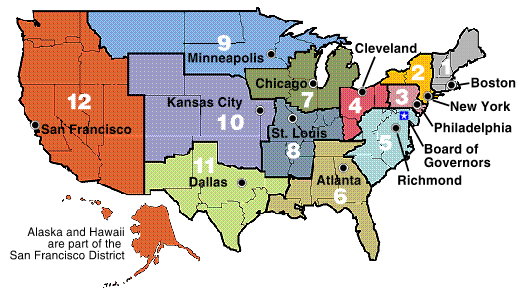
Editor’s Note: There are HBCUs located in 11 of the 12 Federal Reserve Districts with the Minneapolis Federal Reserve District territory being the lone exception. Also, it should be noted that 8 of the 12 cities that house the primary headquarters of the respective Federal Reserve District have HBCUs in them with Cleveland, Kansas City, Minneapolis, and San Francisco being the exceptions.

The members of the Board of Governors are nominated by the President of the United States and confirmed by the U.S. Senate. By law, the appointments must yield a “fair representation of the financial, agricultural, industrial, and commercial interests and geographical divisions of the country,” and no two Governors may come from the same Federal Reserve District.

The full term of a Governor is 14 years; appointments are staggered so that one term expires on January 31 of each even-numbered year. A Governor who has served a full term may not be reappointed, but a Governor who was appointed to complete the balance of an unexpired term may be reappointed to a full 14-year term.

Once appointed, Governors may not be removed from office for their policy views. The lengthy terms and staggered appointments are intended to contribute to the insulation of the Board–and the Federal Reserve System as a whole–from day-to-day political pressures to which it might otherwise be subject.

In addition to serving as members of the Board, the Chairman and Vice Chairman of the Board serve terms of four years, and they may be reappointed to those roles and serve until their terms as Governors expire. The Chairman serves as public spokesperson and representative of the Board and manager of the Board’s staff. The Chairman also presides at Board meetings. Affirming the apolitical nature of the Board, recent Presidents of both major political parties have selected the same person as Board Chairman.

The Congress sets the salaries of the Board members. For 2012, the Chairman’s annual salary is $199,700. The annual salary of the other Board members (including the Vice Chairman) is $179,700.

Source: Federal Reserve

HBCU Money™ Histronomics: The Chronological Order Of Federal Reserve Chairmans

Janet_Yellen_official_Federal_Reserve_portrait

Charles Hamlin (Harvard University)  Aug. 10, 1914-Aug. 9, 1916

W.P.G. Harding (University of Alabama) Aug. 10, 1916-Aug. 9, 1922

Daniel R. Crissinger (University of Akron) May 1, 1923-Sept. 15, 1927

Roy A. Young (Unknown) Oct. 4, 1927-Aug. 31, 1930

Eugene Meyer (Yale University) Sept. 16, 1930-May 10, 1933

Eugene R. Black (University of Georgia) May 19, 1933-Aug. 15, 1934

Marriner S. Eccles (Brigham Young University) Nov. 15, 1934-Jan. 31, 1948

Thomas B. McCabe (Swarthmore College) Apr. 15, 1948-Mar. 31, 1951

William Martin, Jr (Yale University) Apr. 2, 1951-Jan. 31, 1970

Arthur F. Burns (Columbia University) Feb. 1, 1970-Jan. 31, 1978

G. William Miller (U.S. Coast Guard Academy) Mar. 8, 1978-Aug. 6, 1979

Paul A. Volcker (Princeton University) Aug. 6, 1979-Aug. 11, 1987

Alan Greenspan (New York University) Aug. 11, 1987-Jan. 31, 2006

Ben S. Bernanke (Harvard University) Feb. 1, 2006-Feb. 3, 2014

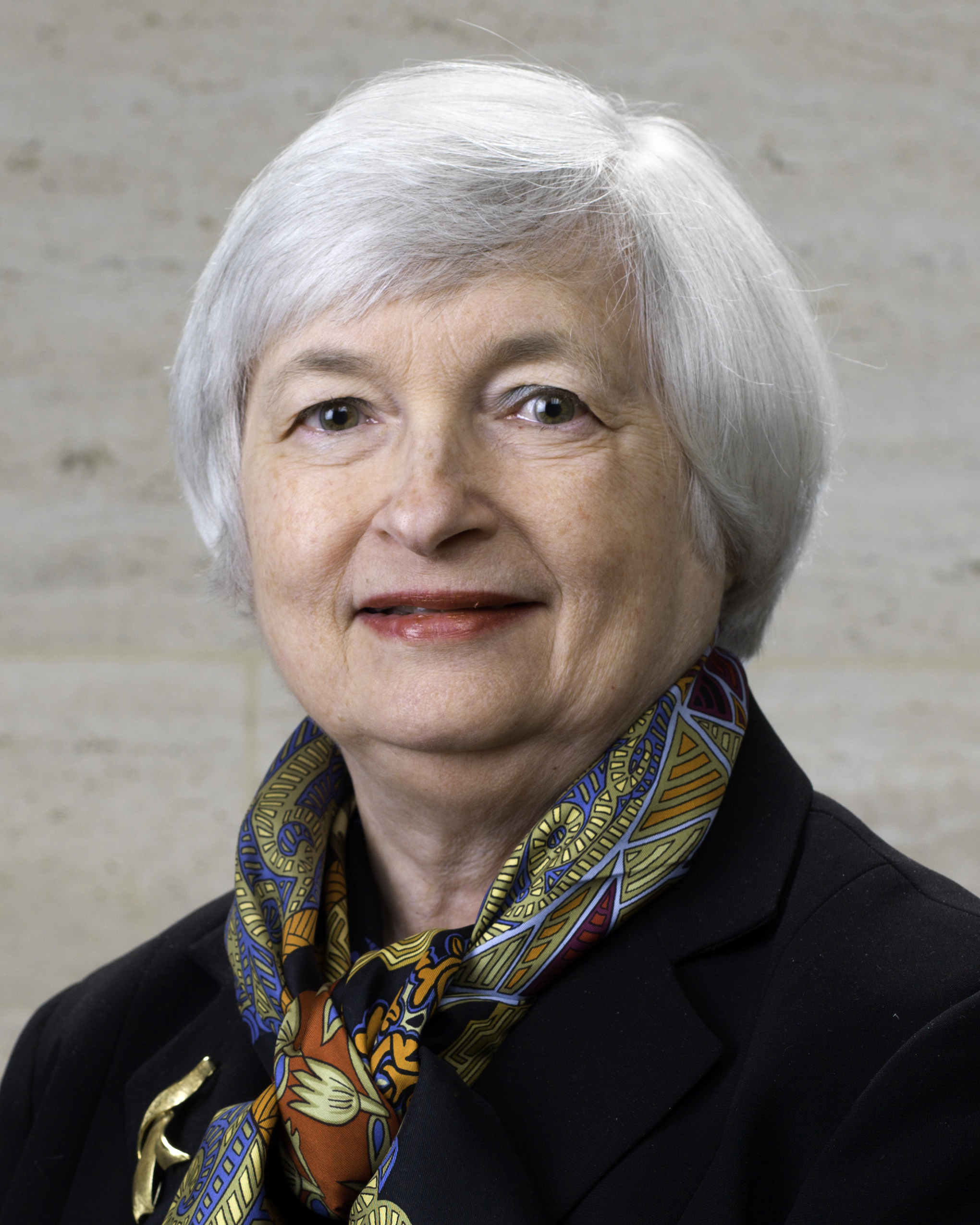
Janet Yellen (Brown University) Feb. 3 2014 – Present

Source: Federal Reserve