
Tag Archives: african american unemployment

African America’s October Unemployment Report – 13.1%

jobs_pic

Overall Unemployment: 7.3% (7.2%)

African America Unemployment: 13.1% (12.9%)

Latino America Unemployment: 9.1% (9.0%)

European America Unemployment: 6.3% (6.3%)

Asian America Unemployment: 5.2% (5.3%)

Previous month in parentheses.

Analysis: Overall unemployment ticked up by 10 basis points. African and Latino American unemployment rate ticked upward by 20 and 10 basis points, respectively. European American unemployment rate remained unchanged. Asian Americans were the only group to see a decline in their unemployment rate. African America remains the only group with double digit unemployment.

African American Male Unemployment: 13.0% (14.0%)

African American Female Unemployment: 11.5% (10.0%)

African American Teenage Unemployment: 36.0% (35.1%)

African American Male Participation: 66.8% (67.9%)

African American Female Participation: 61.3% (61.2%)

African American Teenage Participation: 27.3% (29.4%)

Previous month in parentheses.

Analysis: African American male unemployment drops, but male participation rate also declines by 110 basis points. African American female unemployment see the inverse of males with unemployment rising, while female participation rate bumps up 10 basis points. African American teenagers suffered a double blow of of a rising unemployment rate, while their participation rate dropped by 210 basis points.

Conclusion: The overall economy added 204 000 jobs in October. However, African America saw a decline of 184 000 jobs. The uncertain pattern going into last month has cleared up, but unfortunately the certainty that has come is grimace. Four key employment metrics: labor force, number of employed, employment-population ratio, and participation rate are all at five month lows. The number of unemployed is at its second highest in five months. There is no lipstick to put on this current pig. The best hope there is right now is temporary hiring due to the holidays the next few months, but there is very little in the way for optimism based on current employment patters in African America.
African America’s September Unemployment Report – 12.9%

jobs_pic

Overall Unemployment: 7.2% (7.3%)

African America Unemployment: 12.9% (13.0%)

Latino America Unemployment: 9.0% (9.3%)

European America Unemployment: 6.3% (6.4%)

Asian America Unemployment: 5.3% (5.1%)

Analysis: Overall unemployment dropped 10 basis points. African, European, and Latino Americans saw decreases in their unemployment rates with Latinos seeing the most notable decrease. Asian America saw an uptick but still maintains the lowest unemployment rate of all groups. African America continues to be the only group in double digits.

African American Male Unemployment: 14.0% (13.5%)

African American Female Unemployment: 10.0% (10.6%)

African American Teenage Unemployment: 35.1% (38.2%)

African American Male Participation: 67.9% (66.6%)

African American Female Participation: 61.2% (61.5%)

African American Teenage Participation: 29.4% (28.9%)

*Previous month in parentheses.

Analysis: The unemployment rate for African American men sees a healthy rise of 50 basis points, but participation rate sees its highest number in the past 5 months. African American women see their unemployment rate drop. It worryingly is dropping on the back of the fifth straight month of participation decline for African American women. The teenage group is the only one of the three who sees a drop in unemployment rate and rise in participation. A rare double win for any of the three groups.

Conclusion: The economy added 148 000 jobs as a whole. African American saw a net plus of 151 000 new jobs. The good news is that government hiring picked up, which favors African American employment rising. The bad news is that African America is still too dependent on government employment, something that will continue to be in the crosshairs as governments deal with pension liabilities and other debt. In September, the number of employed African Americans falls dead in the middle with no real trend upwards or downwards over the past five months. The participation rate is at its second lowest over the past five months, but sees its first uptick after four months of straight declines. At this point, the data is hard to get a trending pattern of African American unemployment either way. It could be that for now – no news is good news (or bad news).

Without Intervention, Syria Could Raise African American Unemployment

By William A. Foster, IV

Employment, which Galen calls nature’s physician, is so essential to human happiness that indolence is justly considered as the mother of misery. – Burton

I have often contended that African Americans struggle to look at things from their own interest. It is no secret that when most of America catches the proverbial cold, we seem to catch pneumonia as the saying goes. Often what is good for other communities is bad for us and vice versa, and what is bad for other communities can sometimes be worse for us. The latter seems to be the case of what will happen if America does not intervene in Syria.

Many African Americans are anti-war because of America’s history of imperialism. These concerns are justified but also misled. Nobody has suffered from America’s imperialism domestically more than African Americans. However, America’s ability to be so prosperous is its ability to control much of the resources around the world either through soft or hard power. While this leaves many chastising American policy abroad, rarely is anyone willing to give up their cushion way of American life. Even for African Americans we enjoy a way of life that many around the world wished they had and that we so often still try to integrate ourselves into. Things like running water, electricity, cheaper gas, and many other basic necessities.This happens because American power allows for the scales to be tilted in the favor of American citizens and their institutions. Unfortunately, we control and own very few of these institutions and tend to end up with the leftovers and scraps instead of the main meals of prosperity.

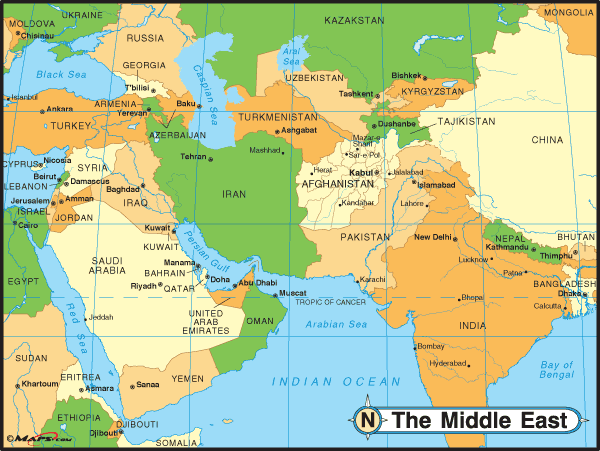
The current African American unemployment rate is 13.0 percent. If the Strait of Hormuz, where 20 percent of the world oil goes through and 35 percent of seaborne traded oil flows, expect American companies to react accordingly. An instant spike of product cost and transportation would most likely lead many companies to cutting labor to deal with the new expenses. Given our history of last hired and first fired due to our dependency on European American owned multinational companies, it would not be hard to imagine that many jobs that we hold in private companies would be in danger upon disruption of the oil supply.

middle_east

Syria on its face is not a major oil supplier and is fairly inconsequential to the actual global oil supply. Timothy Gardener from Reuters in a recent article points out, “Syria has not exported any oil since late 2011, when international sanctions came into force. Prior to the sanctions Syria produced 370,000 barrels per day (bpd), roughly 0.4 percent of global supplies, and exported less than 150,000 bpd, mainly to Europe.” The problem as it were with the Syria situation is just how quickly the situation could be prone to spread to other countries. This possibility alone has caused oil prices to spike more than $8 per barrel since the beginning of August. The many factions at play between Sunni/Shiite groups within Syria and outside influences like Al-qadea, Iran, and others make a complicated matter even more so.

In the end, African America will continue to push the flag of human rights and equality because it is a social value we hold dear in our community. The economic reality for us is another matter in itself and with August numbers showing African American employment at its worst in the past five months the situation in Syria could expedite the downward spiral. Many analyst have already predicted that a U.S. strike could bring oil prices back down. If we want to truly be beholden to our value of human rights, then we ourselves must obtain the economic independence to do so. Whether we like it or not for now, our  economic fate is indeed tied to America’s foreign policy.

African America’s August Unemployment Report – 13.0%

jobs_pic

Overall Unemployment: 7.3% (7.4%)

African America Unemployment: 13.0% (12.6%)

Latino America Unemployment: 9.3% (9.4%)

European America Unemployment: 6.4% (6.6%)

Asian America Unemployment: 5.1% (5.7%)

Analysis: The unemployment rate overall dropped to 7.3 percent. African America is the only group to see their unemployment rate rise and maintains itself firmly in the double digits. Asian America has the most significant drop. Latino and European America saw negligible drops.

African American Male Unemployment: 13.5% (12.5%)

African American Female Unemployment: 10.6% (10.5%)

African American Teenage Unemployment: 38.2% (41.6%)

African American Male Participation: 66.6% (67.6%)

African American Female Participation: 61.5% (62.0%)

African American Teenage Participation: 28.9% (28.4%)

*Previous month in parentheses.

Analysis: The unemployment rate for African American men saw an significant uptick coupled with a dropping participation rate. African American women also experienced an uptick in their unemployment rate while participation rate dropped. Only the teenage group showed improvement in its unemployment rate and participation rate.

Conclusion: The economy added 169 000 new jobs overall. African America saw a decline a 210 000 in its employed ranks. It is the second lowest number of employed African Americans in the past five months and by far its biggest drop in employment over that same period. African America’s labor force is at its lowest in the past five months. The labor force number indicating that many African Americans are simply giving up on the chance of finding employment. The one bit of light in the coal mine is that African American teenagers picked up 30 000 jobs. Overall,  almost every piece of unemployment data is the worse it has been in five months. A frightening measure as many African American families head back into the school year needing to providing more not less.

African America’s July Unemployment Report – 12.6%

jobs_pic

Overall Unemployment: 7.4% (7.6%)

African America Unemployment: 12.6% (13.7%)

Latino America Unemployment: 9.4% (9.1%)

European America Unemployment: 6.6% (6.6%)

Asian America Unemployment: 5.7% (5.0%)

Analysis: The unemployment rate overall dropped to 7.4 percent. African America sees the most significant drop although it remains the only group with double digit unemployment. Latino America and Asian America both experience a rise in their unemployment rate with European America’s rate remaining unchanged.

African American Male Unemployment: 12.5% (13.0%)

African American Female Unemployment: 10.5% (12.0%)

African American Teenage Unemployment: 41.6% (43.6%)

African American Male Participation: 67.6% (67.1%)

African American Female Participation: 62.0% (62.3%)

African American Teenage Participation: 28.4% (28.1%)

*Previous month in parentheses.

Analysis: All African American groups saw a decline in their unemployment rates. However, the women who showed the most significant decline also saw a decline in their participation rate. African American men saw a significant uptick in their participation rate while the teenagers saw a negligible uptick.

Conclusion: The overall economy added 162 000 jobs in the month of July. African America added 228 000 jobs in the month of July. The 16.3 million employed African Americans is the largest employed number in the past five months. The participation rate overall for African America remains unchanged from June’s numbers showing that there has not been much increase in the civilian labor force of African America. It remains at the second lowest participation rate over the past five months. Essentially, those who have been looking for work have maintained but no new surge in confidence about employment opportunities seem to be grasping the rest of African America’s labor force. The female participation rate had a concerning drop as they are the linchpin group of the African American household. Their participation rate is the lowest it has been in the past five months but their number of employed is at its highest in five months so it is a mixed bag of results. Overall, the statistics appear to be moving in the right direction for African America but should be approached with some caution until we see the civilian labor force numbers increasing in conjunction with the employed numbers.