Many people are liberal in principle but reluctant in practice. – John M. Burgess

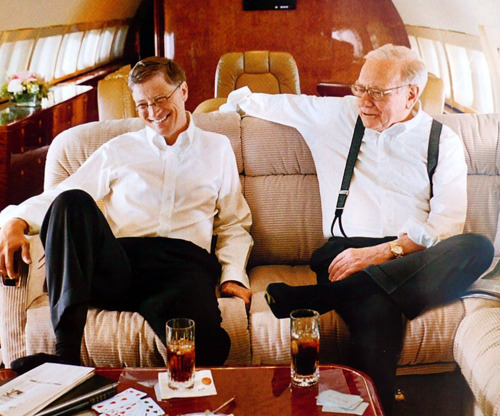
Warren Buffett just recently made a donation of $2 billion to the Bill & Melinda Gates Foundation. A foundation it should be noted with a larger endowment than Bill Gates’ alma mater Harvard. This was after it was reported by Bloomberg that Buffett had earned $12.1 billion over the past twelve months. Now, to be clear I firmly believe that nobody should tell another man what they should or are obligated to do with their resources. However, I have real issues with European American liberals always having solutions to fix African American issues and yet interestingly enough none of those solutions ever involve them relinquishing resources to our control and allowing us to become institutionally equitable. Instead, their solutions are often presented more in a manner resembling the savior complex.
In 2006, Warren Buffett made a $31 billion pledge to the Bill & Melinda Gates Foundation. He stated that he was good at making money and that essentially the Gates Foundation would know how to best use it help the masses. That the Gates Foundation does major “philanthropy” in Africa which arguably given Europe and America’s medical history in Africa always raises red flags. There is also the sidebar of research being funded at the University of Pennsylvania on HBCUs and at Rice University on the history of African American towns. The two schools have a combined endowment value of $10.3 billion. An amount over five times the size of all 100 plus HBCUs combined. Have either suggested that the way to help the institutional issues of HBCUs or African America institutionally is to release some of the assets under their control? No, not once. Just 5 percent of that $10.3 billion endowment would allow a $5 million infusion to all 100 HBCUs.
The current net worth of Gates & Buffett is a combined $134 billion according to Bloomberg’s Billionaire Index. Yes, you read that number correctly. They have pushed for the wealthy to sign the “Giving Pledge” where the wealthiest billionaires pledge to give over fifty percent of their wealth to charity. Ironically, in all of that warm and fuzziness not once does it say that any of the wealth will go into the hands of African American controlled charity or institutions. Again, a donation of $2 billion would be equivalent to 1.5 percent of their combined net worths and yet would double the size of HBCU endowments in a single sign of the pen and allow for all 100 plus HBCUs to receive an infusion of $20 million per school. Again, just 1.5 percent.
I want to make it clear that I do not believe these men should or have to give their money to HBCUs or any African American institution. However, I am simply tired of hearing how much equality is desired in this country when we all know equality is an equity of power and power is derived from institutional control of resources. It is also not to say that these men would not give substantially to HBCUs if they were asked which I have no way of knowing whether or not they have or have not been. However, if the Bill & Melinda Gates Foundation is so in touch with the problems going on in the world it bewilders for me to believe they are not aware of the systematic poverty that impairs African American institutions themselves and how empowering them with actual resources would allow them to greatly impact the social and economic fates of millions of African Americans that HBCUs and their communities serve directly or indirectly.
Instead, what has happened and what will continue to happen is HBCUs will get six-figure grants and such from institutions like the Gates’ Foundation or get a report promoting increasing “diversity” as a means of stopping the flow of African Americans from our institutions as the answer to fix revenue shortfalls. In reality, the reason which seems to be often ignored that so many African Americans started having to choose HWCUs was because they had to go where they were offered the most financial assistance which HBCUs were never in position to do given historical funding discrepancies from the public and private polices of European Americans. There is one segment of European American that would gladly just crush African American institutions into oblivion but at least they are honest about it. The other segment seems intent on ignoring the fact that our situation is what it is because of them but are more than willing to help so long as we acknowledge them for saving us. The Great White Hope who talks a good game but when it comes time to really put their money where their mouth is, I have found more noise in an abandoned cemetery at four in the morning in rural West Virginia.
Dr. Clarke once said that in the early 20th century African Americans were debating between their alliances to the Soviet Union or United States. In the end, they realized that the Soviet Union wanted them to be free no more than the United States but they wanted them under their domination. He went on to say that they realized they were not in a battle between an oppressor and liberator but two oppressors with different methods of oppression. I contend much of the same could be applied on a micro scale as it relates to the relationship African Americans have to European American conservatives and liberals. It often pops up when we use the term of choosing between the “lesser of two evils” when deciding whether to vote Democrat or Republican. Maybe, just maybe it is time stop trying to separate the lot and simply view the situation for what it is.