HBCU Money™ Business Book Feature – Academically Adrift: Limited Learning on College Campuses

academically-adrift

In spite of soaring tuition costs, more and more students go to college every year. A bachelor’s degree is now required for entry into a growing number of professions. And some parents begin planning for the expense of sending their kids to college when they’re born.

Almost everyone strives to go, but almost no one asks the fundamental question posed byAcademically Adrift: are undergraduates really learning anything once they get there? For a large proportion of students, Richard Arum and Josipa Roksa’s answer to that question is a definitive “no.”

Their extensive research draws on survey responses, transcript data, and, for the first time, the state-of-the-art Collegiate Learning Assessment, a standardized test administered to students in their first semester and then again at the end of their second year. According to their analysis of more than 2,300 undergraduates at twenty-four institutions, forty-five percent of these students demonstrate no significant improvement in a range of skills – including critical thinking, complex reasoning, and writing – during their first two years of college. As troubling as their findings are, Arum and Roksa argue that for many faculty and administrators they will come as no surprise – instead, they are the expected result of a student body distracted by socializing or working and an institutional culture that puts undergraduate learning close to the bottom of the priority list.

Academically Adrift holds sobering lessons for students, faculty, administrators, policy makers, and parents – all of whom are implicated in promoting or at least ignoring contemporary campus culture. Higher education faces crises on a number of fronts, but Arum and Roksa’s report that colleges are failing at their most basic mission will demand the attention of us all.

HBCU Money™ Dozen 6/2 – 6/6

12

Did you miss HBCU Money™ Dozen via Twitter? No worry. We are now putting them on the site for you to visit at your leisure. We have made some changes here at HBCU Money™ Dozen. We are now solely focused on research and central bank articles from the previous week.

Research

5 Reasons Why China is Attacking U.S. Tech l CIOonline trib.al/GKVHXfJ

Extreme evolution: How snakes became the über-eater l New Scientist ow.ly/xGKHh

Convert waste CO2 and chicken feathers into fertiliser l New Scientist ow.ly/xGKLJ

World’s Oldest Solar Device l Clean Technicadlvr.it/5txx05

What’s the best approach to building next-generation data center networks? l Network Worldow.ly/xGL7U

Where have all the species gone? Network model explains long-term stagnation in marine life. l APS Physics ow.ly/xGLem

Federal Reserve, Central Banks, & Financial Departments

While the unemployment rate has dropped since late 2009, unemployment duration remains high l St. Louis Fed bit.ly/1t1XlUQ

What is monetary policy? Take our online course to find out l Econ Lowdown bit.ly/1l1oynr

United States Signs $500 Million Loan Guarantee Agreement with Tunisia l Treasury Departmentgo.usa.gov/8sbm

Future population change will likely reduce income and sales tax revenue in every state l KC Fed ow.ly/xGMqj

What Americans (Don’t) Know about Student Loan Collections l NY Fed nyfed.org/UeirCV

Christopher Whalen: Are US home prices falling? l Housing Wire hwi.re/5tNWKq

Thank you as always for joining us on Saturday for HBCU Money™ Dozen. The 12 most important research and finance articles of the week.

The HBCU Money™ Weekly Market Watch

Our Money Matters /\ June 6, 2014

A weekly snapshot of African American owned public companies and HBCU Money™ tracked African stock exchanges.

NAME TICKER PRICE (GAIN/LOSS %)

African American Publicly Traded Companies

Citizens Bancshares Georgia (CZBS) $8.70 (0.00% UNCH)

M&F Bancorp (MFBP) $4.85 (0.00% UNCH)

Radio One (ROIA) $4.39 (0.39% DN)

African Stock Exchanges

Bourse Regionale des Valeurs Mobilieres (BRVM)  232.13 (0.10% UP)

Botswana Stock Exchange (BSE)  9 111.93 (0.03% DN)

Ghana Stock Exchange (GSE)  2 343.98 (9.27% UP)*

Nairobi Stock Exchange (NSE)  149.29 (N/A)

Johannesburg Stock Exchange (JSE) 49 933.99 (0.13% DN)

International Stock Exchanges

New York Stock Exchange (NYSE) 10 904.22 (0.52% UP)

London Stock Exchange (LSE)  3 669.04 (0.77% UP)

Tokyo Stock Exchange (TOPIX)  1 234.57 (0.15% UP)

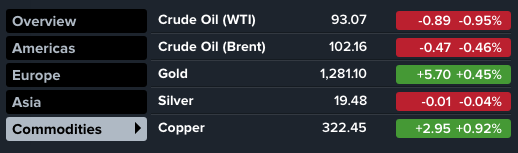
Commodities

Screen Shot 2014-06-06 at 6.36.38 PM

HBCU Money™ Histronomics: S.2510 – Howard University Endowment Act

Howard_University_seal

Sponsor: Dan Quayle (R-IN) – Introduced March 30, 1984

Summary:

Howard University Endowment Act – Authorizes the Secretary of Education to establish an endowment program for Howard University. Authorizes the Secretary, from funds available in any fiscal year for the University, to make grants into the endowment fund established under this Act at the University. Authorizes the Secretary to enter into agreements with the University, including provisions necessary to assure that the purposes of this Act will be achieved.

Requires the University, in order to receive such a grant, to: (1) deposit in the endowment fund an amount equal to such grant; and (2) administer the endowment fund in accordance with the requirements of this Act. Prohibits the source of funds for such institutional match from including Federal funds or funds derived from an existing endowment fund.

Limits the period of any such grant to 20 years. Prohibits the University from withdrawing or expending any of its endowment fund corpus during such grant period. Allows the University, upon expiration of such period, to use the endowment fund corpus plus any endowment fund income for any educational purpose.

Sets forth requirements for investments of the endowment fund corpus and endowment fund income.

Sets forth provisions relating to authorized withdrawals and expenditures of endowment fund income.

Sets forth provisions for enforcement of requirements under this Act.

Makes conforming amendments to specified Federal law relating to Howard University.

Source: Congress.gov

HBCU Money™ Business Book Feature – The Race for What’s Left: The Global Scramble for the World’s Last Resources

9781250023971

From Michael Klare, the renowned expert on natural resource issues, an invaluable account of a new and dangerous global competition

The world is facing an unprecedented crisis of resource depletion—a crisis that goes beyond “peak oil” to encompass shortages of coal and uranium, copper and lithium, water and arable land. With all of the planet’s easily accessible resource deposits rapidly approaching exhaustion, the desperate hunt for supplies has become a frenzy of extreme exploration, as governments and corporations rush to stake their claim in areas previously considered too dangerous and remote. The Race for What’s Left takes us from the Arctic to war zones to deep ocean floors, from a Russian submarine planting the country’s flag on the North Pole seabed to the large-scale buying up of African farmland by Saudi Arabia, China, and other food-importing nations.

As Klare explains, this invasion of the final frontiers carries grave consequences. With resource extraction growing more complex, the environmental risks are becoming increasingly severe; the Deepwater Horizon disaster is only a preview of the dangers to come. At the same time, the intense search for dwindling supplies is igniting new border disputes, raising the likelihood of military confrontation. Inevitably, if the scouring of the globe continues on its present path, many key resources that modern industry relies upon will disappear completely. The only way out, Klare argues, is to alter our consumption patterns altogether—a crucial task that will be the greatest challenge of the coming century.