Category Archives: Lists

HBCU Money™ Business Book Feature – Start with Why: How Great Leaders Inspire Everyone to Take Action

7108725

“A powerful and penetrating exploration of what separates great companies and great leaders from the rest.”
-Polly LaBarre, coauthor of Mavericks at Work

Why are some people and organizations more innovative, more influential, and more profitable than others? Why do some command greater loyalty?

In studying the leaders who’ve had the greatest influence in the world, Simon Sinek discovered that they all think, act, and communicate in the exact same way-and it’s the complete opposite of what everyone else does. People like Martin Luther King Jr., Steve Jobs, and the Wright Brothers might have little in common, but they all started with why.

Drawing on a wide range of real-life stories, Sinek weaves together a clear vision of what it truly takes to lead and inspire.

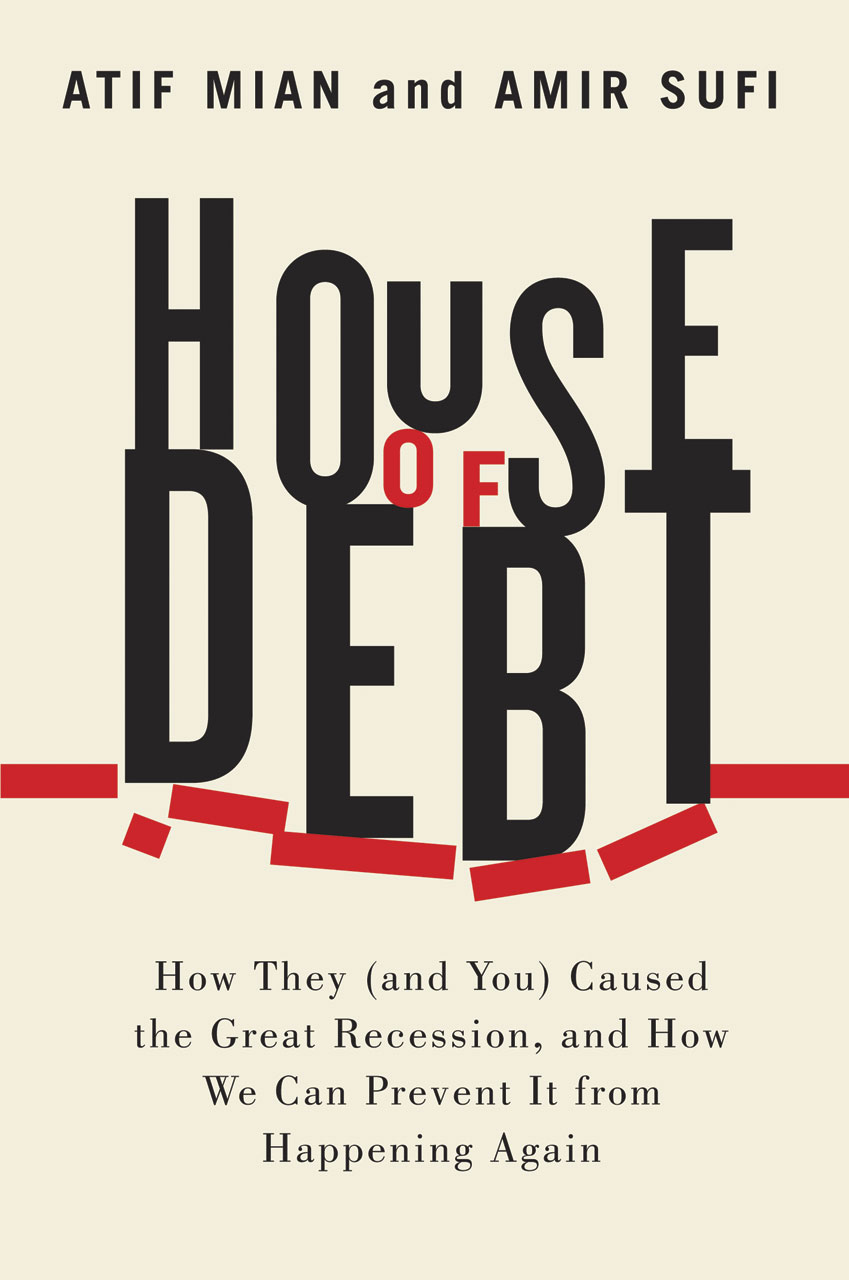
HBCU Money™ Business Book Feature – House of Debt: How They (and You) Caused the Great Recession


9780226081946

The Great American Recession resulted in the loss of eight million jobs between 2007 and 2009. More than four million homes were lost to foreclosures. Is it a coincidence that the United States witnessed a dramatic rise in household debt in the years before the recession—that the total amount of debt for American households doubled between 2000 and 2007 to $14 trillion? Definitely not. Armed with clear and powerful evidence, Atif Mian and Amir Sufi reveal in House of Debt how the Great Recession and Great Depression, as well as the current economic malaise in Europe, were caused by a large run-up in household debt followed by a significantly large drop in household spending.

Though the banking crisis captured the public’s attention, Mian and Sufi argue strongly with actual data that current policy is too heavily biased toward protecting banks and creditors. Increasing the flow of credit, they show, is disastrously counterproductive when the fundamental problem is too much debt. As their research shows, excessive household debt leads to foreclosures, causing individuals to spend less and save more. Less spending means less demand for goods, followed by declines in production and huge job losses. How do we end such a cycle? With a direct attack on debt, say Mian and Sufi.  More aggressive debt forgiveness after the crash helps, but as they illustrate, we can be rid of painful bubble-and-bust episodes only if the financial system moves away from its reliance on inflexible debt contracts. As an example, they propose new mortgage contracts that are built on the principle of risk-sharing, a concept that would have prevented the housing bubble from emerging in the first place.

Thoroughly grounded in compelling economic evidence, House of Debt offers convincing answers to some of the most important questions facing the modern economy today: Why do severe recessions happen? Could we have prevented the Great Recession and its consequences? And what actions are needed to prevent such crises going forward?

HBCU Money™ Business Book Feature – Academically Adrift: Limited Learning on College Campuses

academically-adrift

In spite of soaring tuition costs, more and more students go to college every year. A bachelor’s degree is now required for entry into a growing number of professions. And some parents begin planning for the expense of sending their kids to college when they’re born.

Almost everyone strives to go, but almost no one asks the fundamental question posed byAcademically Adrift: are undergraduates really learning anything once they get there? For a large proportion of students, Richard Arum and Josipa Roksa’s answer to that question is a definitive “no.”

Their extensive research draws on survey responses, transcript data, and, for the first time, the state-of-the-art Collegiate Learning Assessment, a standardized test administered to students in their first semester and then again at the end of their second year. According to their analysis of more than 2,300 undergraduates at twenty-four institutions, forty-five percent of these students demonstrate no significant improvement in a range of skills – including critical thinking, complex reasoning, and writing – during their first two years of college. As troubling as their findings are, Arum and Roksa argue that for many faculty and administrators they will come as no surprise – instead, they are the expected result of a student body distracted by socializing or working and an institutional culture that puts undergraduate learning close to the bottom of the priority list.

Academically Adrift holds sobering lessons for students, faculty, administrators, policy makers, and parents – all of whom are implicated in promoting or at least ignoring contemporary campus culture. Higher education faces crises on a number of fronts, but Arum and Roksa’s report that colleges are failing at their most basic mission will demand the attention of us all.

HBCU Money™ Business Book Feature – The Race for What’s Left: The Global Scramble for the World’s Last Resources

9781250023971

From Michael Klare, the renowned expert on natural resource issues, an invaluable account of a new and dangerous global competition

The world is facing an unprecedented crisis of resource depletion—a crisis that goes beyond “peak oil” to encompass shortages of coal and uranium, copper and lithium, water and arable land. With all of the planet’s easily accessible resource deposits rapidly approaching exhaustion, the desperate hunt for supplies has become a frenzy of extreme exploration, as governments and corporations rush to stake their claim in areas previously considered too dangerous and remote. The Race for What’s Left takes us from the Arctic to war zones to deep ocean floors, from a Russian submarine planting the country’s flag on the North Pole seabed to the large-scale buying up of African farmland by Saudi Arabia, China, and other food-importing nations.

As Klare explains, this invasion of the final frontiers carries grave consequences. With resource extraction growing more complex, the environmental risks are becoming increasingly severe; the Deepwater Horizon disaster is only a preview of the dangers to come. At the same time, the intense search for dwindling supplies is igniting new border disputes, raising the likelihood of military confrontation. Inevitably, if the scouring of the globe continues on its present path, many key resources that modern industry relies upon will disappear completely. The only way out, Klare argues, is to alter our consumption patterns altogether—a crucial task that will be the greatest challenge of the coming century.

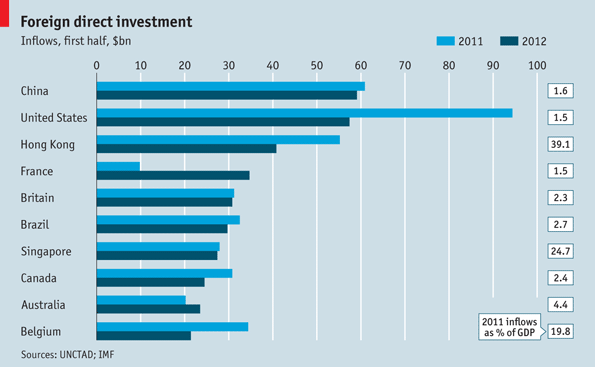
HBCU Money™ B-School: Investing Across Borders Interesting Facts

By World Bank Group

20121027_INC343

Investing Across Sectors

  • More than a quarter of the 87 countries surveyed by Investing Across Borders (IAB) have few or no sector-specific restrictions on foreign ownership of companies.
  • Smaller countries have fewer restrictions on foreign ownership of companies, while larger countries — such as China, Mexico, the Philippines, and Thailand — are among those with the most.
  • Countries in Eastern Europe and Central Asia and Latin America and the Caribbean tend to be the most open to foreign ownership of companies.
  • Though services account for a growing share of global foreign direct investment (FDI), foreign ownership of companies is more restricted in the service sector than in the primary and manufacturing sectors.
  • Worldwide, restrictions on foreign ownership are strictest in media, transportation, electricity, and telecommunications industries.
  • Most countries allow foreign ownership of equity in alternative energy companies — with some countries in Middle East and North Africa being notable exceptions.

Starting a Foreign Business

  • In most countries measured by Investing Across Borders (IAB), starting a foreign company takes longer and requires more steps than starting a domestic company.
  • The most common additional procedure required of foreign companies is the foreign investment approval or declaration, required in 48% of the 87 surveyed countries.
  • In Eastern Europe and Central Asia, the additional procedures required of foreign businesses add only 4 days on average to the total start-up time.
  • Georgia and Rwanda have the fastest process for starting a foreign business of all measured countries.
  • Only 3 of the 87 surveyed countries do not have their commercial laws and regulations publicly available online.
  • Companies are able to download business registration forms in 59% of all measured countries, but only 18% of them offer electronic registration services.
  • Four out of the 87 surveyed countries do not allow foreign companies to hold foreign currency bank accounts.
  • Haiti is the only IAB country where the minimum capital requirements are more favorable for foreign than domestic companies.

Accessing Industrial Land

  • In 1 in 4 of the countries surveyed by Investing Across Borders (IAB), foreign companies cannot own private land.
  • All the countries surveyed allow foreign-owned companies to lease land.
  • More than half the countries surveyed do not allow foreign companies to use land leases as collateral.
  • It takes as little as 10 days to lease private land in Armenia — and as many as 149 days in Nicaragua.
  • Across the 87 IAB countries the average time it takes to lease land from the government is more than twice that required to lease land from a private holder.
  • Nearly two-thirds of countries require an additional approval to authorize the lease of government-held land to foreign companies.
  • In only one-third of countries with both a land registry and cadastre are the two public agencies linked to share data, facilitating information access.
  • Less than half the countries do not provide accessible public documentation on previous environmental impact assessments conducted on industrial lands.

Arbitrating Commercial Disputes

  • All Investing Across Borders (IAB) countries recognize arbitration as a tool for resolving commercial disputes, and only 8 of the 87 countries do not have a specific arbitration law: Albania, Argentina, Bosnia and Herzegovina, Ethiopia, Liberia, Mali, Montenegro, and Poland.1
  • About half of IAB countries have laws that distinguish between domestic and international arbitration.
  • The Czech Republic and Mexico are among 17 IAB countries where businesses can conduct arbitration proceedings online.
  • In most countries in Latin America and the Caribbean, foreign lawyers without local bar membership are not permitted to represent parties in arbitration proceedings.
  • There are no functional arbitration institutions in Cambodia and Sierra Leone, while Colombia and Malaysia have many active institutions.
  • In most countries in East Asia and the Pacific, laws do not require courts to assist during arbitration proceedings with orders for production of evidence or appearance of witnesses. In contrast, 4 of the 5 IAB countries in South Asia legally require domestic courts to assist in arbitrations.
  • Many countries in Eastern Europe and Central Asia have adopted special rules to ensure fast enforcement proceedings of arbitration awards, such as establishing special authorities outside the judiciary to issue writs of execution.

http://iab.worldbank.org/Data/Interesting%20Facts

1.Source: Investing Across Borders 2010.