Category Archives: Economics

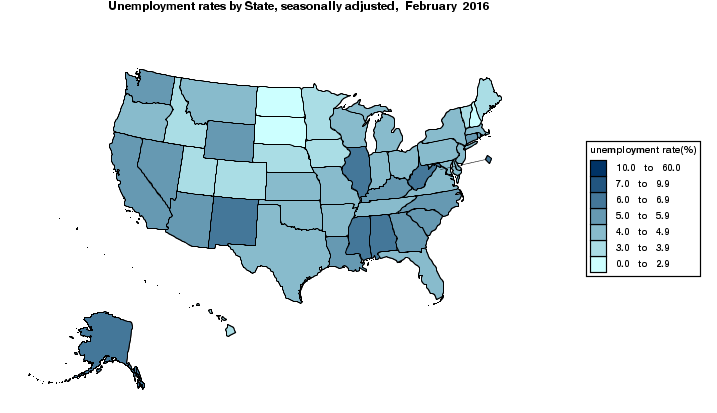
Unemployment Rate By HBCU State – March 2016

Screen Shot 2016-05-10 at 3.47.00 PM

STATES WITH RISING UNEMPLOYMENT: 7

STATES WITH DECLINING UNEMPLOYMENT: 9

STATES WITH UNCHANGED UNEMPLOYMENT: 8

LOWEST: ARKANSAS & VIRGINIA – 4.0%

HIGHEST – DISTRICT OF COLUMBIA & ILLINOIS – 6.5%

STATE – UNEMPLOYMENT RATE (PREVIOUS)*

ALABAMA –  6.2% (6.2%)

ARKANSAS – 4.0% (4.2%)

CALIFORNIA – 5.4% (5.5%)

DELAWARE – 4.4% (4.6%)

DISTRICT OF COLUMBIA – 6.5% (6.5%)

FLORIDA – 4.9% (4.9%)

GEORGIA – 5.5% (5.4%)

ILLINOIS – 6.5% (6.4%)

KENTUCKY – 5.6% (5.8%)

LOUISIANA – 6.1% (5.9%)

MARYLAND – 4.7% (4.7%)

MASSACHUSETTS – 4.4% (4.5%)

MICHIGAN – 4.8% (4.8%)

MISSISSIPPI – 6.3% (6.5%)

MISSOURI –  4.2% (4.2%)

NEW YORK – 4.8% (4.8%)

NORTH CAROLINA – 5.5% (5.5%)

OHIO – 5.1% (4.9%)

OKLAHOMA – 4.4% (4.2%)

PENNSYLVANIA – 4.9% (4.6%)

SOUTH CAROLINA – 5.7% (5.5%)

TENNESSEE – 4.5% (4.9%)

TEXAS – 4.3% (4.4%)

VIRGINIA – 4.0% (4.1%)

*Previous month in parentheses.

African America’s April Jobs Report – 8.8%

jobs

Overall Unemployment: 5.0% (5.0%)

African America Unemployment: 8.8% (9.0%)

Latino America Unemployment: 6.1% (5.6%)

European America Unemployment: 4.3% (4.3%)

Asian America Unemployment: 3.8% (4.0%)

Previous month in parentheses.

Analysis: Overall unemployment rose slightly in the month of April from the previous month. African and Asian American both saw 20 basis point declines.  European America was the only group to go unchanged. Lastly, Latino America has an uptick of 50 basis points in their unemployment rate.

African American Male Unemployment: 9.5% (8.7%)

African American Female Unemployment: 6.9% (8.0%)

African American Teenage Unemployment: 26.0% (25.3%)

African American Male Participation: 68.1% (67.2%)

African American Female Participation: 60.2% (61.5%)

African American Teenage Participation: 29.2% (30.5%)

Previous month in parentheses.

Analysis:African American males had a 80 basis point increase in their unemployment rate and a 90 basis point increase in their participation rate. African American females had a 110 basis point decrease in their unemployment rate and a 130 basis point decrease in their participation rate. African American teenagers unemployment rate increased 70 basis points and participation rate experienced a decrease of 130 basis points.

CONCLUSION: The overall economy added 160 000 jobs in April. African America lost 59 000 jobs in April, the second consecutive decrease in the past five months. The African American labor force also pulled back with a decline of almost 100 000 for a second consecutive month. Nervously, the participation rate is at its lowest over the past five months remains with a very sharp decline of 40 basis points. A divergence from a rate that has been fairly steady as it goes the past five months. There are signs that fresh economic thunderstorms are settling in over the African American economy. The Federal Reserve continues to suppress interest rates, which while keeping the stock market humming along (barely) is also keeping lending tight. The latter being a situation that prevents many of America’s small businesses from hiring and even more potential businesses from even getting off of the ground. If banks can not make enough money off making a loan to a risky small business just opening its doors, then better to park the cash in Treasuries and wait out the interest rate conundrum. Meanwhile, the American economy continues to die a paper cut death. African America’s economy just lost another bank making lending for small businesses and therefore job creation within the community an even higher hurdle to climb, as if jumping over Mount Olympus with a broken leg was not hard enough. Maybe the winds will change, but until the Federal Reserve decides to take the economy off of the low interest rate medicine, then there is very little hope of the economy breaking out into a real sprint. Currently, the downside looks a lot more probable than the upside.

African American needs an increase of 742 000 jobs to match the country’s unemployment rate – a decrease of 37 000 jobs from the previous month.

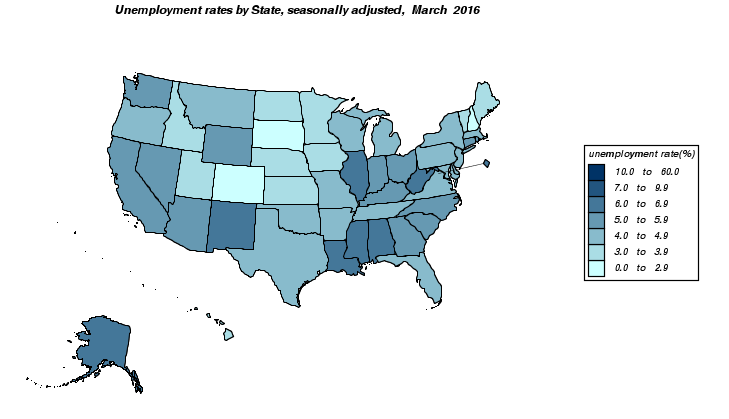
Unemployment Rate By HBCU State – February 2016

Screen Shot 2016-04-04 at 9.55.06 PM

STATES WITH RISING UNEMPLOYMENT: 5

STATES WITH DECLINING UNEMPLOYMENT: 17

STATES WITH UNCHANGED UNEMPLOYMENT: 2

LOWEST: VIRGINIA – 4.1%

HIGHEST – DISTRICT OF COLUMBIA & MISSISSIPPI – 6.5%

STATE – UNEMPLOYMENT RATE (PREVIOUS)*

ALABAMA –  6.2% (5.9%)

ARKANSAS – 4.2% (5.1%)

CALIFORNIA – 5.5% (5.8%)

DELAWARE – 4.6% (5.1%)

DISTRICT OF COLUMBIA – 6.5% (6.6%)

FLORIDA – 4.9% (5.1%)

GEORGIA – 5.4% (5.7%)

ILLINOIS – 6.4% (5.4%)

KENTUCKY – 5.8% (4.9%)

LOUISIANA – 5.9% (6.2%)

MARYLAND – 4.7% (5.1%)

MASSACHUSETTS – 4.5% (4.6%)

MICHIGAN – 4.8% (5.0%)

MISSISSIPPI – 6.5% (5.9%)

MISSOURI –  4.2% (5.0%)

NEW YORK – 4.8% (4.8%)

NORTH CAROLINA – 5.5% (5.7%)

OHIO – 4.9% (4.4%)

OKLAHOMA – 4.2% (4.3%)

PENNSYLVANIA – 4.6% (5.1%)

SOUTH CAROLINA – 5.5% (5.6%)

TENNESSEE – 4.9% (5.6%)

TEXAS – 4.4% (4.4%)

VIRGINIA – 4.1% (4.2%)

*Previous month in parentheses.

African America’s March Jobs Report – 9.0%

jobs

Overall Unemployment: 5.0% (4.9%)

African America Unemployment: 9.0% (8.8%)

Latino America Unemployment: 5.6% (5.4%)

European America Unemployment: 4.3% (4.3%)

Asian America Unemployment: 4.0% (3.8%)

Previous month in parentheses.

Analysis: Overall unemployment rose slightly in the month of March from the previous month. No group to experienced a decline, while European America was the only group to go unchanged. All other groups saw 20 basis point increases in their unemployment rates.

African American Male Unemployment: 8.7% (8.6%)

African American Female Unemployment: 8.0% (7.9%)

African American Teenage Unemployment: 25.3% (23.3%)

African American Male Participation: 67.2% (67.5%)

African American Female Participation: 61.5% (62.0%)

African American Teenage Participation: 30.5% (28.8%)

Previous month in parentheses.

Analysis:African American males had a 10 basis point increase in their unemployment rate and a 30 basis point decrease in their participation rate. African American females had a 10 basis point increase in their unemployment rate and a 50 basis point decrease in their participation rate. African American teenagers unemployment rate increased 200 basis points and participation rate experienced an increase of 170 basis points.

CONCLUSION: The overall economy added 215 000 jobs in March. African America lost 92 000 jobs in March marking the first decrease in the past five months. The African American labor force also pulled back with a decline of almost 60 000 after three months of growth. Thankfully, participation rate over the past five months remains virtually unchanged meaning that African America’s employment situation is basically doggy paddling in the middle of the economic ocean, still. While some believe that improving job conditions are pulling the rest of the nation off the sideline, it appears to be sending African American to it. This could be largely dependent on the types of jobs and where African America is concentrated. An unusual rise for African American teenagers participation rate, while the adults declined. The market and economy are showing modest growth, but the true sustainability of it remains to be seen with so many negative marks in the global macroeconomic environment.

African American needs an increase of 779 000 jobs to match the country’s unemployment rate – an increase of 20 000 jobs from the previous month.

Federal Reserve Chairwoman Janet Yellen’s March 2016 Press Conference (Video)

Excerpt from March Press Conference with Chairwoman Janet Yellen:

“Consistent with its statutory mandate, the Committee seeks to foster maximum employment and price stability. The Committee currently expects that, with gradual adjustments in the stance of monetary policy, economic activity will expand at a moderate pace and labor market indicators will continue to strengthen. However, global economic and financial developments continue to pose risks. Inflation is expected to remain low in the near term, in part because of earlier declines in energy prices, but to rise to 2 percent over the medium term as the transitory effects of declines in energy and import prices dissipate and the labor market strengthens further. The Committee continues to monitor inflation developments closely.”

Full Press Conference & FOMC Statement: