Category Archives: Economics

African America’s November Jobs Report – 8.6%

jobs

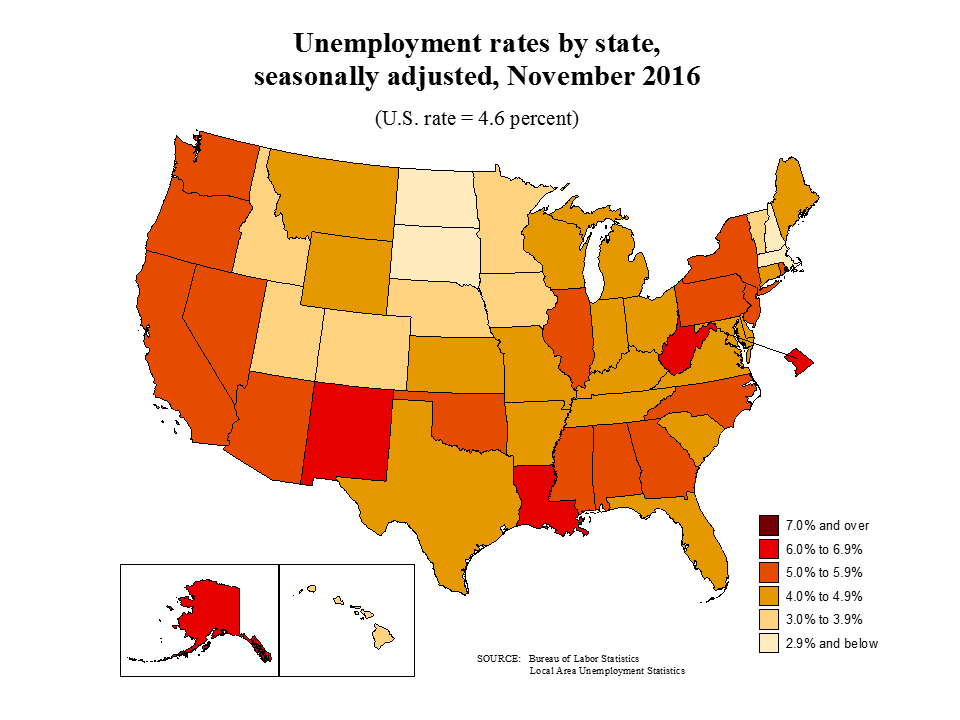
Overall Unemployment: 4.6% (4.9%)

African America Unemployment: 8.1% (8.6%)

Latino America Unemployment: 5.7% (5.7%)

European America Unemployment: 4.2% (4.3%)

Asian America Unemployment: 3.0% (3.4%)

Previous month in parentheses.

Analysis: Overall unemployment dropped 30 basis points to its lowest since August 2007. All groups except Latino America saw a decline in their unemployment rate, who saw their unemployment rate go unchanged. African, Asian, and European America saw declines of 50, 40, and 10 basis points, respectively.

African American Male Unemployment: 7.7% (8.7%)

African American Female Unemployment: 7.1% (7.1%)

African American Teenage Unemployment: 26.6% (27.6%)

African American Male Participation: 67.5% (67.5%)

African American Female Participation: 62.6% (62.3%)

African American Teenage Participation: 28.0% (28.3%)

Analysis: African American men saw a 100 basis point decrease in their unemployment and no change in their participation rate. African American women saw no change in their unemployment rate and 30 basis point increase in their participation rate. African American teenagers saw a 100 basis point decrease in their unemployment rate and a 30 basis point decrease in their participation rate.

CONCLUSION: The overall economy added 178 000 jobs in November. A noticeable difference from the 161 000 in October. African America added a substantial 154 000 jobs in November. Leading to the highest African American employed numbers in the past five months. Unfortunately, despite such robust jobs growth in the month, the participation rate for African American moved only 10 basis points. The participation rate simply refusing to break from this five month bandwidth. All key variables were in the green in an unprecedented fashion, participation rate aside. The labor force increased, employed increased, and unemployed went down. December looms with a rate hike on the horizon and just how it will impact economic planning by small and big businesses alike will not be known for months. The psychological impact of the moment alone will be of significant given one has not happen in almost ten years. Also of note, for the first time since December of 2015, average hourly earnings took a dip.

African America currently needs 505 000 jobs to match America’s unemployment rate. A decrease of 218 000 jobs from October.

African America’s October Jobs Report – 8.6%

jobs

Overall Unemployment: 4.9% (5.0%)

African America Unemployment: 8.6% (8.3%)

Latino America Unemployment: 5.7% (6.4%)

European America Unemployment: 4.3% (4.4%)

Asian America Unemployment: 3.4% (3.9%)

Previous month in parentheses.

Analysis: Overall unemployment was virtually unchanged. All groups except African America saw a decline in their unemployment rate, who saw a 30 basis point increase in their unemployment rate. Asian, European, and Latino America saw declines of 50, 10, and 70 basis points, respectively.

African American Male Unemployment: 8.7% (8.2%)

African American Female Unemployment: 7.1% (7.0%)

African American Teenage Unemployment: 27.6% (27.2%)

African American Male Participation: 67.5% (67.5%)

African American Female Participation: 62.3% (62.3%)

African American Teenage Participation: 28.3% (30.2%)

Analysis: African American men saw a 50 basis point increase in their unemployment and no change in their participation rate. African American women saw a 10 basis point increase in their unemployment rate and no change in their participation rate. African American teenagers saw a 40 basis point increase in their unemployment rate and a 190 basis point decrease in their participation rate.

CONCLUSION: The overall economy added 161 000 jobs in October. A marginal difference between the 156 000 in September. African America saw a decline of 70 000 jobs in October. The last jobs report before 2016 U.S. presidential election. What does African America’s outlook like now there is a president-elect Donald Trump? It is truly hard to say. The natural reaction is visceral, but there is the possibility that his election continues to galvanize African America to invest in itself and become less dependent on other groups.

African America currently needs 723 000 jobs to match America’s unemployment rate. An increase of 89 000 jobs from August.

Unemployment Rate By HBCU State – July 2016

Screen Shot 2016-09-06 at 12.48.25 AM

STATES WITH RISING UNEMPLOYMENT: 9

STATES WITH DECLINING UNEMPLOYMENT: 10

STATES WITH UNCHANGED UNEMPLOYMENT: 5

LOWEST: VIRGINIA – 3.7%

HIGHEST – LOUISIANA – 6.3%

STATE – UNEMPLOYMENT RATE (PREVIOUS)*

ALABAMA –  5.7% (6.0%)

ARKANSAS – 3.9% (3.8%)

CALIFORNIA – 5.5% (5.4%)

DELAWARE – 4.3% (4.2%)

DISTRICT OF COLUMBIA – 5.9% (6.0%)

FLORIDA – 4.7% (4.7%)

GEORGIA – 5.0% (5.1%)

ILLINOIS – 5.8% (6.2%)

KENTUCKY – 4.9% (5.0%)

LOUISIANA – 6.3% (6.2%)

MARYLAND – 4.3% (4.3%)

MASSACHUSETTS – 4.1% (4.2%)

MICHIGAN – 4.5% (4.6%)

MISSISSIPPI – 6.0% (5.9%)

MISSOURI –  4.7% (4.5%)

NEW YORK – 4.7% (4.7%)

NORTH CAROLINA – 4.7% (4.9%)

OHIO – 4.8% (5.0%)

OKLAHOMA – 5.0% (4.8%)

PENNSYLVANIA – 5.6% (5.6%)

SOUTH CAROLINA – 5.2% (5.4%)

TENNESSEE – 4.3% (4.1%)

TEXAS – 4.6% (4.5%)

VIRGINIA – 3.7% (3.7%)

*Previous month in parentheses.

African America’s August Jobs Report – 8.1%

jobs

Overall Unemployment: 4.9% (4.9%)

African America Unemployment: 8.1% (8.4%)

Latino America Unemployment: 5.6% (5.4%)

European America Unemployment: 4.4% (4.3%)

Asian America Unemployment: 4.2% (3.8%)

Previous month in parentheses.

Analysis: Overall unemployment was unchanged. All groups except African America saw a rise in their unemployment rate, who saw a 30 basis point decline in their unemployment rate. Asian, European, and Latino America saw rises of 40, 10, and 20 basis points, respectively.

African American Male Unemployment: 7.6% (8.2%)

African American Female Unemployment: 7.1% (7.3%)

African American Teenage Unemployment: 26.1% (25.7%)

African American Male Participation: 67.3% (67.7%)

African American Female Participation: 62.2% (61.0%)

African American Teenage Participation: 31.6% (27.7%)

Analysis: African American men saw a 60 basis point decline in their unemployment, but also saw a 40 basis point decline in their participation rate. African American women saw a 20 basis point decline in their unemployment rate, but a 120 basis point increase in their participation rate. African American teenagers saw 40 basis point increase in their unemployment rate, but a 390 basis point increase in their participation rate.

CONCLUSION:The overall economy added 151 000 jobs in August. A significant drop the 255 000 in July. However, African America added an unprecedented 280 000 jobs in August after only 31 000 jobs in July. This marks only the second time since HBCU Money started reporting the African American Jobs Report that African America’s job growth has outpaced overall America. The overall jobs though did come in less than estimates of 180 000, which has many questioning whether or not the Federal Reserve and Chairwoman Janet Yellen will actually raise rates or continue to kick the can down the road.

African America currently needs 634 000 jobs to match America’s unemployment rate. A decrease of 46 000 from July.

Federal Reserve’s 2015 Economic Household Well Being Report

BlackFamily-Smiles-940x380

KEY FINDINGS

  • Sixty-nine percent of adults report that they are either “living comfortably” or “doing okay,” compared to 65 percent in 2014 and 62 percent in 2013. However, 31 percent, or approximately 76 million adults, are either “struggling to get by” or are “just getting by.”
  • Thirty-two percent of adults report that their income varies to some degree from month to month, and 43 percent report that their monthly expenses vary to some degree. Forty-two percent of those with volatile incomes or expenses say that they have struggled to pay their bills at times because of this volatility.
  • Forty-six percent of adults say they either could not cover an emergency expense costing $400, or would cover it by selling something or borrowing money (47 percent in 2014).
  • Twenty-one percent of those who borrowed to attend a for-profit institution are behind on their loan payments. Among those who borrowed to attend a public or not-for-profit institution, 7 percent and 5 percent are behind on their payments, respectively.
  • Thirty-one percent of non-retired respondents report that they have no retirement savings or pen- 2 Economic Well-Being of U.S. Households, 2015 sion at all, including 27 percent of non-retired respondents age 60 or older.

FULL REPORT CLICK HERE.