Category Archives: Municipalities

Ohio’s Unclaimed Billions Could Empower Central State and Wilberforce Instead of Enriching the NFL

You can’t have political power unless you have economic power. You can’t have economic power unless you own something. — Dr. Claud Anderson

In the quiet towns of Wilberforce, Ohio, two institutions — Central State University and Wilberforce University — have stood for generations as monuments of African American intellectual resilience and historical fortitude. Founded in eras when the very idea of African American higher education was radical, both institutions have graduated engineers, entrepreneurs, theologians, and teachers who seeded entire Black communities with knowledge and leadership. Yet, in 2025, they remain financially fragile — their endowments barely grazing the thresholds needed for robust institutional health.

Meanwhile, Governor Mike DeWine just approved $600 million in state funds — sourced from Ohio’s $4.8 billion in unclaimed assets — to support the Cleveland Browns’ new domed stadium in Brook Park, an NFL franchise owned by billionaires. The Haslam Sports Group, the Browns’ owners, is contributing an additional $1.2 billion to the project, and Cuyahoga County is expected to round out the financing with another $600 million. The stadium, estimated at $2.4 billion, is framed as a jobs and tourism engine — the typical rationale for professional sports subsidies. But beneath the surface lies a deeply racialized economic pattern: Black bodies as capital, Black institutions as afterthoughts.

Let us state this plainly — $200 million in endowment funding (split between Central State and Wilberforce University) would account for just 4.17% of the $4.8 billion in unclaimed assets Ohio plans to repurpose. Yet it would transform the future of two of America’s most storied HBCUs, whose total combined endowments likely do not reach even $20 million today.

The $200 Million That Could Rebuild Black Educational Futures

An endowment is the economic engine of institutional independence. It enables faculty hiring, scholarships, research labs, infrastructure repair, and the kind of multi-generational planning that insulates a university from the unpredictable winds of politics and philanthropy.

  • Central State University, Ohio’s only public HBCU, receives state support — but suffers from persistent underfunding compared to Ohio’s predominantly white public institutions.
  • Wilberforce University, a private HBCU affiliated with the African Methodist Episcopal Church and the first college owned and operated by African Americans, has been in survival mode for decades, enduring accreditation threats and enrollment declines — largely due to chronic financial starvation.

A $100 million endowment per institution, conservatively managed with a 5% annual drawdown, would provide each HBCU with $5 million per year in perpetuity. That’s enough to:

  • Offer full-ride scholarships to dozens, if not hundreds, of students.
  • Endow faculty chairs in business, STEM, and African American studies.
  • Fund campus maintenance and restoration for aging facilities.
  • Launch centers focused on African American policy, agriculture, or entrepreneurship.
  • Reduce reliance on tuition and thus open doors to more low-income students.

In short, it would empower these institutions to build, not just survive.

Meanwhile, the Billionaire NFL Franchise Gets a Taxpayer Bailout

The Cleveland Browns’ new stadium is not just an economic development plan — it’s a public-funded monument to private wealth. Let us remember: The NFL is a tax-exempt cartel whose franchises are operated by billionaires and whose profits — through broadcast rights, luxury boxes, and merchandise — soar year after year.

The public rationale for subsidizing stadiums is that they will generate jobs, tourism, and long-term economic vitality. Yet, study after study from economists across ideological spectrums consistently shows that these promises are overstated or entirely unfounded. Most NFL stadiums create a short-term construction boom, followed by long-term debt and opportunity costs.

But perhaps more galling is this: the economic lifeblood of the NFL is disproportionately Black men. While roughly 13% of the U.S. population is Black, nearly 60% of NFL players are African American. These players, often trained in underfunded high schools, many from single-parent households and first-generation college trajectories, generate billions — yet the communities and institutions from which they originate remain underdeveloped and neglected.

It is a grotesque inversion: Black talent builds white wealth, while Black institutions remain marginal.

Black Athletes, White Wealth, and the Poverty of Institutional Ownership

The NFL, and by extension the Cleveland Browns, benefits from a system where the labor is Black, but the ownership is almost entirely white. Out of 32 NFL teams, only one have non-white principal owners: Shahid Khan, a Pakistani-American who owns the Jacksonville Jaguars.

Meanwhile, no HBCU alum holds equity in any major professional sports franchise, despite HBCUs being core contributors to the American athletic pipeline that fuels leagues like the NFL and NBA.

Despite producing generations of elite athletes, coaches, and sports executives, no collective of HBCU alumni has leveraged its wealth or influence to acquire equity in a major professional sports franchise, leaving the economic rewards of Black athletic labor concentrated elsewhere.

Imagine a model where Ohio had used even half of the $600 million to create a Black Education & Sports Endowment, partially controlled by a consortium of HBCUs, Black public schools, and community development organizations. The returns from that endowment could support thousands of students, community health centers, literacy programs, and STEM labs for generations.

Instead, we see yet another example of extractive economics, where African American physical, cultural, and intellectual capital is used to build empires for others, while Black institutions — including HBCUs — remain dependent on begging, philanthropy, and hope.

Why Unclaimed Funds Should Serve The Forgotten

Ohio’s decision to redirect $1.7 billion in unclaimed funds to cover state expenditures is fiscally creative — but morally questionable. These are not “free” funds. They are monies left in dormant bank accounts, uncashed checks, unclaimed insurance payouts — many of which disproportionately belong to low-income individuals who lacked the resources or knowledge to retrieve them.

Data suggests that Black Americans are disproportionately represented among unclaimed property holders — in part due to higher levels of economic displacement, address changes, and financial exclusion. Redirecting these funds to subsidize an NFL franchise, instead of redressing the institutional and educational gaps that created that unclaimed status, is a betrayal.

Ohio could have:

  • Created a permanent Black Higher Education Trust, benefiting Central State and Wilberforce.
  • Used 5% of unclaimed funds — about $240 million — to fund Black-led public health initiatives in underserved areas.
  • Directed even 1% of those funds — roughly $48 million — to finance land acquisition and economic development for Black-owned businesses.

Instead, we’ve chosen to rescue billionaires from spending their own money.

HBCU Endowments Are An Economic Empowerment Issue — And the Gateway to Political Power

Endowments are more than just financial assets. They are strategic tools of power — insulating institutions from political winds, enabling bold experimentation, and giving their stakeholders the leverage to influence policy, not just plead for it.

For African America, the chronic undercapitalization of HBCUs is not merely a funding gap — it is an economic power vacuum that undercuts the entire community’s ability to advocate effectively for systemic redress.

While Williams College and Bowdoin College — small liberal arts schools with fewer than 2,500 students — boast endowments of $3.7 billion and $2.58 billion respectively, many HBCUs operate with endowments under $50 million, and some under $10 million. This discrepancy is not accidental. It is the compounding result of centuries of exclusion from generational wealth accumulation, philanthropic networks, and public investment.

Until African American institutions — especially HBCUs — are armed with independent and sizable capital, they will remain vulnerable to the whims of legislatures, accreditation bodies, and philanthropic trends. Worse, they will lack the institutional might to challenge inequity in courtrooms, boardrooms, and ballot boxes.

The fight for reparations, education equity, health justice, and fair housing requires leverage — and leverage requires capital. Political power without economic power is temporary and transactional. But economic power institutionalized through endowments can translate into permanent seats at the table, not just access to it.

Endowing HBCUs, then, is not a charitable gesture. It is a foundational strategy for African American sovereignty and redress. Without institutions that are capable of outlasting election cycles and media trends, African America will continue fighting uphill with borrowed tools and limited voice.

Ohio had a chance to fund that future. Instead, it chose to subsidize a stadium — once again reminding us: until we build our own institutions, we will always be asked to cheer from the stands while others profit from our play.merican educational infrastructure for the next 100 years. Instead, he invested in a stadium with a 20-year shelf life.

Choose the Future You Fund

In 2029, a new domed stadium will open in Brook Park. It will gleam with LED lights and imported steel. It will be filled with cheering fans on Sundays and concerts on Saturdays. The Browns may even win a playoff game or two.

But just 50 miles away, on the campuses of Wilberforce and Central State, students will still walk cracked sidewalks. Professors will still work on contracts. Students will still withdraw for financial reasons.

Unless Ohio chooses to invest in the institutions that nurture and protect Black futures, those futures will continue to be harvested but never planted.

This is not just about football. It is about the future of Black Ohio. And whether our institutions will ever be allowed to rise beyond survival — and into sovereignty.

Disclaimer: This article was assisted by ChatGPT.

Student Loans and Tax Credits: A Creative Plan to Solve the Student Loan Crisis

“A hunch is creativity trying to tell you something.” – Frank Capra

Once upon a time in the bustling town of Gradsville, there lived a recent college graduate named Tim. Armed with a shiny diploma and a mountain of student loans, Tim was ready to take on the world, or so he thought. After months of job hunting, he finally landed a gig at a local coffee shop, where he expertly crafted lattes while dreaming of his future as a high-powered executive.

One fateful morning, as he was frothing milk, Tim received an email from his loan servicer. The subject line read: “Your Student Loan Repayment Starts Now!” His heart raced. He opened the email, and there it was: a number so big it could compete with the national debt. Tim squinted at the screen, convinced it was a prank. “This must be a mistake!” he muttered, spilling a little espresso on his apron.

Determined to tackle the situation, he decided to devise a plan. Tim figured if he couldn’t pay his loans, he might as well make the most of his situation. So, he took his trusty old bicycle, painted it bright pink, and outfitted it with a sign reading, “Will Work for Student Loan Payments!” He rode around town, ringing a tiny bell and offering to do odd jobs for anyone willing to pay him in cash.

At first, the townsfolk were amused. Mrs. Jenkins, the elderly lady down the street, hired him to weed her garden. Tim spent hours pulling weeds, but when he presented her with the bill, she handed him a cookie instead. “This is for the effort, dear,” she said sweetly.

Undeterred, Tim pressed on. He mowed lawns, walked dogs, and even became a local celebrity for his “Bicycle Karaoke” sessions, where he belted out off-key renditions of pop songs while pedaling through the park. “I will survive!” he sang, as people threw coins into his basket.

But as the days turned into weeks, Tim realized he was raking in more laughs than cash. One evening, after a particularly exhausting day, he collapsed on his couch, exhausted and broke. Just then, his phone buzzed. It was an alert from his loan servicer: “Your payment is due tomorrow!”

In a moment of desperation, Tim decided to get creative. He hosted a “Loan Repayment Comedy Show” at the coffee shop, charging admission and promising a night of laughter. The townsfolk packed the place, eager to see the local hero make fun of his financial woes. Tim took the stage, and with each joke, he poked fun at his debt, his job, and even his pink bicycle.

By the end of the night, he had raised enough money to make his first payment. The crowd cheered, and Tim realized something important: while student loans were a burden, laughter was the best way to lighten the load.

With a new plan in mind, he turned his bike into a mobile comedy machine, spreading joy and occasionally collecting spare change. And just like that, Tim learned that sometimes, the best way to deal with life’s challenges is to find humor in them—even if it involves a pink bicycle and a lot of bad singing!

In a landscape where the burden of student debt looms over millions of Americans, I offer a glimmer of hope with an innovative proposal. Tax Credits. The creative use of tax credits can be designed to alleviate the financial strain of student loans. 

The cost of higher education continues to soar. As of 2025 higher education costs are nearly $35,000 per year for private institutions and over $10,000 for public universities. Over 45 million borrowers now collectively owe over $1.7 trillion in student debt. This staggering figure has become a significant hurdle for graduates entering the workforce, hindering their ability to invest in homes, start businesses, and contribute to local economies.

What exactly is the problem?

The student loan crisis has reached critical levels. According to the Federal Reserve, approximately one in five borrowers is in default or delinquency, while the average monthly payment for federal student loans hovers around $400. For many, this payment is a substantial chunk of their income, especially for young professionals just starting their careers. The implications extend beyond individual borrowers; they ripple through the economy, stifling growth and innovation. We are currently bordering on student loans reaching levels where they pose systemic risk to the entire system.

The proposed solution is tax credits for individuals and institutions.

To address this escalating issue, a two-pronged solution is proposed: tax credits for individuals repaying student loans and tax credits for institutions that implement aggressive debt reduction initiatives.

1.  Tax Credits for Individuals: This initiative would provide borrowers with a tax credit for every dollar they pay toward their student loans. Currently only student loan interest is tax deductible up to $2,500 per year. Under this new proposal full student loan payments become tax deductible. For example, someone with a $400 a month student loan payment will pay $4,800 in a full tax year. That $4,800 becomes a tax credit that can be used to lower their income tax burden. This would not only ease the financial burden but also encourage timely repayments, ultimately reducing the total outstanding debt. 


2. Additional Tax Credits for Individual payments to the loans of others. Under this new tax provision taxpayers who actively make student loan payments on behalf of other student loan holders can also receive a dollar-for-dollar tax credit.

3. Tax Credits for Private Entities: By aligning private institutional interests with the economic well-being of the public, private institutions would be motivated to contribute to the solution of student loan debt. Imagine Apple or JP Morgan deciding to allocate several billion a year to paying student loans of private citizens in exchange for tax credits. If the top 200 companies in the S&P 500 committed $1 billion each year to paying student loans it would mean that over a 10 year stretch nearly all student loans can be eliminated. Imagine a highly educated populace without the burden of student loan debt.

There are major benefits across the board.

This solution has the potential to benefit various stakeholders, including the wealthy, corporations, higher education institutions and local and state economies.

Wealthy individuals could see tax deductions that encourage more investment into the broader economy with the new capital. Simultaneously they also can benefit from a more educated workforce that drives productivity and innovation into the future.

Corporations would gain from a more skilled labor pool without the financial burden of student debt hindering employees’ productivity. Companies could also leverage tax credits to invest in employee education programs, enhancing workforce skills while reducing tax liabilities.

Higher Education Institutions benefit through potential students and current students now knowing that they can comfortably pursue educational goals without the fear of post graduate debt crippling their ability to perform in the labor force.

Local and state economies would see a revival as graduates with reduced debt would have more disposable income to spend on housing, goods, and services. This consumption can lead to job creation and increased tax revenues, offsetting some of the initial losses from the tax credits.

Like most policy shifts there will be opposition.

Despite its potential benefits, this proposal would likely face opposition from several parties. Conservative fiscal policymakers may argue that tax credits could lead to significant revenue losses for the federal government, exacerbating the national debt.  From a social standpoint there is bound to be criticisms of unfairness from individuals that did not attend college. Additionally, some economists may present a potential moral hazard in the form of people focusing too much on education and delaying real world labor pursuit. This has the potential to slow the proliferation of qualified labor into the workforce.

Estimating Revenue Loss for the Federal Government

Implementing such a tax credit system is not without its costs. Estimates suggest that the federal government could lose approximately $20 billion annually in tax revenue if the credits are widely adopted. This figure reflects both the individual tax relief provided to individuals and the institutional incentives for corporations. While this loss could raise concerns about funding for other critical programs, proponents will likely argue that the long-term economic benefits of a more educated populace and a healthy economy would outweigh the initial financial drawbacks.

In conclusion, the proposal for tax credits aimed at alleviating the student loan crisis presents a promising solution to a pressing problem. By aligning the interests of individuals, corporations, and the economy, this approach could pave the way for a brighter future, where education is an investment rather than a burden. As the conversation around student debt continues, it is crucial to explore innovative solutions that can lead to systemic change.

The Lessons of Harvey: Businesses Need To Be Integrated Into City’s Emergency Plans

“As cities have grown rapidly across the nation, many have neglected infrastructure projects and paved over green spaces that once absorbed rainwater.” –  Charles Duhigg

By William A. Foster, IV

One of my favorite shows is Star Trek and one of the most memorable characters was from the Voyager series, Seven of Nine. She was a former Borg, a species that strived for perfection and efficiency. Despite being separated from the Borg, she remained rooted in their values of striving for perfection and efficiency. Humanity often is very reactive at times in its striving for efficiency. This is especially true when it comes to natural disasters. Often times when we think we are prepared for the absolute worse, Mother Nature says, “Hold my drink.” and proceeds to exceed even our expectations of just what is possible from her. Worst case scenarios by municipalities have been time and time again blown out of the water (no pun intended) over the past few decades as climate change appears to be bringing about more volatile natural disasters.

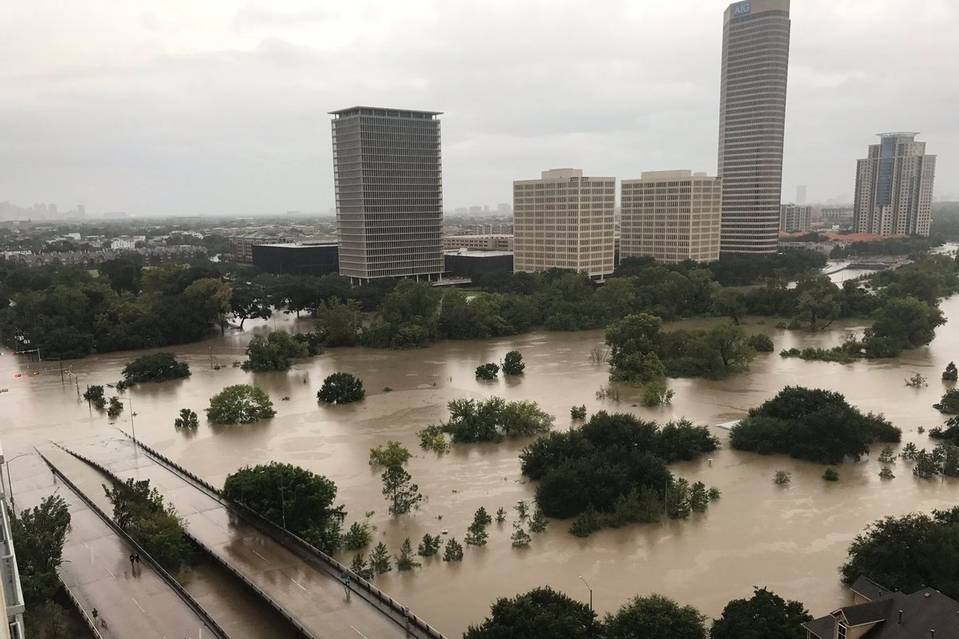
Over the past decade, Houston has seen a population boom since the Great Recession. While the rest of the country struggled Houston thrived and expanded almost 22 percent over the period thanks to triple digit oil prices. A construction boom inside Houston’s inner loop, historically a place most Houstonians avoided, took root. To the point, developers could not build fast enough for the population influx coming in from around the country. In the process though some serious infrastructure problems have started to arise. Houston was already notorious for flooding, now as developers took lots where once a single-family residence stood and put three to four townhouses on them, green space drastically reduced and the notorious flooding has become even worse with water having virtually nowhere to go. Enter, Harvey.

To be fair, Harvey is an unusual beast of spectacular fashion, although Irma may prove to be the start of a trend. Somewhere between 10-15 trillion gallons are what is expected to have dropped into the city of Houston after Hurricane and Tropical Storm Harvey was done. It is an unprecedented event for the fourth-largest city in the United States. To put it in perspective, imagine the entire state of Delaware which is comparable to Greater Houston’s almost 2300 square miles of geography, with six times the population being submerged under water. Greater Houston’s population is well over six million and the last time a mass evacuation was tried twelve years ago, more people died in the evacuation than in the actual storm. It would likely require Houston a week or two to have a calm organized evacuation that did not overwhelm the city and state’s highways and roads. And perhaps at this point, trying to evacuate people is just the wrong idea. There are so many logistical and socioeconomic problems with trying to do so, all one needs is to look back on Hurricane Katrina for a reality check of why it is nearly impossible to do so.

So how can a city like Houston and others learns from the lessons of Harvey? Often times, what we need is right in front of our face. In the case of Harvey, the case is no different. Having to drive throughout the city during the storm where virtually every business was closed something striking occurred to me. Office buildings that were over ten stories were ghost ships, while most shelters are assigned to schools and churches that are usually no more than two stories. The office building ghost ships,  that is to say that there was absolutely no one in them are an untapped asset in the city’s emergency infrastructure. As of 2015, Houston had 50 office buildings under construction totaling almost 18 million square feet of space. The locations of these buildings are widespread like Houston covering areas like downtown, the Energy Corridor/West Houston, the Woodlands (north), and others around the city creating a virtual net of buildings that if properly prepared with their owners could have been used at emergency shelters far above the flooding waters and much shorter distances to travel for Houstonians than what was comprised. The city’s major convention center, George R. Brown Center, was turned into the central hub of evacuation. Unfortunately, Houston’s geography is expansive. The city at its widest points can easily take almost two hours to get to the city center by car when traffic is not impaired. Couple that with low storied churches and schools and it is easy to see why office buildings which are more plentiful throughout the city could be a vital addition to emergency planning. What obstacles could be holding them back?

I suspect three main issues. One, the city’s planning department would need to ensure future buildings include potential emergency use in the developer’s plans. It would also require these buildings, their owners, and their tenants to be part of any emergency planning committee that would go into action should it be required. Almost the equivalent of a volunteer emergency force. Second, the additional cost that could be associated with fitting current and future buildings for such a task must be shouldered somehow. These costs that could certainly be offset by favorable tax credits for a period of time, municipal subsidizing, etc. The third issue would be security of sensitive information. I can not stress how vital this would be in considering which office buildings to consider given the sensitivity of identity theft both on a individual and institutional level. Again, all three of these things are logistical things that can be handled accordingly.

Every time we think we have seen the worst that Mother Nature has to throw at us, the ante seems to be upped just a little (or lot) more. We are continuing to change the dynamics by which we interact with our environment and in turn how the environment interacts with us. The burden of just how we handle future stresses that the natural disasters may pose will take a more broad minded and efficient strategy than what we currently use. Moving and evacuating large bodies of people will only get less and less likely in cities where density is increasing. One of the key to taking on a lot of weight is to spread out the weight so that it is properly balanced. The same goes for cities when it comes to disasters.