Author Archives: hbcumoney

The Finance & Tech Week In Review – 7/22/17

Every Saturday the HBCU Money staff picks ten articles they were intrigued by and think you will enjoy for some weekend reading impacting finance and tech.

Cows Produce Powerful HIV Antibodies / Science News http://ow.ly/M7U630dQSt2

Fire ants build tall towers that are constantly sinking and being rebuilt / Science News http://ow.ly/xsRt30dQSzt

Digital drinking buddy replaces ill-advised tweets with cat pics / New Scientist 

God vs the multiverse: The 2500-year war / New Scientist 

Could your data-intensive research use a boost? / Argonne 

Forget coding, we need to teach our kids how to dream / WEF 

Would the minimum wage increase have helped only St. Louis City residents? / St. Louis Fed 

Explore the regional impact of the Boston Fed / Boston Fed 

When will we see a Tesla of the skies? / WEF

Why ‘cashless societies’ don’t benefit the poor / WEF 

Unemployment Rate By HBCU State – May 2017

STATES WITH RISING UNEMPLOYMENT: 5

STATES WITH DECLINING UNEMPLOYMENT: 16

STATES WITH UNCHANGED UNEMPLOYMENT: 3

LOWEST: ARKANSAS – 3.4%

HIGHEST: DISTRICT OF COLUMBIA – 6.0%

STATE – UNEMPLOYMENT RATE (PREVIOUS)*

ALABAMA –  4.9% (5.4%)

ARKANSAS – 3.4% (3.5%)

CALIFORNIA – 4.7% (4.8%)

DELAWARE – 4.7% (4.6%)

DISTRICT OF COLUMBIA – 6.0% (5.9%)

FLORIDA – 4.3% (4.5%)

GEORGIA – 4.9% (5.0%)

ILLINOIS – 4.6% (4.7%)

KENTUCKY – 5.0% (5.1%)

LOUISIANA – 5.7% (5.8%)

MARYLAND – 4.2% (4.3%)

MASSACHUSETTS – 4.2% (3.9%)

MICHIGAN – 4.2% (4.7%)

MISSISSIPPI – 4.9% (5.0%)

MISSOURI –  3.9% (3.9%)

NEW YORK – 4.4% (4.3%)

NORTH CAROLINA – 4.5% (4.7%)

OHIO – 4.9% (5.0%)

OKLAHOMA – 4.3% (4.3%)

PENNSYLVANIA – 5.0% (4.9%)

SOUTH CAROLINA – 4.1% (4.3%)

TENNESSEE – 4.0% (4.7%)

TEXAS – 4.8% (5.0%)

VIRGINIA – 3.8% (3.8%)

*Previous month in parentheses.

African America’s June Jobs Report – 7.1%

Overall Unemployment: 4.4% (4.3%)

African America Unemployment: 7.1% (7.5%)

Latino America Unemployment: 4.8% (5.2%)

European America Unemployment: 3.8% (3.7%)

Asian America Unemployment: 3.6% (3.6%)

Previous month in parentheses.

Analysis: Overall unemployment rose 10 basis points. This was a rise from the lowest levels since May 2001. African and Latino America dropped 40 basis points, while Asian and European America were negligible in their change.

African American Male Unemployment: 6.3% (6.5%)

African American Female Unemployment: 6.8% (7.0%)

African American Teenage Unemployment: 21.1% (27.3%)

African American Male Participation: 67.5% (67.5%)

African American Female Participation: 62.4% (62.9%)

African American Teenage Participation: 30.8% (31.3%)

Analysis: All three African American groups saw decreases in their unemployment rate, but it was the Teenage group who led the way with an astounding 620 basis point drop. Participation rates though for women and teenagers both declining, while the men had no change.

African American Male-Female Job Gap: 945 000 jobs (1 038 000 jobs)

CONCLUSION: The overall economy added 222 000 jobs in June. This exceeded many economists expectations. African America saw a job increase came in at 16 000, a fourth straight month of job gains. However, job growth appears to be slowing after two months ago coming in at 100 000 and the month prior being at 46 000. Still this is the highest number of employed that African America has seen overall in sometime. Explaining job growth for the country let alone African America at this point has reached a guessing game for many economists. The participation rates continue to be a concern overall, especially among men who continue to see their number slide and women’s participation rate remains erratic at best.

African America currently needs 608 000 jobs to match America’s unemployment rate. A decrease of 108 000 from May.

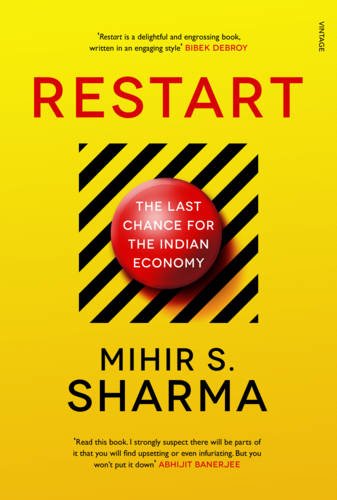
HBCU Money™ Business Book Feature – Restart: The Last Chance for the Indian Economy

Farms, not factories. When industry is the path to prosperity. Ancient, archaic laws When the majority of Indians are less than 25 years old. Armies of unemployed. When companies are hunting for skilled workers. Half-built highways. When its people dream of speed. Indias problems can seem overwhelming. But solutions exist.

In Restart, Mihir S. Sharma shows what can and must change in Indias policies, its administration and even its attitudes. The answers he provides are not obvious. Nor are they all comforting or conventional. Yet they could, in less time than you can imagine, unleash the creativity of a billion hopeful Indians.