Author Archives: hbcumoney

HBCU Money™ B-School: How To Start An Airline

Boeing_787

How many HBCU owned airlines are there in America? Zero. How many African American owned airlines are there in America? Zero. In Africa, the story is quite different with a number of airlines popping up over the past five years in the ownership hands of native Africans. So it appears we have some catching up to do with our brethren in the motherland. Given HBCUs are often flush with engineering talent, one HBCU owned airline alone could create massive job opportunities. Jet Blue employs almost 14 000 people and is one of the smallest low fare regional airlines, while one of the bigger regional players Southwest Airlines employs almost 50 000.

However, starting an airline is not for the faint of heart and maybe one of the hardest entrepreneurial challenges one can take on. Boeing’s airline startup page says, “Few businesses have as many variables and challenges as airlines. They are capital-intensive. Competition is fierce. Airlines are fossil fuel dependent and often at the mercy of fuel price volatility. Operations are labor intensive and subject to government control and political influence. And a lot depends on the weather.” However, if you are up to the challenge of finding a niche in the space, then you are on your way to creating a multi-billion company since the industry average of value is $2.7 billion (below) according to Yahoo Finance.

Screen Shot 2015-01-10 at 1.39.04 PM

So visit Startup Boeing’s website here and as the Nat King Cole song says and quoted in the Tuskegee Airmen movie of 1995, “Straighten up and fly right.”

A New Threat To African American Owned Media Launched By Comcast/NBC

“I do not expect the white media to create positive black male images.” – Huey Newton

nbc_blk_logo_rev-straight-v2_web_7741563203e89c8803b5c80acc45a42b

I have to say when this first came across my feed I thought it was a hoax. NBC, a wholly owned subsidiary of Comcast, would not really be getting into culture specific media. I was wrong, then I was worried. Below is the editorial release from Amber Payne, Editor of NBCBLK: 

NBCBLK covers stories by, for and about the black community. Our product is meant to elevate America’s conversation about black identity, politics, and culture. We share positive, solution-based journalism and report on challenging issues that communities of color face today. NBCBLK taps NBC News journalists around the world to tell these stories, and we curate reports from NBC News platforms — Nightly, Today Show, Dateline, and local affiliates among other NBC outlets.

We welcome your ideas, your feedback, and your perspective.

It goes without saying that it is already difficult to get many African Americans to consider African American news outlets first when they consume media be it newspapers, television, radio, or digital media. Many in African America often feel validated when other communities promote businesses targeted at us as some form of acceptance.  It goes back to the old saying about our perception of white ice being colder than black ice. In media, it is even more complicated given its ability to shape the values and ideals of its consumer. When news breaks on anything relating to our community very rarely do we as African Americans turn first to our news sources. Even covering the Mike Brown, Trayvon Martin, and other police shootings almost none of my Facebook feed posted articles relating to the matter from an African American owned media outlet. According to BlackNews.com, “There are currently about 200 different black newspapers in about 150 different cities across the United States. Many cities, such as Los Angeles and New York, have more than one paper.”  This is not including digital only sites like HBCU Money, HBCU Digest, and many other HBCU owned sites. Granted, we are lacking in television station ownership and have a fleeting ownership of radio stations, but when it comes to digital newspapers and magazines we have a strong presence, but it is under consumed by our communities.

This latest foray by NBC will potentially only make that even more difficult as we consistently turn to European American owned outlets to get our point of view. CNN, MSNBC, NY Times, just to name a few or the ones like NBCBLK who cater to African Americans with European American ownership such as The Root, BET, and even TVOne to some degree given its complex partnership with you guessed it, Comcast. Their views of us often shaped by internal politics and biases be they liberal or conservative.

And who is benefiting from this media asset? Well to know that you would have to know who Comcast major shareholders (below) are. The top ten institutions that own Comcast shares are a who’s who among major financial institutions, none of which are African American owned.

Screen Shot 2015-01-23 at 6.05.27 PM

Therefore every click and view that the new site receives is only increasing the financial value of these media and financial institutions outside of our community’s ownership and control. However, African American owned media should not shy away from this challenge or competition. Competition is the business we are in and to reach our audience we must think ahead of the curve and create value that they can not get anywhere else, but it goes without saying they are instantly a game changer. That sound you hear? African American owned media company CEOs and presidents rushing to their war rooms.

HBCU Money™ Business Book Feature – Ebony & Ivy: Race, Slavery, & the Troubled History of America’s Universities

512ekThWQUL

A 2006 report commissioned by Brown University revealed that institution’s complex and contested involvement in slavery—setting off a controversy that leapt from the ivory tower to make headlines across the country. But Brown’s troubling past was far from unique. In Ebony and Ivy, Craig Steven Wilder, a rising star in the profession of history, lays bare uncomfortable truths about race, slavery, and the American academy.

Many of America’s revered colleges and universities—from Harvard, Yale, and Princeton to Rutgers, Williams College, and UNC—were soaked in the sweat, the tears, and sometimes the blood of people of color. The earliest academies proclaimed their mission to Christianize the savages of North America, and played a key role in white conquest. Later, the slave economy and higher education grew up together, each nurturing the other. Slavery funded colleges, built campuses, and paid the wages of professors. Enslaved Americans waited on faculty and students; academic leaders aggressively courted the support of slave owners and slave traders. Significantly, as Wilder shows, our leading universities, dependent on human bondage, became breeding grounds for the racist ideas that sustained them.

Ebony and Ivy is a powerful and propulsive study and the first of its kind, revealing a history of oppression behind the institutions usually considered the cradle of liberal politics.

HBCU Money™ Dozen 1/19 – 1/23

december12

Did you miss HBCU Money™ Dozen via Twitter? No worry. We are now putting them on the site for you to visit at your leisure. We have made some changes here at HBCU Money™ Dozen. We are now solely focused on research and central bank articles from the previous week.

Research

BlackBerry issues futile call for ‘app neutrality’ l Network World ow.ly/HNePp

EU should oblige Internet firms to hand over encryption keys, says antiterrorist advisor l CIOonline trib.al/tcp6U5y

Report: Apple Watch aims to last 19 hours per charge l Macworld dlvr.it/8Bv8dR

Learn how oysters promote healthy coasts l NOAA 1.usa.gov/1ATlTQW

6 products that will protect your privacy l Network World bit.ly/1CjHvtX

New research re-creates planet formation, super-Earths, giant planets l Livermore Lab 1.usa.gov/1yy3j3H

Federal Reserve, Central Banks, & Financial Departments

The pace of poverty reduction in Ethiopia has been impressive—Ethiopia Poverty Assessment l World Bank wrld.bg/HL5GL

What are potential indirect effects of attending a certain type of high school? l St. Louis Fed bit.ly/1xE6kLN

How can we foster the ongoing innovation of online content? l Davos wef.ch/1yGSfBJ

Study finds unique opportunity for women in Family Businesses l CPI Financial ow.ly/HNUHA

Five Simple Questions That Reveal Your Financial Health and Wealth l St. Louis Fed bit.ly/1Cjp5JE

Drop in oil prices is 3rd largest since WWII. All 9 commodities are weakening l World Bank wrld.bg/HPvK1

Thank you as always for joining us on Saturday for HBCU Money™ Dozen. The 12 most important research and finance articles of the week.

The HBCU Money™ Weekly Market Watch

Our Money Matters /\ January 23, 2015

A weekly snapshot of African American owned public companies and HBCU Money™ tracked African stock exchanges.

NAME TICKER PRICE (GAIN/LOSS %)

African American Publicly Traded Companies

Citizens Bancshares Georgia (CZBS) $8.90 (0.00% UNCH)

M&F Bancorp (MFBP) $4.50 (0.00% UNCH)

Radio One (ROIA) $1.80 (6.25% DN)

African Stock Exchanges

Bourse Regionale des Valeurs Mobilieres (BRVM)  249.86 (0.05% UP)

Botswana Stock Exchange (BSE)  9 497.33 (0.09% DN)

Ghana Stock Exchange (GSE)  2 183.24 (3.44% DN)*

Nairobi Stock Exchange (NSE)  166.68 (N/A)

Johannesburg Stock Exchange (JSE) 48 816.57 (0.11% DN)

International Stock Exchanges

New York Stock Exchange (NYSE) 10 788.33 (0.65% DN)

London Stock Exchange (LSE)  3 664.41 (0.53% UP)

Tokyo Stock Exchange (TOPIX)  1 403.22 (0.99% UP)

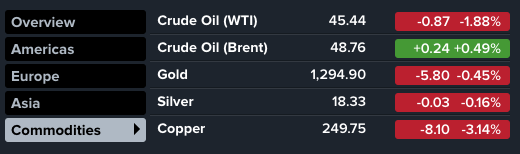
Commodities

Screen Shot 2015-01-23 at 3.59.27 PM