
“It is not wrong to go back for that which you have forgotten.” — Akan Proverb (Sankofa)
I have been an adjunct professor at a community college for over three years now. Each semester, I pose a simple but revealing question to my students: “Why are you in college?”
The responses rarely vary. “To get a job.” “To have a career.” “To make money.”
It is always with the best of intentions, but as we know, the road to hell is paved with just that. The deeper concern isn’t just what they say—it’s what they don’t know they are saying. Their words echo the hollowed-out purpose of an institution increasingly seen as a conveyor belt to corporate compliance, not intellectual or spiritual emancipation.
The tragedy is not just that college has become a transactional space—it is that most students no longer see what is missing.
A Dangerous Assumption: The Degree as Destiny
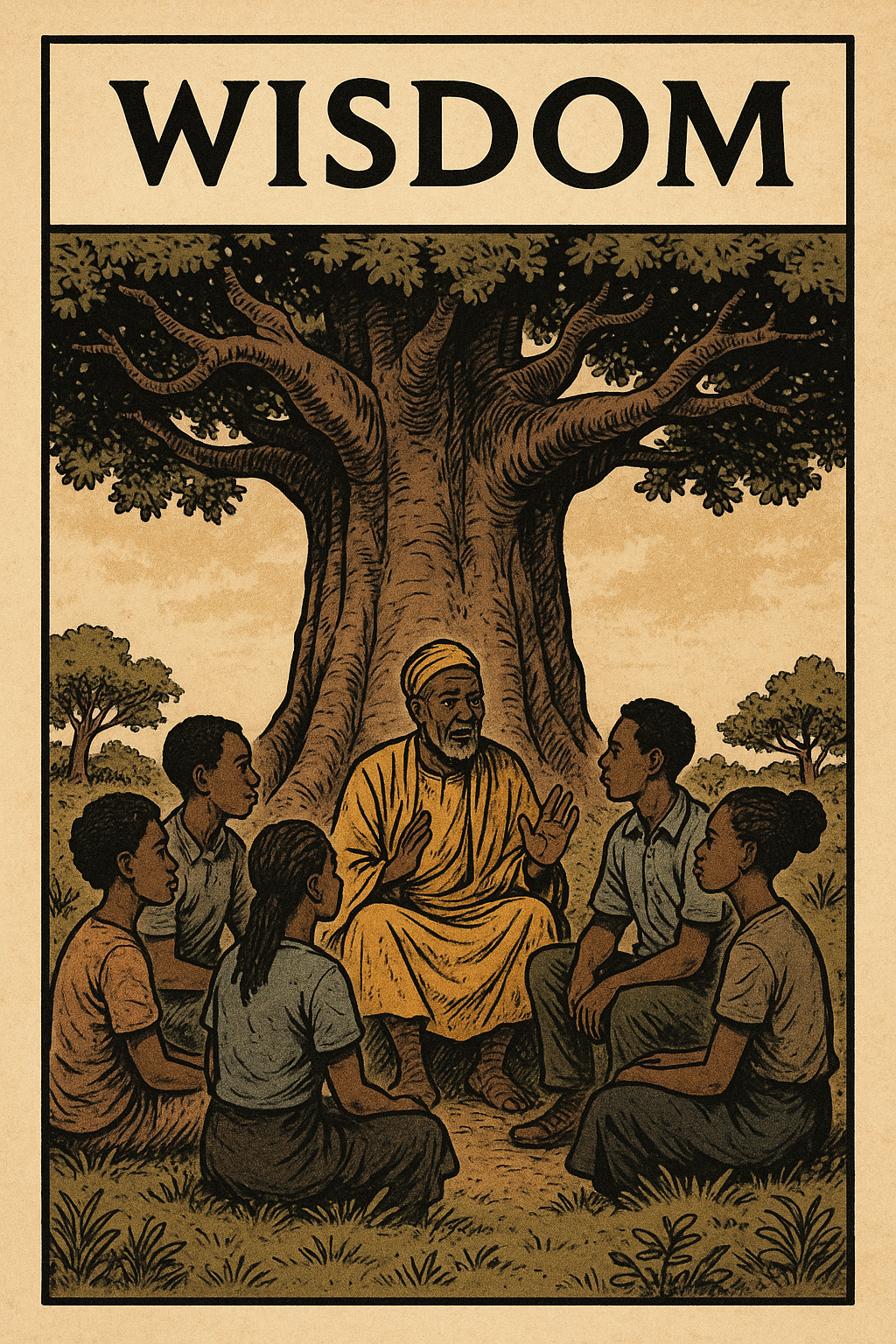
In traditional West African thought, especially among the Yoruba, Ashanti, and Dogon peoples, education was never merely about utility. It was about becoming. It wasn’t just about what one could do in the world, but who one was becoming in the process of doing. Wisdom (or ọgbọn) was holistic, rooted in spirit, culture, lineage, and ethical alignment.
In stark contrast, American colleges today are increasingly sold to students as pipelines into labor markets. The neoliberal restructuring of higher education has succeeded in stripping the classroom of its sacredness. Students arrive not as seekers of truth or participants in community-building, but as clients seeking a credential.
They are not wrong to want a better future. But the belief that a degree alone secures a path to success is dangerously outdated. Labor markets are global and brutally competitive. And yet, most students have no concept of what it means to be in labor competition or how to distinguish themselves in a sea of sameness.
They do not know this is a contest because no one has told them it is.
College as Corporate Farm System
The unspoken arrangement between college and corporation mirrors that of a sports minor league. Students are recruited, trained, disciplined, and filtered for usefulness. It is no longer about a community of learners, but a pool of potential employees.
Students are assessed not on the strength of their ideas or their empathy for others, but on GPA, punctuality, compliance, and increasingly, soft skills—a euphemism for the ability to conform without friction.
In this model, students become “pre-workers,” graded not just academically but for “employability.” The path to the corporation becomes the primary purpose. The majors, the minors, the co-curriculars—all orbits around this gravitational center.
We must ask: when did the university stop being a space of liberation and become an internship waiting room?
The Cultural Theft of the Intellectual Spirit
Among the Igbo, the concept of Uche represents deep thought and the reasoning capacity of the individual, connected to community values. In Mande philosophy, the griots were not just musicians—they were living libraries, guardians of memory and morality. Education in these contexts required introspection, storytelling, ritual, and intergenerational exchange.
Modern academia has no griots. It has PDFs.
Students are flooded with information but left without wisdom. They learn statistics but not social context. They study algorithms but never ask, “Should this be built?” They can diagram a sentence but struggle to speak with conviction about who they are or what they owe the world.
This is the intellectual poverty of college-as-job-training. It leaves students technically prepared but spiritually bankrupt.
The Lost Opportunity of Human Development
College could be—and once tried to be—a sacred place. A place where students read James Baldwin and bell hooks in the same semester. Where they wrestled with Du Bois’ double consciousness or Ngũgĩ wa Thiong’o’s Decolonising the Mind. Where poetry and engineering sat at the same dinner table.
Instead, students now rush through degree plans like a to-do list, burdened by debt and starved for reflection.
The irony? Most students don’t even know what they missed. Because they were never told that college was supposed to be anything more.
This is the perverse genius of capitalism—it doesn’t just steal your labor; it makes you grateful for it. And when it fails you, it says: you must not have tried hard enough.
Sankofa: Reclaiming What Was Left Behind
The West African principle of Sankofa invites us to return to the past to retrieve what we’ve lost. In the context of higher education, this means reviving the idea of college as a rite of passage. As a collective journey toward know thyself.
Students must be re-taught to ask not just, “What job do I want?” but also:
- Who am I becoming?
- What is my relationship to the earth, to my people, to time?
- What problems am I here to solve?
- What history is encoded in my blood?
These are not abstract questions. They are survival questions.
And the answers cannot be outsourced to ChatGPT or LinkedIn.
The Labor Competition That No One Told Them About
Ask your students, “Are you in labor competition?” Most won’t know what you mean. But they are. Fiercely so.
They are competing against peers not just in their state, but across continents. They are up against rising automation, temporary gigs, and an unforgiving algorithmic HR culture. And yet, no one has taught them how to think strategically about their learning, their networks, or their future.
In West African wisdom, the hunter (ode) does not walk into the forest unaware of his prey. He studies the tracks, the winds, the seasons. He understands his tools, but more importantly, his limitations.
Students today must be taught how to become hunters of opportunity—not scavengers of job listings.
The Role of the Teacher as Elder and Not Just Instructor
In many African traditions, the teacher was not just a transmitter of knowledge but a shaper of souls. In the Yoruba Ita tradition, the elder doesn’t just instruct—he listens, counsels, and corrects with compassion. Teaching was deeply relational.
Yet, American higher education treats adjuncts like gig workers. There is no time or value placed on mentorship, on intergenerational intimacy, on the sacred trust between elder and learner.
If the classroom is to be a village, then the professor must be more than a taskmaster. We must become what the Akan call Nananom Nsamanfo—the wise ancestors-in-training who guide without domination.
The Corporate Mirage of “Success”
Let us not mistake the corner office for true elevation. Many students are being trained for jobs that will not exist in 10 years. They are being groomed to serve an economy that has no loyalty to them.
The African philosophy of Ubuntu teaches that “I am because we are.” What if success was not a solo climb, but a collective lift?
We must replace the myth of individual upward mobility with a more grounded sense of communal striving. A degree should not just lift one person—it should lift a family, a neighborhood, a people.
Otherwise, what is the point?
The Spiritual Toll of False Promises
When the yellow brick road turns into a dead end, students don’t just suffer economically. They suffer spiritually.
They feel betrayed, ashamed, and often, alone.
They were told that college was the answer. And when that answer doesn’t deliver, they think the fault lies with them—not the system.
This is educational gaslighting. And it has consequences. It breeds disillusionment, disengagement, and generational cynicism.
If colleges cannot be honest about what they are and what they are not, then they must not be surprised when students walk away from them.
Toward A New College Vision Rooted in African Thought
Let us dream, then, of a new kind of college. One that takes seriously the principles of:
- Sankofa – return and remember
- Ubuntu – relationship and community
- Ọgbọ́n – wisdom and ethical discernment
- Uche – deep critical thought
- Nommo – the power of the word and naming
Let us imagine a college where philosophy is not an elective but a foundation. Where entrepreneurship is taught alongside ethics. Where majors are less about marketability and more about mission.
Where the goal is not just to earn but to become.
The Path Forward Must Be Reclaimed
Beauty may be skin deep, but ugly is to the bone. And the perception of college as a glorified HR prep course is deeply, systemically ugly. It reflects not just a misalignment of values but a degradation of purpose.
College must be reclaimed not as a minor league for corporations but as a site of cultural, intellectual, and spiritual resurrection.
The African proverb says, “Until the lion learns to write, every story will glorify the hunter.”
It is time for students, educators, and communities—especially those of us rooted in African traditions—to begin writing new stories.
Not just for the classroom.
But for the world.
 HBCU Money