
Strike an enemy once and for all. Let him cease to exist as a tribe or he will live to fly in your throat again. – Shaka Zulu, Advice to King Dingiswayo on the treatment of the defeated Ndwanwes
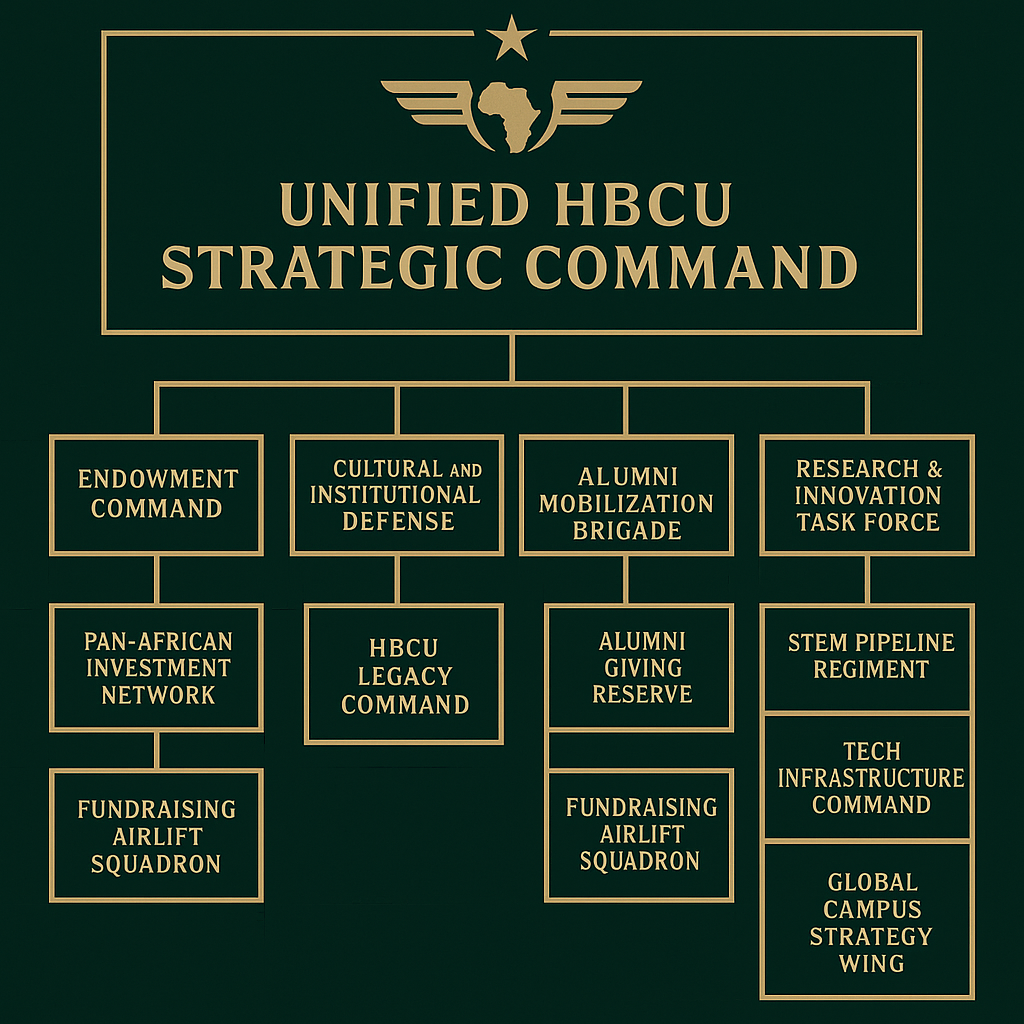
The Battle for the Black Mind
At the beginning of the 20th century, African American higher education was a mission of survival. By the end of the century, it had become a struggle for relevance. Today, the nation’s Historically Black Colleges and Universities (HBCUs) face a different kind of warfare—one not waged on battlefields but in boardrooms, budget hearings, and data dashboards. Declining endowments, limited research funding, a shrinking pool of Black male students, and encroachment by Predominantly White Institutions (PWIs) on their traditional demographic base has left many HBCUs strategically adrift.
But what if the remedy lies not in education reform think tanks or philanthropic patchwork, but in the unlikeliest of quarters—military strategy?
In the art of war, commanders engage in a disciplined process known as the “Estimate of the Situation.” Codified in U.S. military doctrine, this method assesses terrain, adversaries, capabilities, and courses of action before deciding how to marshal forces to achieve objectives. It is a doctrine of clarity, decisiveness, and ruthless prioritization—traits HBCUs, long forced into reactive postures, desperately need. If deployed correctly, it may offer a blueprint for survival and supremacy.
Terrain and Threat Assessment
The educational terrain for HBCUs is marked by systemic deprivation. While the Ivies and flagship publics boast endowments in the billions—Harvard’s at over $50 billion and the University of Texas System’s UTIMCO fund at $66 billion—only a handful of HBCUs cross the $100 million threshold. In 2024, Howard University led with a $908 million endowment, trailed by Spelman College ($569 million) and Hampton University ($379 million). By contrast, many HBCUs hover in the single-digit millions, dependent on volatile tuition revenue and susceptible to enrollment shocks.
Their adversaries are both external and internal. PWIs, emboldened by racial reckoning post-George Floyd, have launched aggressive DEI (Diversity, Equity, and Inclusion) marketing campaigns targeting high-achieving Black students, faculty, and even entire academic programs traditionally incubated within HBCUs. These institutions are mimicking HBCU cultural strengths while wielding superior infrastructure, funding, and media amplification.
Internally, decades of underfunding by state legislatures, inconsistent leadership pipelines, and fractured alumni giving have made coordination among HBCUs difficult. Public HBCUs often answer to politically hostile boards or governors who see their growth as optional, not imperative. In some Southern states, Black institutions are funded at levels far below their white counterparts, even while serving disproportionately more first-generation and low-income students.
The question then is: what does victory look like?
Mission Analysis: Existential or Expansionist?
In military parlance, the mission must be clear: is it to survive or to dominate? Too many HBCUs adopt a minimalist, survivalist mindset—hoping to keep doors open, retain accreditation, and attract enough enrollment to balance the books. But such passivity is tantamount to strategic surrender. If the mission is redefined as expansionist—growing endowments, poaching research talent, building technology hubs, or acquiring other institutions—then a different posture is required. One of preemption, consolidation, and power projection.
The underlying assumption should be this: the war for Black minds will intensify in the next decade as the U.S. becomes more diverse and the global competition for brainpower increases. If HBCUs do not act like insurgent militaries—nimbly, strategically, and with unified doctrine—they risk being romantic relics rather than revolutionary institutions.
Center of Gravity: The Black Intellectual Capital Base
In military strategy, the “center of gravity” is the source of an entity’s strength. For HBCUs, that center is their unparalleled social trust within the African American community and their historical mandate to serve as the custodians of Black intellectual capital.
Every great military power identifies its core asset. Rome had its legions. Britain its navy. The Soviet Union its armored divisions. For HBCUs, it is their alumni networks, faculty thought leadership, and cultural currency. But this center is fragile—threatened by underinvestment and neglect.
HBCUs should protect and project this strength. This means doubling down on producing future Black PhDs, engineers, doctors, and diplomats not as an accidental byproduct, but as a stated national security imperative for Black America. It also means developing internal think tanks and war colleges of their own—places where institutional planning, scenario modeling, and leadership development are continuous and sophisticated.
Logistics and Lines of Communication: The Endowment as Supply Chain
No army survives without logistics. In the higher education battlefield, the logistics trail is the endowment. It funds scholarships, shields against state austerity, allows for faculty recruitment, and finances long-term infrastructure. Currently, the Black educational front is malnourished.
A military-style “Operation Supply Line” could change this. Instead of chasing microgrants from corporations and philanthropies, a war doctrine would focus on concentrated, large-scale capital campaigns to create state-level or regional endowment federations.
Imagine, for example, if North Carolina’s five public HBCUs—North Carolina A&T, Fayetteville State, Elizabeth City State, Winston-Salem State, and North Carolina Central—pooled assets and donor bases into a centralized fund similar to UTIMCO. This would enable sophisticated portfolio strategies, risk mitigation, and scale advantages. Donors could give once, and see those funds managed professionally and distributed strategically.
The same could apply to private HBCUs, with alliances organized around geographic or academic complementarities. But like military alliances, these federations must be underpinned by mutual accountability and binding mission coherence.
Command Structure and Unity of Effort
Another hallmark of successful military strategy is clarity of command. At present, the HBCU landscape resembles a coalition of militias—each acting autonomously, sometimes duplicating efforts or even competing for the same resources. This is operationally inefficient.
There is precedent for unity. During World War II, Allied forces coordinated through joint command centers and mission directives despite national differences. HBCUs must do the same, perhaps through the reimagining of the Thurgood Marshall College Fund and UNCF as strategic command centers with teeth—not just fundraising conduits but institutions empowered to set joint priorities, coordinate lobbying efforts, and deploy institutional reinforcements to weaker allies.
This would mean acting less like separate colleges and more like battalions of a unified liberation force. Leadership exchanges, shared procurement, collaborative curriculum design, and a universal strategic plan should all be part of the doctrine.
War Games: Scenario Planning for a Disruptive Future
In military planning, exercises and simulations are key to testing preparedness. HBCUs need war games of their own—scenarios that model enrollment collapse, cyberattacks, political defunding, or rival university encroachments.
How would an HBCU survive if its primary state funding was cut 30% overnight? What if a prominent PWI began offering free tuition to Black students within its region? Could it recruit, retrain, and digitally educate at scale in response?
Scenario planning should not be theoretical. HBCUs could embed these exercises into board retreats, trustee meetings, and presidential onboarding. Just as generals must war-game an invasion, university leaders must anticipate disruption and know their mobilization plans.
Counteroffensive: Reclaiming the Intellectual Offensive
Finally, no military campaign is complete without a counteroffensive. HBCUs must stop playing defense. They should reclaim the offensive by launching campaigns that define what Black excellence is—not as an assimilationist ideal, but as an autonomous civilization-building agenda.
This could include opening campuses abroad in Africa and the Caribbean, creating a Black Fulbright equivalent to rotate scholars through HBCU-led global programs, or establishing “colonies of influence” in major American cities through cultural centers and satellite campuses.
The ultimate strategic goal is deterrence: to make it clear to the philanthropic sector, the corporate elite, and rival institutions that HBCUs are not simply cultural landmarks but geopolitical actors in the knowledge economy. Their preservation, therefore, is not charity—it is strategic alignment with the future.
Final Estimate: Can Military Strategy Save HBCUs?
The Estimate of the Situation is a cold, analytical process. It recognizes no nostalgia, entertains no sentimentality. It demands clarity, precision, and ruthless self-appraisal. For HBCUs, the time for reactive strategies and wistful memory is over. What is required is a war doctrine.
The adversaries are organized. The battlefield is asymmetric. And time is not on the side of the disorganized.
Yet, there is hope. Unlike in war, HBCUs do not need to annihilate their enemies. They need only to out-strategize them. With the right command structure, pooled resources, rigorous planning, and cultural clarity, they can turn the tide.
As Shaka Zulu warned: to spare a weakened enemy is to invite a future war. For HBCUs, the weakened enemy is irrelevance—and they must strike now to ensure it never flies at their throat again.
 HBCU Money