Man, biologically considered, and whatever else he may be into the bargain, is the most formidable of all beasts of prey, and indeed, the only one who preys systematically on his own species. — William James
![hqdefault[1]](https://hbcumoney.com/wp-content/uploads/2013/07/hqdefault1.jpg?w=300&h=225)
It is one thing in a war when the enemy is shooting at you. This is an expected part of war. It is a whole other thing when your own fellow soldier turns towards you and starts shooting at you while yelling at you saying he is trying to help you. That scene in essence describes the behavior of Earvin “Magic” Johnson and Russell Simmons prepaid card offerings and the focus of these products on the African American community.
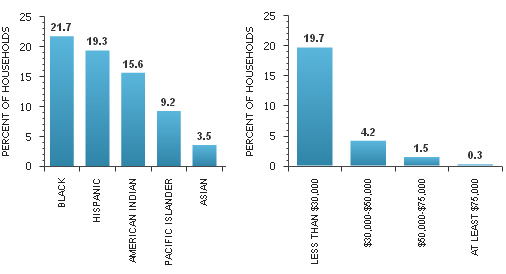
BOOM! That sound you just heard is the prepaid card explosion according to the Network Branded Prepaid Card Association. In 2009, Americans spent roughly $18 billion on prepaid cards and just three short years later that number had doubled to $37 billion. Prepaid is booming and everyone wants a slice. That boom has been especially present in African America as the past 20 years have not been kind to African American owned banks seeing their ranks dropped by over 50 percent and a rise of payday loans & check cashing businesses take their place in African American communities. This has led to a daunting crisis in the number of African Americans that are unbanked/underbanked. The FDIC reports the nation’s unbanked percentage is 7.7 percent, while African America is three times that average at well over 20 percent (graph below). In terms of the underbanked, the national average is 17.9 percent, while African America comes in at a staggering 31.6 percent, almost double the national average. However, the $1.1 trillion in African American buying power has to go somewhere. That somewhere appears to be a growing opportunity in the prepaid debit card space and the Dutch Shultzes of finance have taken notice.

As a former banker myself, the biggest way that individuals were able to gain access to capital and credit was a premise long ago quoted by J.P. Morgan and it has come to define the modern era of banking, “A man I do not trust could not get money from me on all the bonds in Christendom.” Today, we would call it relationship banking. Great credit is wonderful, lots of money in the bank never hurts, but character and relationship is what most often defines when bankers will give that extra push to someone to ensure they have enough access to capital and credit to make their venture worthwhile. Relationship building requires just what it implies. A longstanding healthy relationship between the client and bank. Unfortunately, shadow banking (i.e. prepaid debit cards, payday loans, etc.) has actually undermined real relationship banking and thus created a lot of the Ike & Tina relationship banking African Americans have with financial services.
The estimated net worth of Mr. Johnson and Mr. Simmons is a combined $840 million dollars. By no means even close to the transformative upper echelon of wealth but certainly not peanuts either. These two could have easily joined together and formed a small bank or credit union that offered no fee debit cards in exchange for direct deposit banking. They could have strengthened the 21 African American owned banks we have left. In either case, it would have allowed them to generate a profit, which is clearly what they are in it for despite their “altruistic” preachings about their cards, and allowed African Americans to keep more of their money while building a relationship with a financial institution. That is what they could have done. Instead, they chose to shuck and jive as front men for companies whose predatory practices leave them looking like the Uncle Ruckuses of financial services to anyone who understands the purpose of financial institutions purpose for assisting in economic progress for communities.
So who are the people and companies really profiting from the Magic and Rush prepaid cards? In Mr. Johnson’s case, OneWest Bank of Pasadena, California. OneWest Bank is formerly the very controversial IndyMac bank that collapsed during the financial crisis in 2008 where thousands of everyday savers were at risk of losing much of their lifetime savings. OneWest Bank is owned primarily by three hedge fund managers, two of whom are the legendary in financial circles. There is George Soros, the man who famously broke the British Pound on Black Wednesday. The other legend is John Paulson, who made $4 billion in 2007 by shorting subprime debt and then followed up an even more impressive performance in 2010 earning $5 billion. Yes, those figures are for one year of earnings. Lastly, the man who brought them all together was Steven Mnunchin, a former Goldman Sachs VP and hedge fund manger himself. The former IndyMac now OneWest bank made thousands of people lose much of their life savings along with predatory short sales and foreclosures now has reopened under another name, new management, and the smiling face of Earvin Johnson to help it generate predatory fees from financially illiterate African Americans. Poof, consumer money is being drained by hidden fees just like magic. As for the RushCard fronted by Russell Simmons, it is actually owned by The Bancorp Inc. which is headquartered in Wilmington, Delaware. The company is publicly traded but it is controlled by its founder Betsy Cohen. Apparently, Mr. Simmons has a thing for going into businesses with Cohens.
The sad thing is prepaid cards have their place. They are actually great for traveling abroad to limit your financial risk and some forms of budgeting. Realistically, the underbanked/unbanked are not the demographic traveling abroad. That these cards are being presented as a primary form of banking is what is most disturbing. A very costly primary way of primary banking at that. Some even believe that they are building their credit by using these cards. Further speaking to the lack of financial aptitude about financial services. They are doing more to undermine financial growth in our community than help it grow and progress.
It is very unfortunate that these two men who are so idolized in the African American community are doing so much harm to it. Pimping out a celebrity idol culture to drain an already poor and struggling African America of its pennies. Predatory financial services continues to leave African America vulnerable to a disproportionate amount of subprime lending, gentrification of our neighborhoods, and the ability to generate wealth. In large part this occurs because we refuse to recognize that ownership of our own financial institutions and services within our communities greatly reduces the risk of predatory behavior and raises insitutional accountability. It is highly unlikely that either of these gentleman use prepaid cards or would recommend anyone they care about to use it. If actions speak louder than words, then their actions indicate to me that they simply do not care at all.

![hqdefault[1]](https://hbcumoney.com/wp-content/uploads/2013/07/hqdefault1.jpg)

 HBCU Money